














If you’re tasked with keeping bottle fillers running efficiently under heavy demand—like at airports or busy gyms—compressor cooling efficiency isn’t just a nice-to-have; it’s mission critical. Balancing high gallons per hour (GPH) recovery rates with minimal energy consumption during peak loads defines the future of sustainable hydration.
In this white paper, we cut through the noise to reveal the engineering principles behind advanced hermetically sealed compressors, thermodynamic heat exchange, and smart IoT-driven thermal management. No fluff, just the technical insights you need to evaluate cooling systems that maintain consistent 10°C water delivery while controlling your facility’s energy footprint.
Ready to understand how top-tier bottle fillers handle surge demand without breaking a sweat or your budget? Let’s dive in.
Executive The Thermal Challenge in Hydration
At Driplife, we understand that modern hydration isn’t just about water quality—it’s about thermal consistency. For facility managers and OEM partners, the critical engineering hurdle is maintaining a strict 10°C water output during Peak Demand Cooling Load. In high-traffic environments like airports or corporate campuses, a standard dispenser often fails to keep up with the surge, resulting in lukewarm water and dissatisfied users. The challenge lies in balancing rapid heat extraction with energy sustainability.
The Metric: Recovery Rate and EER
We measure success through two primary indicators: Gallons Per Hour (GPH) Recovery Rate and the Energy Efficiency Ratio (EER). It is not enough to simply have a cold tank; the system must possess the Thermodynamic Heat Exchange capacity to recover chilled temperatures immediately after a dispense cycle.
- Recovery Rate: The speed at which the system returns water to the target temperature after a 50% draw-down.
- EER: The ratio of cooling capacity to power input, ensuring we meet Energy Star Tier Standards without inflating operational costs.
The Solution: High-Torque Compressors & IoT
Leveraging our 15+ years of R&D and a manufacturing capacity of 500,000 units annually, we engineer solutions that go beyond basic cooling. Our approach integrates Hermetically Sealed Systems with high-torque compressors designed to handle significant Ambient Temperature Delta. By utilizing our on-site software laboratories, we incorporate IoT Predictive Maintenance to monitor thermal performance in real-time. This ensures that our 4-in-1 systems (Purification, Cold, Hot, Ice) minimize Standby Power Consumption while delivering industrial-grade reliability for the modern lifestyle.
The Physics of Cooling: Compressor Dynamics in Bottle Fillers
At the core of every high-performance bottle filler lies the compressor. In our OEM/ODM manufacturing process, we recognize that the demands placed on a commercial unit vastly exceed those of a standard home refrigerator. We engineer our systems to handle rapid thermal exchange without faltering, ensuring that the first drop is as cold as the last.
Compressor Selection: Industrial-Grade Reliability
We don’t rely on generic residential components for high-traffic applications. Instead, we utilize industrial-grade hermetically sealed compressors. These units are designed to withstand continuous duty cycles found in offices, gyms, and airports.
- Hermetically Sealed System: By enclosing the motor and compressor in a single welded steel shell, we eliminate leakage points and reduce noise, creating a robust system that requires minimal maintenance.
- Refrigerant Choice: We standardize on the R-134a refrigerant cycle. This thermodynamic medium offers excellent heat transfer properties and stability, ensuring our systems remain compliant with environmental standards while delivering aggressive cooling power.
The Refrigeration Cycle Explained
To maintain a consistent 5.2L/min flow rate in our under-sink and countertop units, we optimize the four critical stages of the refrigeration cycle:
- Compression: The compressor pressurizes the R-134a gas, raising its temperature significantly.
- Condensation: The hot gas flows through the condenser coils, rejecting heat into the environment and turning into a high-pressure liquid.
- Expansion: The liquid passes through an expansion valve, instantly dropping in pressure and temperature.
- Evaporation: The cold refrigerant absorbs heat from the water reservoir, chilling the water before returning to the compressor.
This precise cycle allows our smart water purifiers to recover quickly after heavy usage, preventing the “warm water sandwich” effect common in lesser systems.
Condenser Efficiency: Fan-Cooled vs. Static
In a controlled lab, static cooling coils might work, but in the real world, ambient temperatures fluctuate. A static coil relies on natural convection, which fails when a machine is tucked under a counter or placed in a warm hallway.
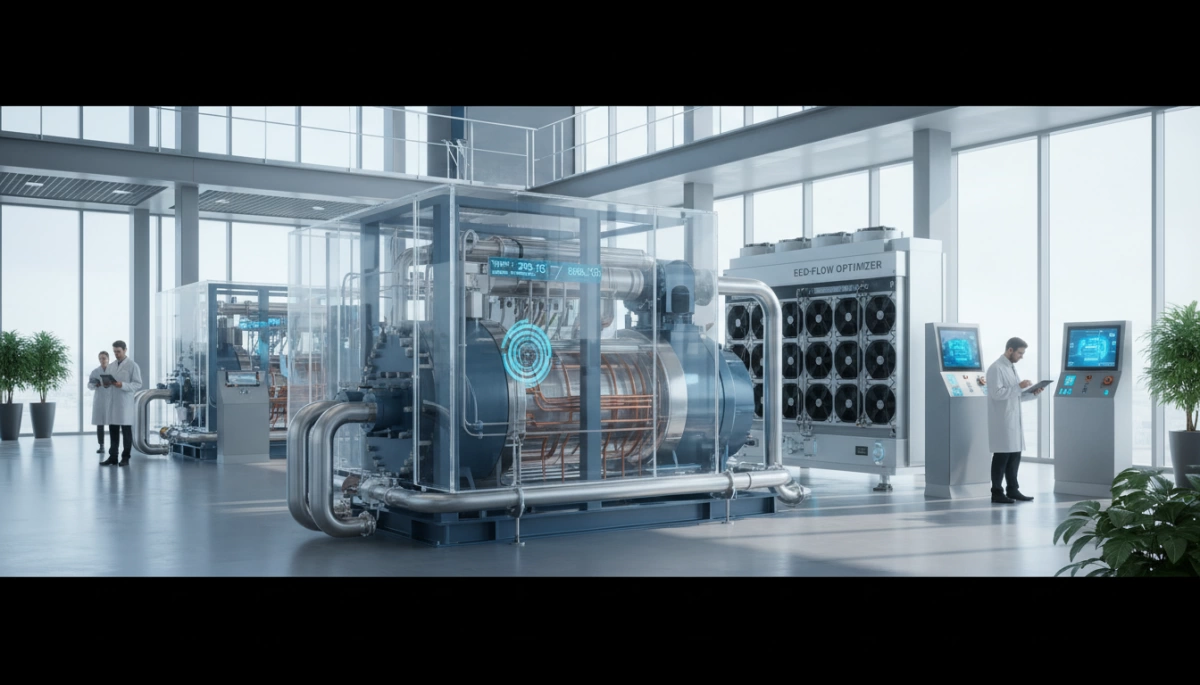
To combat this, we implement a fan-cooled condenser unit. By actively forcing air over the coils, we maximize the ambient temperature delta, ensuring efficient heat rejection even when the room temperature rises. This active approach prevents the compressor from overheating and ensures the system operates within its optimal efficiency curve, regardless of external conditions.
Optimizing the Duty Cycle: Energy vs. Performance
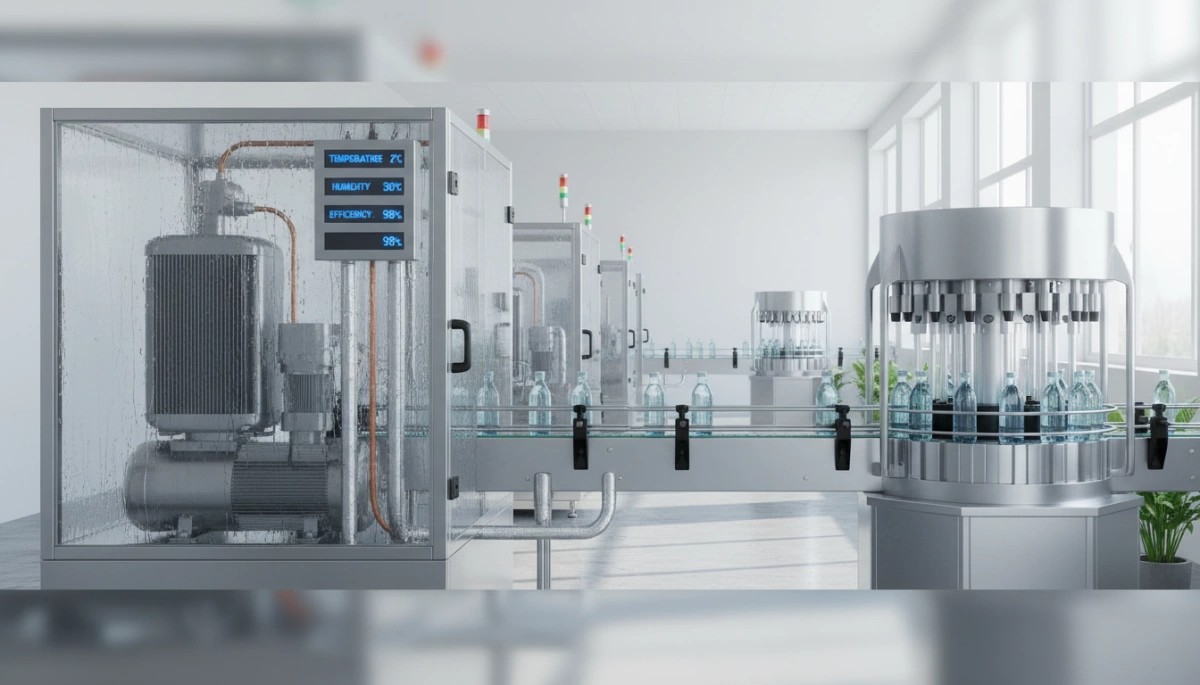
Balancing immediate cooling availability with long-term energy savings is the core of our engineering philosophy at Driplife. We understand that a compressor running continuously is a waste of money, but a system that can’t keep up with the morning rush at a school or airport is a failure. To solve this, we focus on strictly managing the Peak Demand Cooling Load through intelligent duty cycles rather than raw power alone.
Reducing Short-Cycling and Wear
The biggest enemy of compressor longevity is short-cycling—where the unit rapidly turns on and off for small temperature adjustments. This spikes Standby Power Consumption and degrades internal components.
- Smart Logic: Our R&D team programs control boards to allow a specific temperature variance (delta) before engaging the compressor.
- Energy ROI: This prevents the energy spike associated with startup torque, ensuring the system runs in longer, more efficient bursts.
Driplife Smart Advantage: The Reservoir as a Thermal Battery
We treat the chilled water tank as a thermal battery. By utilizing a high-capacity reservoir, we can store “cold energy” during low-traffic periods. This ensures Cold Chain Consistency without forcing the compressor to engage the second a user dispenses 10oz of water. This technology is vital for high-traffic units, similar to the engineering found in our wall-mounted drinking fountain solutions, where reliability is non-negotiable.
Insulation Engineering and Material Science
Thermodynamics dictates that keeping water cold is just as important as making it cold. We utilize 304 Stainless Steel Thermal Conductivity properties paired with high-density foam insulation to minimize thermal loss.
- Sealed Environment: High-density foam creates a barrier against ambient heat, significantly improving Thermal Insulation Efficiency.
- Hygienic Storage: The 304 stainless steel tank not only resists corrosion but maintains temperature stability better than plastic alternatives, reducing the frequency of compressor cycles.
The Role of IoT in Cooling Efficiency
Modern manufacturing isn’t just about bending steel; it’s about coding intelligence into the machine. At our facility, our dedicated software laboratories focus heavily on IoT Predictive Maintenance. We don’t just guess when a compressor needs a break; we track it. By monitoring compressor run-times and temperature stability in real-time, we ensure Cold Chain Consistency regardless of external conditions.
- Real-Time Monitoring: Our systems constantly check the Ambient Temperature Delta to adjust cooling cycles dynamically, ensuring the machine works harder only when necessary.
- Predictive Alerts: We can detect thermal drift or low refrigerant levels before the unit fails, preventing downtime and expensive emergency repairs.
- Cost Reduction: Smart management significantly lowers Standby Power Consumption, directly impacting the bottom line for facility operators.
This level of integration is standard in our high-performance units, including our seltzer water machine lineup, where maintaining specific temperatures is vital for carbonation quality. For facility managers, this translates to a lower Total Cost of Ownership (TCO) and a reliable supply of cold hydration during Peak Demand Cooling Load periods. We engineer these systems to be proactive, not reactive.
Hygiene and Thermodynamics: The Hidden Link
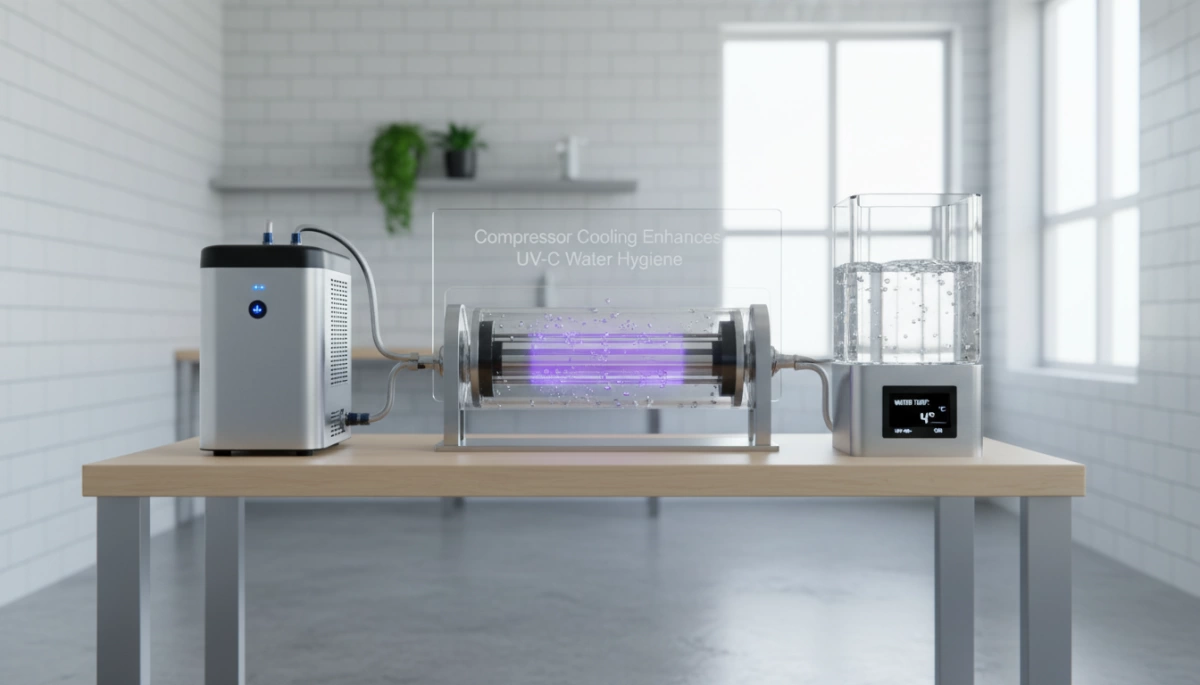
At Driplife, we view thermodynamics as a critical component of hygiene, not just refreshment. In our engineering philosophy, maintaining Cold Chain Consistency within the unit is a primary defense against contamination. When our compressors maintain a steady output below 10°C, the water acts as a natural bacteriostat, significantly inhibiting the metabolic rate of potential bacteria compared to ambient standing water.
To ensure absolute purity, we don’t rely on temperature alone. We integrate active sterilization directly into the cooling loop. By pairing our high-efficiency thermal exchange systems with effective UV water treatment systems, we create a dual-barrier defense.
The Synergy of Cold and UV-C
This combination of rapid cooling and UV-C LED sterilization offers distinct advantages for facility managers and end-users:
- Biofilm Prevention: Cold temperatures combined with UV exposure prevent the formation of biofilm on internal tank surfaces and tubing.
- Taste Preservation: Keeping water consistently chilled preserves the crisp taste profile while the UV system neutralizes microorganisms without using chemicals.
- Operational Safety: The system ensures that even during standby periods, the water quality remains stable and safe for immediate consumption.
Comparative Analysis: Active Compressor vs. Thermoelectric Cooling
When designing commercial hydration solutions, the choice between thermoelectric modules and active compressor systems defines the machine’s capability. While thermoelectric cooling (Peltier) offers a quiet, vibration-free operation suitable for low-volume residential units, it relies heavily on the Ambient Temperature Delta. If the room gets hot, the cooling performance plummets, making it unreliable for the high-traffic environments we serve.
Performance Benchmarking: Handling the Peak Demand
For facility managers, the critical metric is the Peak Demand Cooling Load. Thermoelectric units struggle to recover once the pre-chilled reservoir is emptied, leading to a poor user experience during lunch rushes or break times.
In contrast, the Active Compressor systems we manufacture at Driplife are engineered for resilience. By utilizing a robust refrigerant cycle, our units maintain Cold Chain Consistency regardless of the external environment. This ensures that the water output remains stable even when the ambient temperature rises, a necessity for public spaces like schools and airports.
The Driplife Advantage: High GPH and Rapid Recovery
Our innovation and development focus is on maximizing the Cooling capacity GPH (Gallons Per Hour). We integrate industrial-grade compressors that provide rapid thermal recovery. This means the system spends less time struggling to reach the set temperature and more time in a low-energy standby mode.
Key Operational Differences:
- Recovery Speed: Our compressor systems chill water down to 10°C significantly faster than thermoelectric counterparts.
- Volume Handling: Designed for continuous dispensing without thermal degradation.
- Heat Dissipation: We utilize Fan-Cooled Condenser Units to efficiently reject heat, preventing the system from overheating during heavy usage cycles.
Energy ROI Calculation
While a compressor pulls more power during its run cycle compared to a thermoelectric chip, the total energy consumption over 24 hours is often lower in high-use scenarios. A thermoelectric unit may run continuously at 100% capacity trying to battle a warm room, whereas our compressor cycles off once the target temperature is hit.
Efficiency Breakdown:
- Thermoelectric: High duty cycle, low efficiency in warm climates, higher long-term cost per liter.
- Driplife Compressor: Intermittent duty cycle, high cooling density, better Energy ROI Calculation for commercial deployments.
For OEM/ODM partners looking to deploy reliable bottle fillers, the compressor-based approach delivers the performance reliability required to protect your brand reputation and lower the total cost of ownership for the end-user.
Engineering for the Future of Hydration
At Driplife, we view the future of commercial hydration as a precise balance between Peak Demand Cooling Load and sustainable operation. Our engineering philosophy goes beyond simply lowering water temperature; it is about mastering Thermodynamic Heat Exchange to ensure reliability in high-traffic US venues like airports, schools, and offices. We design our systems to deliver consistent Cold Chain Consistency without driving up utility costs through excessive Standby Power Consumption.
By utilizing advanced 304 Stainless Steel Thermal Conductivity and optimizing Condenser Airflow Optimization, we ensure that every unit maintains hygiene and performance simultaneously. Whether we are manufacturing a standalone bottle filler or a multifunctional hot water dispenser with filter, the underlying thermal logic remains the same: rapid recovery and minimal energy waste.
The Driplife OEM/ODM Standard
Our 60,000 sq. ft. facility and dedicated R&D labs allow us to push the boundaries of what a water dispenser can do. We don’t just assemble parts; we rigorously test Variable Speed Compressor cycles and Thermal Insulation Efficiency to meet the modern lifestyle needs of the American market.
Key Engineering Deliverables:
- Rapid Recovery: High Gallons Per Hour (GPH) Recovery Rate for surge periods.
- Smart Management: Integration of IoT Predictive Maintenance to foresee service needs.
- Eco-Compliance: Systems designed to align with Energy Star Tier Standards.
For partners looking to develop the next generation of hydration stations, we provide full transparency into our R-134a Refrigerant Cycle data and manufacturing capabilities. Contact the Driplife engineering team today to download detailed technical specifications or to discuss how our 500,000-unit annual capacity can support your brand’s growth. Let’s build a cooler, more efficient future together.