














The Economics of Truck Rolls in Low Maintenance RO Systems
Distributors feel the real cost of a “free” truck roll. Every unnecessary trip to fix a leaking RO manifold, a nuisance alarm, or a clogging prefilter cuts directly into margin. Fuel, labor, vehicle wear, and admin time stack up fast—and you rarely recover that cost from the dealer, let alone the end user.
How Truck Rolls Erode Margins
Every call-back on a high-maintenance RO unit drives margin erosion from high-maintenance RO units:
- A typical truck roll can easily cost $150–$250 once you factor tech time, drive time, benefits, and dispatch overhead.
- Two or three post-install visits can wipe out the profit on the original RO sale and the first year of aftermarket RO filter revenue.
- Repeated service calls drag down water filtration dealer profit margins and force discounts or credits to keep dealers happy.
With low maintenance RO systems for distributors, the economics flip. When the system is engineered to minimize truck rolls, you protect price, protect margin, and protect relationships.
High Call-Back RO vs Low Maintenance RO
High-call-back RO units behave like a bad SKU in your portfolio:
- More leaks, clogs, and nuisance issues mean more warranty claims and emergency call-outs.
- Techs spend time repeatedly fixing the same models instead of installing new systems or doing profitable upgrades.
- Inventory gets messy with extra fittings, tubing, and “just in case” spare parts to survive field problems.
Low maintenance RO systems are built for install and forget RO systems performance:
- Stable, high-reliability water purification systems that run cleanly for years with only scheduled filter changes.
- Fewer callbacks, fewer parts, and fewer headaches for both the distributor and the dealer.
- More predictable RO system total cost of ownership that you can quantify in sales and ops planning.
Opportunity Cost of Technician Time
Every unnecessary truck roll has a hidden cost: what your tech could have done instead.
- One avoided call-back can free up time for one new install, or several profitable service calls.
- Reducing truck rolls lets you scale distributor operational efficiency and dealer networks without extra headcount.
- When your field team isn’t stuck babysitting problematic RO units, you can grow service revenue, expand territories, and support more dealers with the same staff.
Minimize technician truck rolls with low maintenance RO systems, and you’re not just cutting cost—you’re creating room to grow.
What Makes a Low Maintenance RO System
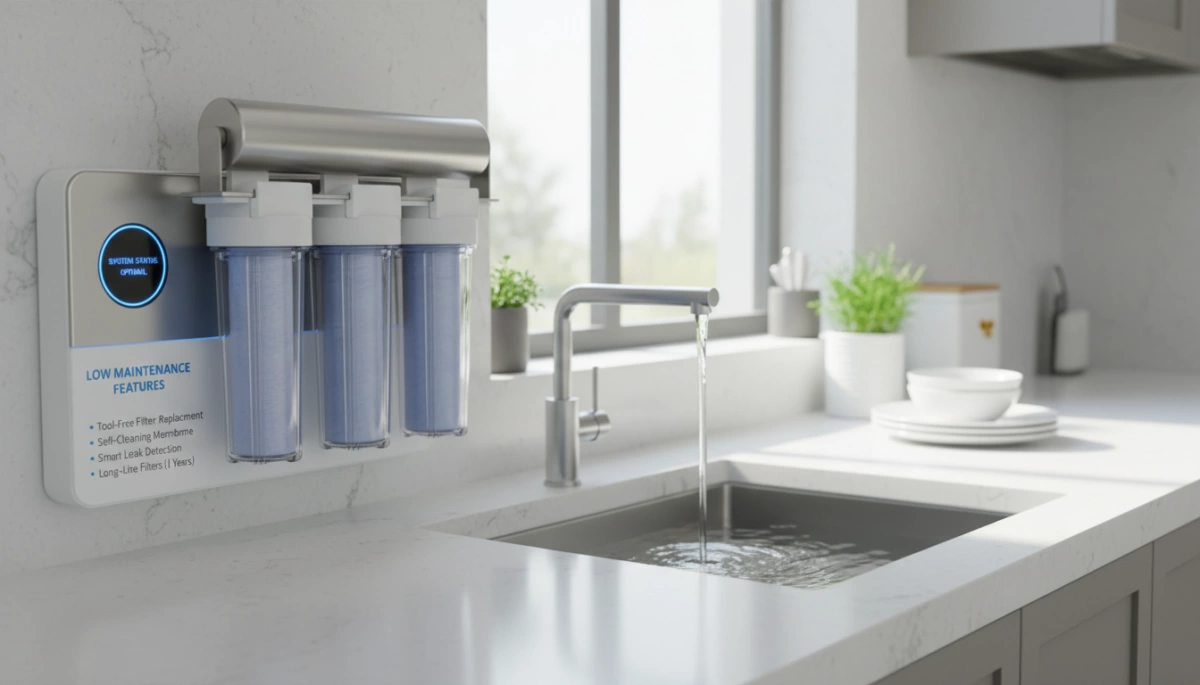
A true low maintenance RO system is engineered from the start to cut service calls, protect margins, and keep installers out of the truck. When I choose or design systems for distributors, I focus on a few core features that directly reduce RO service needs and total cost of ownership.
Core Engineering Features That Reduce Service
The right hardware design is what actually minimizes technician truck rolls and warranty claims. I look for:
- Simple flow paths with fewer fittings and O-rings to cut leak risks
- Service-friendly layouts so techs can reach every part in minutes
- Standardized components that keep RO inventory and spare parts management lean
This is where high-reliability water purification systems win out: the fewer “touch points,” the fewer callbacks and margin erosion from high-maintenance RO units.
Integrated Manifold And Leak-Resistant Design
An integrated waterway RO design pulls the valves, flow restrictor, check valves, and connections into a single manifold. That does a few big things for distributor operational efficiency:
- Slashes leak points compared to loose tubing and push-fits
- Speeds up installs and reduces “come back and fix it” visits
- Makes troubleshooting faster because everything is in one compact block
Leak-proof RO manifold technology is one of the simplest ways to build an “install and forget RO system” that keeps dealer profit margins intact.
Quick-Change RO Filters For DIY Maintenance
Quick-change RO filter cartridge technology is a must if you want fewer service calls and more aftermarket RO filter revenue:
- End-users twist filters on and off without tools
- No opening housings, no spilled water, less chance of cross-threading
- Dealers can sell DIY filter replacement RO systems as a convenience upgrade
With the right design, your customers handle basic upkeep while you keep the predictable subscription-style filter sales coming in.
Smart Monitoring And Uptime-Focused Controls
Smart, uptime-focused RO controls turn a regular system into a low maintenance RO advantage:
- TDS/usage monitoring to signal when filters actually need replacing
- Auto-flush cycles to keep membranes cleaner and extend service life
- Error alerts that point techs straight to the issue when a call is truly needed
On higher capacity applications, pairing smart controls with a robust under sink reverse osmosis system like our high-output under-sink RO units gives distributors reduced service calls, reliable RO positioning, and a strong uptime-focused RO sales story for the U.S. market.
Low Maintenance RO Systems as a Distributor Advantage
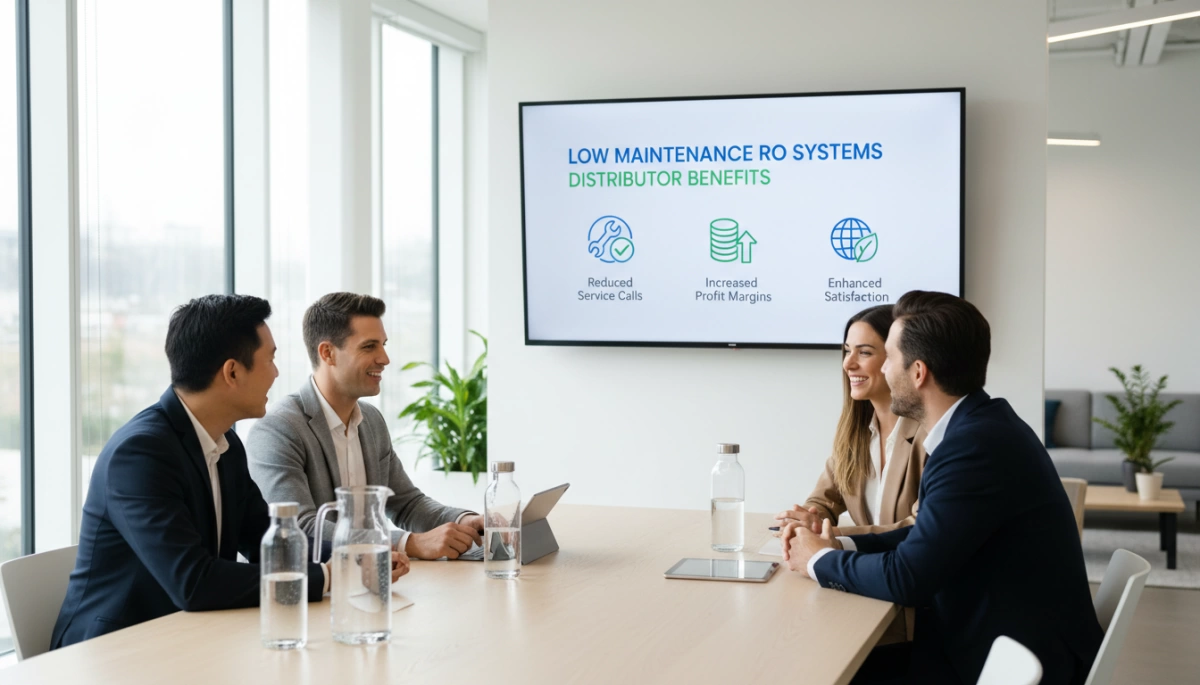
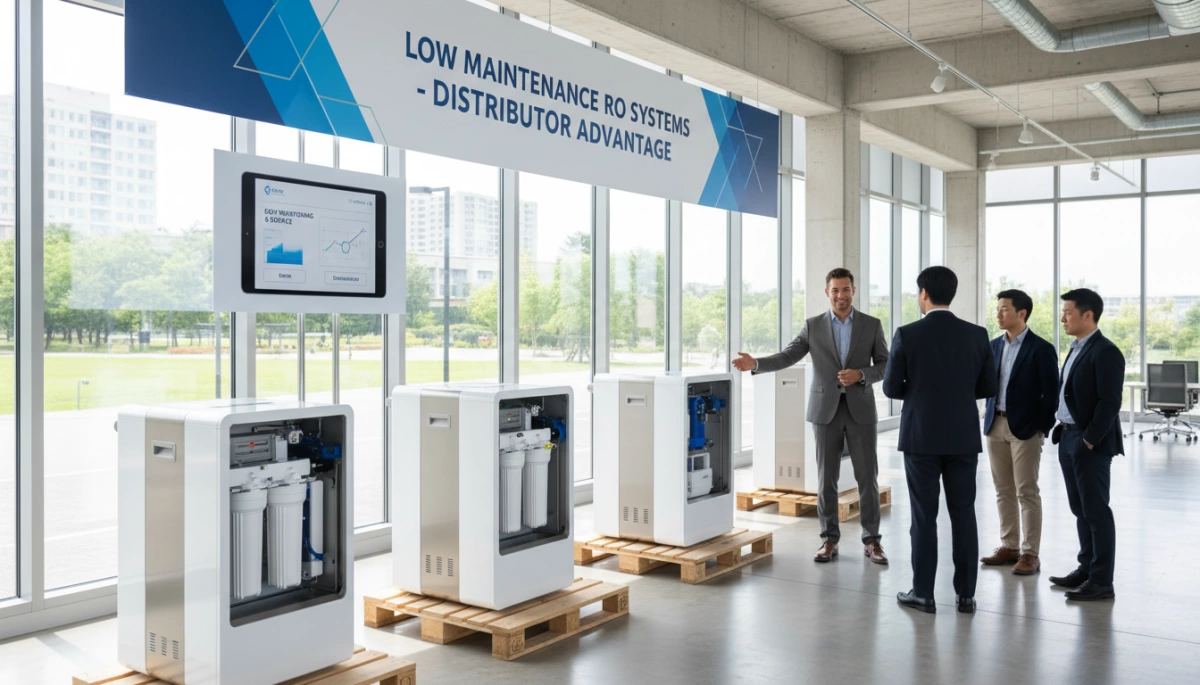
Low maintenance RO systems give me a clear edge as a distributor because they let me grow sales without drowning my team in support. When units are designed to minimize technician truck rolls, I can scale installs across multiple dealer territories without adding extra headcount, overtime, or weekend coverage. That’s real distributor operational efficiency, not just a talking point.
Low maintenance RO systems also protect my margins by reducing water filter warranty claims and repeat service calls. Every avoided truck roll keeps profit in the job instead of burning it on callbacks. High‑reliability, “install and forget” RO systems cut the noise in my service queue and make my dealers look good in front of their customers.
These systems also drive predictable aftermarket RO filter revenue. With quick‑change, DIY‑friendly cartridges, homeowners replace filters themselves on schedule, and I get recurring sales instead of unplanned service events. That pattern matches well with countertop and under‑sink units similar to our reverse osmosis water filter countertop solutions, where the ongoing filter business is often worth more than the initial unit.
On the back end, low maintenance RO designs streamline my RO inventory and spare parts management. Fewer SKUs, unified manifolds, and standardized cartridges simplify ordering, stocking, and shipping. That means less cash tied up in slow‑moving parts and more focus on high‑turn, profitable, aftermarket RO filter lines.
Marketing Low Maintenance RO Systems to Dealers
Teach Dealers to Sell Value Over Price
I always coach dealers to stop leading with “cheapest system” and start leading with “highest profit, lowest hassle.” With low maintenance RO systems for distributors, the value story is simple:
- Fewer callbacks and warranty claims
- Predictable, recurring aftermarket RO filter revenue
- Higher water filtration dealer profit margins on every install
Give dealers a basic “value calculator” so they can show customers how reduced service calls and longer filter life lower the RO system total cost of ownership over 3–5 years.
Position RO Units as Labor-Saving Assets
In today’s labor market, technician time is expensive and tight. I frame our low maintenance RO units as labor-saving assets, not just hardware:
- Each “install and forget” RO system helps minimize technician truck rolls
- Techs can spend more time on new installs and premium projects instead of chasing leaks and nuisance issues
- Dealer owners see real distributor operational efficiency and better use of payroll
When dealers understand that reliable, quick-change RO filter cartridge technology protects their schedule, they stop fighting for the lowest upfront price.
Build a “Peace of Mind” Message
End-users and installers both want peace of mind. I keep the message simple and clear:
- Leak-resistant, integrated waterway RO design cuts surprise problems under the sink
- DIY filter replacement RO systems make it easy for homeowners to stay on top of maintenance
- Uptime-focused RO systems mean clean water without constant attention
When dealers present the system as “the one you don’t need to think about,” close rates go up and margin erosion from high-maintenance RO units goes down.
Use Reliability Stories and Data in Sales
Dealers sell best when they have proof. I arm them with real reliability stories and simple data points:
- Service call rates before and after switching to high-reliability water purification systems
- Average years in the field with no leak-related warranty claims
- Customer reviews highlighting “no issues,” “easy filter swap,” and long-term performance
Tie these stories back to how reverse osmosis works and why low-maintenance design matters by linking to clear education, like a straightforward guide on how a reverse osmosis water filter works. That way, dealers can confidently position low maintenance RO systems as a smarter, long-term support RO appeal instead of just another box on the shelf.
Partnering With Driplife for Low Maintenance RO Solutions
When I look at what really moves the needle for low maintenance RO systems for distributors, it comes down to three things: stable manufacturing, tight QC, and a supply chain you can actually count on. That’s exactly how we’ve built Driplife.
Manufacturing and QC Built Around Low Maintenance
As an OEM reverse osmosis manufacturer in China, we design our lines around RO system total cost of ownership, not just unit price.
- We standardize core components so every batch behaves the same in the field.
- We run pressure, flow, and leak tests on each integrated waterway RO design, not just random samples.
- We track field feedback on reducing water filter warranty claims and feed it back straight into our QC specs.
That’s how we support distributors who want high-reliability water purification systems that don’t chew up service budgets.
Driplife Technologies That Cut Service Calls
Our low maintenance RO advantage is built into the hardware, not just the brochure:
- Leak-proof RO manifold technology and integrated waterway routing to minimize technician truck rolls for leaks and callbacks.
- Quick-change RO filter cartridge technology that’s truly DIY, so dealers can confidently sell install and forget RO systems to homeowners.
- Uptime-focused RO controls and auto-flush logic that protect membranes and stabilize performance, which supports better water taste and quality alongside solutions like our pH balance water filter systems.
For U.S. water treatment dealers, this directly supports higher water filtration dealer profit margins and distributor operational efficiency.
Reliable Supply Chain for RO Distributors and OEM Partners
On the supply side, we keep things simple and dependable for B2B water filter supply chain partners:
- Locked-in SKUs and long-term tooling so you’re not constantly requalifying parts.
- Forecast-based production planning to support RO distributor scalability without extra headcount and avoid inventory gaps.
- Clear documentation and traceability so OEM partners can align product selection with post-sale service reduction strategies.
If you’re building a water treatment business for scalability in the U.S. market, partnering with Driplife OEM water solutions gives you a low maintenance RO platform that reduces field noise and protects your margins.
Playing the Long Game with Low Maintenance RO Systems
When I look at low maintenance RO systems as a distributor advantage, I’m really looking at long‑term profitability, not just the first purchase order. Every truck roll I don’t schedule and every warranty claim I avoid compounds over time. That’s where low maintenance RO systems for distributors pull away from “cheap” high-touch units that quietly drain margin year after year.
Linking Design to Long-Term Profit
The engineering behind a low maintenance RO unit directly shapes your RO system total cost of ownership:
- Fewer leaks and call-backs mean less margin erosion from high-maintenance RO units.
- Stable, “install and forget RO systems” let you scale accounts without adding service headcount.
- Higher uptime and fewer failures keep your water filtration dealer profit margins intact and predictable.
When you choose high-reliability water purification systems, you’re really choosing how profitable your service territory will be three to five years from now.
Aligning SKUs with Service Reduction
I align product selection with clear post-sale service reduction strategies:
- Favor integrated waterway RO design and leak-proof RO manifold technology to minimize technician truck rolls.
- Standardize on DIY filter replacement RO systems with quick-change RO filter cartridge technology to push simple work to the customer instead of the tech.
- Prioritize platforms with proven low warranty rates and clean service histories over “spec sheet only” options.
This kind of distributor operational efficiency is what enables real water treatment business scalability, not just more sales reps.
Next Steps for Your RO Portfolio
If you’re reviewing your RO line-up, I’d treat it like a profit audit:
- Rank current SKUs by call-back rate, truck roll cost, and warranty spend.
- Flag units that consistently drive reducing water filter warranty claims in the wrong direction.
- Shortlist low maintenance RO systems that support RO distributor scalability without extra headcount and create predictable aftermarket RO filter revenue.
If you’re also pushing into rural or harder-to-service regions, it’s worth looking at how low-pressure RO system designs and low maintenance features work together to cut your lifetime service exposure. Long term, the distributors who win are the ones who treat “reduced service calls RO” as a core channel value proposition, not a nice-to-have.