















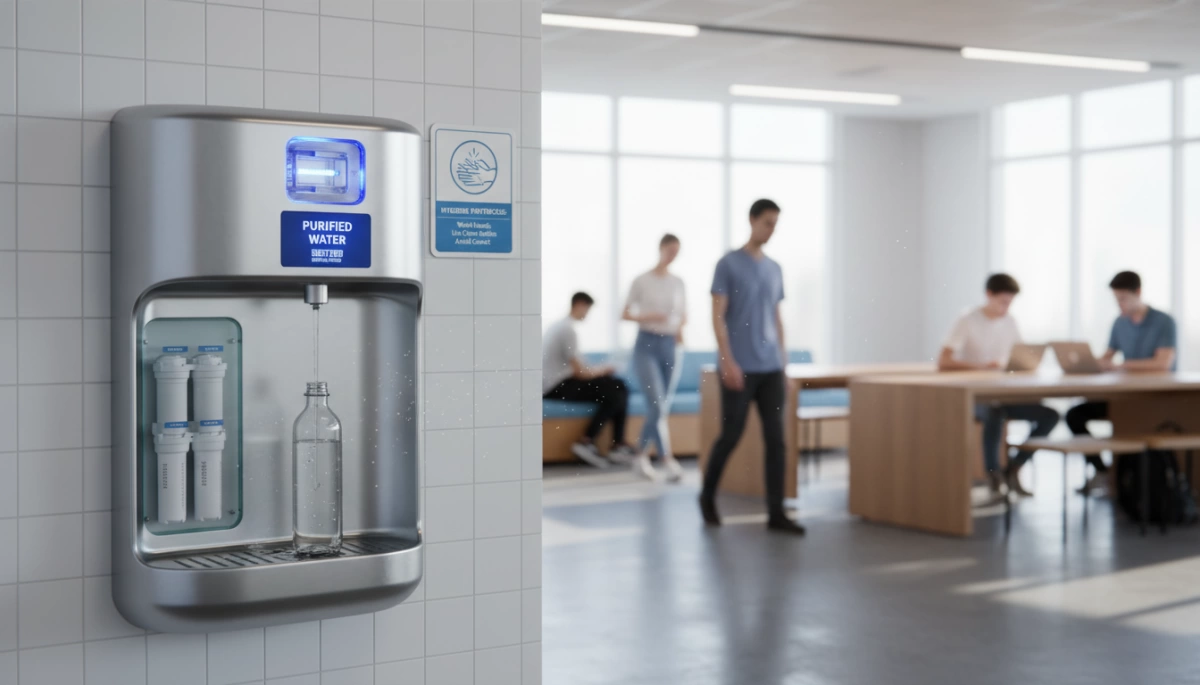
Advanced Filtration Protocols: The First Line of Defense
As facility managers, we know that providing water in public spaces is no longer just about hydration—it is a matter of public safety and liability management. The days of installing a simple fountain and forgetting about it are over. Today, public water quality management requires a defensive strategy that starts before the water even hits the user’s bottle. At Driplife, we view filtration not merely as a feature, but as the primary firewall against liability risks and health hazards.
Understanding Contaminants: Sediment, Chemicals, and Organics
Water traveling through municipal infrastructure is often safe at the source but degrades as it travels through aging distribution networks. By the time it reaches your building, it may have picked up rust, sediment, and biofilm residue. Effective public facility hydration solutions must address three core categories of contaminants:
- Physical Particulates: Sand, rust, and silt that damage internal components and create turbidity.
- Chemical Agents: Residual chlorine and chloramines used in municipal treatment, which affect taste and odor.
- Organic Compounds: Volatile Organic Compounds (VOCs) and pesticides that pose long-term health risks.
Multi-Stage Filtration Explained: Pre-filtration and Activated Carbon
To handle this diverse range of threats, a single filter is rarely sufficient. We utilize a robust multi-stage approach to ensure consistency and safety.
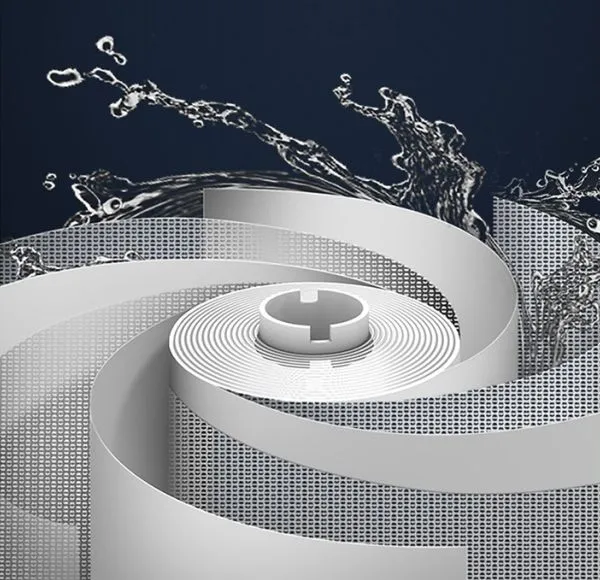
- Pre-filtration: We typically employ a spun polypropylene layer as a sacrificial barrier. This captures larger particulates like sediment and rust, preventing them from clogging the finer, more expensive filters downstream.
- Active Carbon Block Filtration: This is the workhorse of the system. Unlike loose granular carbon, a solid carbon block prevents “channeling” (where water bypasses the filter media). It effectively adsorbs chlorine, lead, and organic chemicals while trapping smaller particulates that escaped the pre-filter.
NSF 42 and 53 Compliance Standards for Liability Protection
When selecting equipment, seeing an “NSF Certified” sticker isn’t enough; you need to know which standard it meets. This distinction is critical for your risk management strategy.
- NSF/ANSI 42 (Aesthetic Effects): This standard certifies that the system reduces non-health-related contaminants like chlorine, taste, and odor. It ensures the water is palatable.
- NSF/ANSI 53 (Health Effects): This is the gold standard for safety. It certifies the reduction of specific health-related contaminants such as lead, cysts (Giardia/Cryptosporidium), and VOCs.
For high-traffic public areas, we strictly recommend systems compliant with NSF/ANSI 53 and 42 standards. This dual compliance provides a documented layer of protection against liability claims regarding water safety.
Filter Replacement Schedules and Real-time IoT Monitoring
The most sophisticated filter in the world is useless if it is clogged or expired. In fact, an overdue filter can become a biological hazard, acting as a breeding ground for bacteria rather than a barrier. Historically, maintenance relied on manual tracking or arbitrary dates, leading to either wasteful premature replacement or dangerous delays.
We have shifted this paradigm using IoT water station monitoring. By integrating flow meters and pressure sensors, our systems provide real-time filter status tracking. Instead of guessing, you receive precise alerts based on actual gallon usage and water quality data. This shift ensures that preventative maintenance schedules are driven by data, not calendars, optimizing operational costs while guaranteeing that every drop dispensed meets safety standards.
UV-C LED Technology: The Biological Firewall
While advanced carbon blocks are excellent for clarity and taste, relying solely on them in a public setting is a gamble I’m not willing to take. Mechanical filtration has a physical limit; it acts like a net. If the holes in the net are larger than the pathogen, the contaminant swims right through. This is where UV-C LED purification technology steps in as the absolute biological firewall for public hydration.
Why Mechanical Filtration Isn’t Enough for Viruses
Standard filters are designed to catch sediment, chlorine, and larger protozoa. However, viruses are significantly smaller than the pore size of even the best NSF 53 certified filters. In high-traffic facilities, Legionella risk management becomes a top priority. Legionella and other waterborne viruses can slip past mechanical barriers.
While mechanical filters provide the fundamental benefits of faucet filtration systems—removing particulates and improving aesthetics—they simply cannot neutralize the DNA of a virus. To guarantee safety in a public bottle filler, we need a method that inactivates the threat rather than just trying to catch it.
The Science of UV-C: Disrupting Pathogen DNA at 260-280nm
We utilize UV-C light specifically in the 260nm to 280nm wavelength range. This isn’t random; this specific spectrum is the germicidal “sweet spot.” When bacteria and viruses are exposed to this light, the photons penetrate their cell walls and disrupt their DNA or RNA.
Essentially, the UV light scrambles the genetic code of the pathogen. It might still be physically present in the water, but it is “dead” in the sense that it cannot reproduce or infect a human host. It renders the water biologically safe in milliseconds.
Point-of-Dispense Sterilization vs. Internal Tanks
A common mistake in older water cooler designs is treating the water inside a holding tank and then pumping it through several feet of tubing to the nozzle. That tubing is a breeding ground for bacteria.
We focus on point-of-use water sterilization. This means the UV-C LED is positioned right at the dispense point. The water is sterilized the instant before it hits your bottle. This eliminates the risk of re-contamination that occurs when purified water sits stagnant in internal pipes.
Preventing Retro-contamination and Biofilm Growth
One of the biggest headaches in facility management is biofilm prevention in plumbing. Biofilm is that slimy layer of bacteria that adheres to the inside of pipes and spouts. In public stations, the spout is exposed to the air and, unfortunately, users’ dirty bottle rims.
Bacteria can actually grow up the water stream into the unit, a process called retro-contamination. By blasting the dispense area with UV-C light, we create a hostile environment for bacteria, preventing biofilm from establishing a foothold at the nozzle.
Energy Efficiency: Mercury Lamps vs. UV-C LEDs
For years, the industry relied on mercury vapor lamps. They were fragile, contained toxic mercury, and required time to warm up to full power. We have shifted entirely to UV-C LEDs for several operational reasons:
- Instant Action: LEDs reach full germicidal power instantly. There is no warm-up time, allowing for on-demand activation via sensors.
- Thermal Management: Mercury lamps emit heat, which can warm the drinking water. LEDs run much cooler.
- Lifespan: LEDs can last for years without replacement, drastically lowering maintenance costs compared to annual bulb changes.
- Sustainability: LEDs are mercury-free, eliminating hazardous waste disposal issues.
Hygiene Protocols: Minimizing Surface Transmission
We cannot focus solely on filtration; the physical interaction with the machine is a primary vector for cross-contamination. Managing water quality in public bottle filling stations requires a holistic approach that addresses both the water chemistry and the user interface. The goal is to deliver hydration without sharing germs.
Touchless Architecture and IR Sensor Activation
The era of the shared push-bar is ending. Touchless sensor activation has shifted from a luxury feature to a facility requirement. By eliminating physical contact points, we drastically reduce the transmission of surface-borne pathogens. However, not all sensors are built equal. We prioritize high-quality infrared (IR) systems that offer precise activation ranges, typically calibrated to 2-3 inches.
When upgrading your facility with a modern wall-mounted drinking fountain, it is crucial to select units with adaptive sensors. These smart sensors distinguish between a bottle being placed for a refill and a person simply walking by, ensuring the system is responsive yet efficient.
Solving Phantom Pours and Reducing Slip Hazards
“Phantom pours”—where a unit activates on its own due to lighting changes or sensor drift—are a facility manager’s nightmare. This isn’t just about water waste; it is a safety issue.
- Liability Reduction: Unintended activation creates puddles, leading to slip-and-fall hazards on hard floors.
- Smart Calibration: We utilize sensors that use “time-of-flight” technology rather than simple light reflection to eliminate false positives.
- Drainage Safety: The drain flow rate must always exceed the dispense rate to prevent overflow during accidental activation.
Material Science: 304 Grade Stainless Steel Benefits
Materials matter. Porous plastics degrade over time, creating microscopic scratches where bacteria hide. This is why 304 grade stainless steel is the non-negotiable standard for our units. It provides a robust, sanitary foundation that supports biofilm prevention in plumbing fixtures.
| Feature | Operational Benefit |
|---|---|
| Non-Porous Surface | Bacteria cannot penetrate the material; easy to sanitize. |
| Corrosion Resistance | Withstands constant exposure to moisture and cleaning chemicals. |
| Impact Durability | Essential for high-traffic areas like schools and gyms. |
| Aesthetic Longevity | Maintains a clean, professional appearance for years. |
Design Considerations: Sloped Basins to Prevent Stagnation
Standing water is a breeding ground for contaminants. Flat basins allow water droplets to pool and stagnate, inviting microbial growth inches from the dispense nozzle. Effective public facility hydration solutions must feature aggressively sloped basins. This design utilizes gravity to ensure immediate evacuation of spilled water. By keeping the dispense area dry, we passively support Legionella risk management and ensure that ADA compliant bottle fillers remain safe and sanitary for every user.
Operational Protocols: Managing the System via IoT
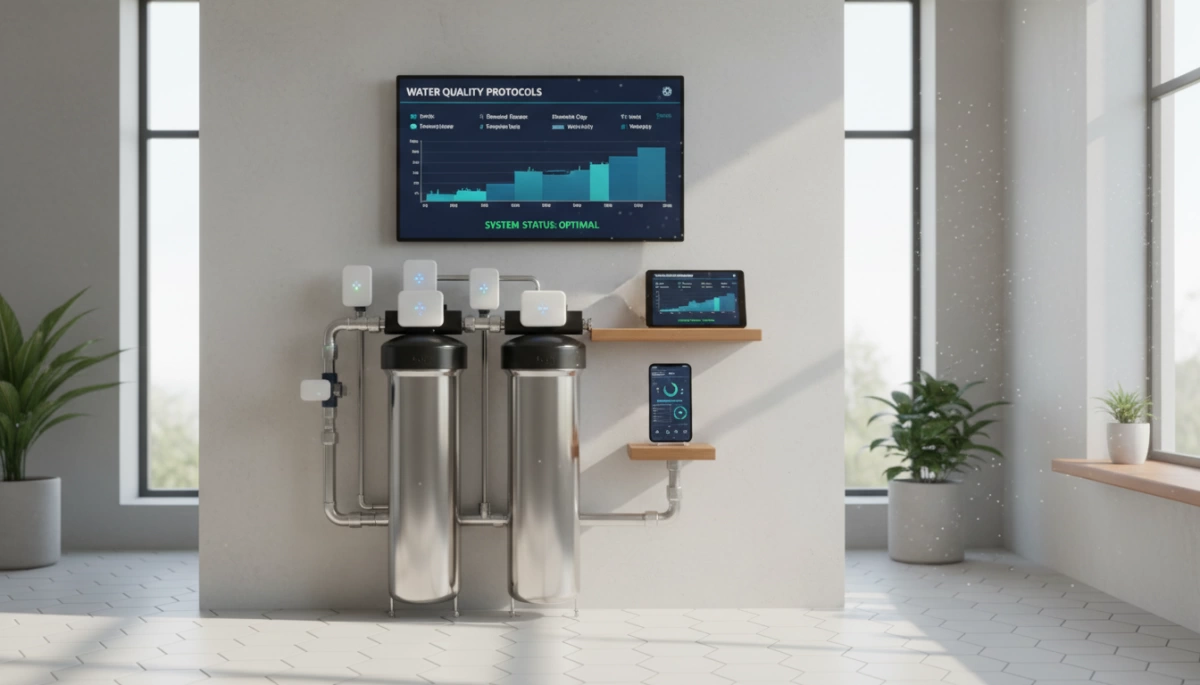
Managing a network of public hydration points used to be a guessing game. Facility managers would often wait for a user complaint or a visible red light before taking action. That approach is obsolete. We are shifting entirely from reactive repairs to preventative maintenance schedules driven by data. By leveraging IoT water station monitoring, we gain a transparent view of the entire water network, allowing us to address issues before they ever impact the user experience.
Shifting from Reactive to Proactive Maintenance
The core benefit of smart connectivity is the ability to predict maintenance needs. Instead of manually checking units or relying on paper logs, facility managers receive automated notifications. This shift ensures that public water quality management remains consistent across large campuses or airports. We no longer wait for flow rates to drop; we schedule filter changes based on actual gallon usage and inlet water quality data. This eliminates the guesswork usually required to spot the physical signs you need a water filter replacement, as the digital dashboard provides precise saturation levels.
Key Data Points: Filter Health and UV Alerts
To maintain a compliance operations checklist, we focus on specific telemetry data provided by the station’s sensors. The most critical alerts involve real-time filter status tracking and UV system integrity.
- Filter Life Percentage: Tracks remaining capacity based on volume and time, preventing overuse of saturated carbon blocks.
- UV-C Functionality: Monitors the LED circuit. If the UV unit fails, the system should automatically lock the dispenser to prevent unsterilized water delivery.
- Flow Rate Anomalies: sudden drops can indicate clogged pre-filters or pressure issues in the building’s plumbing.
Tracking Usage Metrics for Sustainability
Beyond maintenance, these smart units function as a sustainable water refill station tracking tool. The system counts every ounce dispensed, converting that data into “plastic bottles saved.” This is invaluable for organizations tracking Environmental, Social, and Governance (ESG) goals. We can quantify the reduction in single-use plastic waste and report accurate hydration statistics to stakeholders, justifying the investment in high-end infrastructure.
Daily and Weekly SOP Checklists for Facility Staff
While IoT handles the internal diagnostics, physical hygiene requires human intervention. A robust facility operations SOP ensures the exterior remains as safe as the water inside.
Standard Operating Procedure (SOP)
- Daily Protocol:
- Wipe down the dispensing area, IR sensors, and basin with EPA-approved food-safe sanitizers.
- Visually inspect for “phantom pour” activation or sensor obstructions.
- Clear any debris from the drain strainer to prevent standing water.
- Weekly Protocol:
- Deep clean the housing using non-abrasive cleaners to protect the 304 stainless steel finish.
- Verify IoT water station monitoring connectivity (ensure the unit is online).
- Audit the maintenance sanitation schedule logs to ensure staff compliance.
Frequently Asked Questions About Water Station Safety
When implementing managing water quality in public bottle filling stations, facility managers often face specific technical and operational hurdles. Addressing these common inquiries helps clarify the requirements for maintaining a safe, compliant, and efficient hydration network.
How often should filters be replaced in high-traffic public areas?
In high-volume locations like airports, universities, or gyms, the standard “every six months” rule is rarely sufficient. I recommend replacing filters based on gallon usage—typically every 3,000 gallons—or every 3 to 4 months in these zones. Waiting too long risks “breakthrough,” where contaminants bypass the saturated media. Relying on guesswork is risky, which is why understanding filter life monitoring using smart sensors vs timers is critical for accurate maintenance schedules.
Does UV-C technology eliminate the need for chlorine?
No, it does not replace the need for residual disinfectants in the main supply. Chlorine protects the water as it travels through municipal infrastructure. UV-C LED purification technology serves as a point-of-use water sterilization method, acting as a final firewall. It neutralizes chlorine-resistant pathogens (like Cryptosporidium) and bacteria that may have entered through local plumbing right before the water is dispensed.
What is the difference between NSF 42 and NSF 53 standards?
Understanding the distinction between NSF/ANSI 53 and 42 standards is vital for liability protection:
- NSF 42 (Aesthetics): Certifies the reduction of non-health-related contaminants like chlorine taste, odor, and particulates. It ensures the water is palatable.
- NSF 53 (Health Effects): Certifies the reduction of specific health-related contaminants, including lead, cysts, and volatile organic compounds (VOCs).
For public safety, I always advise ensuring your drinking water fountain or filler meets both standards.
Can smart water stations integrate with existing building management systems?
Yes, modern IoT water station monitoring systems are designed for integration. Advanced units can communicate with Building Management Systems (BMS) via APIs or standard protocols. This allows facility teams to view real-time filter status, leak detection alerts, and usage metrics on a centralized dashboard, effectively automating the preventative maintenance schedule.