

















If you’re responsible for keeping your team happy, hydrated, and productive, choosing the right office water filter is a much bigger decision than it looks on the surface.
You’re not just replacing a few bottled water deliveries. You’re deciding how your workplace will handle daily hydration, control long‑term costs, and demonstrate a real commitment to sustainability.
The challenge? Most options either look great on paper but fail under real office peak loads, or they’re over-engineered systems that drive up maintenance and service costs without adding real value for employees.
In this guide, you’ll learn how smart offices are switching to bottleless, plumbed‑in filtration systems that:
- Deliver consistently great-tasting water employees actually drink
- Cut plastic waste and storage headaches
- Keep total cost of ownership predictable and under control
You’ll also see how manufacturers like driplife design commercial water filtration systems specifically for modern workplaces—so your next office water solution actually works long term, not just on install day.
How Offices Choose Water Filtration Solutions That Actually Work Long Term
Why Office Drinking Water Is a Different Problem Than Home Use
In an office, drinking water is not a “nice-to-have.” It’s infrastructure. The way I design an office water filter system is very different from how I’d choose a home filter, because the stakes and usage patterns are completely different.
Higher User Count and Peak Usage
In most offices, demand spikes hard—usually around:
- Morning (8–10 a.m.) – coffee, first water fill
- Lunch (11:30 a.m.–1:30 p.m.) – refills, food prep
- Afternoon (2–4 p.m.) – hydration and coffee/tea
A typical plumbed-in water cooler for office use must handle:
| Factor | Home Use | Office Use |
|---|---|---|
| Users per day | 2–5 people | 10–200+ employees |
| Peak draw time | Spread out | Heavy, concentrated peaks |
| Flow requirement | Moderate | High flow, fast recovery |
| Capacity expectation | A few gallons | Continuous, all-day availability |
If your office hydration station can’t keep up at peak times, people simply stop using it and go back to bottled drinks or unfiltered tap.
Shared Responsibility for Hygiene and Safety
At home, one or two people handle cleaning and filter changes. In an office, no one “owns” the water cooler, which is exactly why the office water dispenser with filter must be:
- Touch-minimized – sensor or paddle-operated to reduce cross-contact
- Simple to sanitize – smooth surfaces, easy-wipe panels
- Low-maintenance – clear filter change indicators, long-life cartridges
For shared spaces, I build workplace hydration solutions that assume:
- Employees will not baby the equipment
- Cleaning has to be quick and obvious
- Any hygiene lapse reflects on the company, not just the device
Consistency More Important Than Customization
At home, you might tweak taste, add reverse osmosis, or chase “perfect water.” In an office, employees mainly want:
- Clean, neutral taste (no chlorine, no odors)
- Cold when it should be cold; hot when it should be hot
- Always available, without “out of order” signs
That’s why, in offices, reliability beats customization every time. A good office water filter must prioritize:
- Uptime over ultra-complex filtration
- Simple operation over fancy controls
- Consistent, safe drinking water over boutique taste profiles
When I design or specify a commercial water filtration system for offices, my first filter is not “What’s the purest?” but “What will work flawlessly every day with minimal user effort?”
Common Pitfalls With Typical Office Water Setups
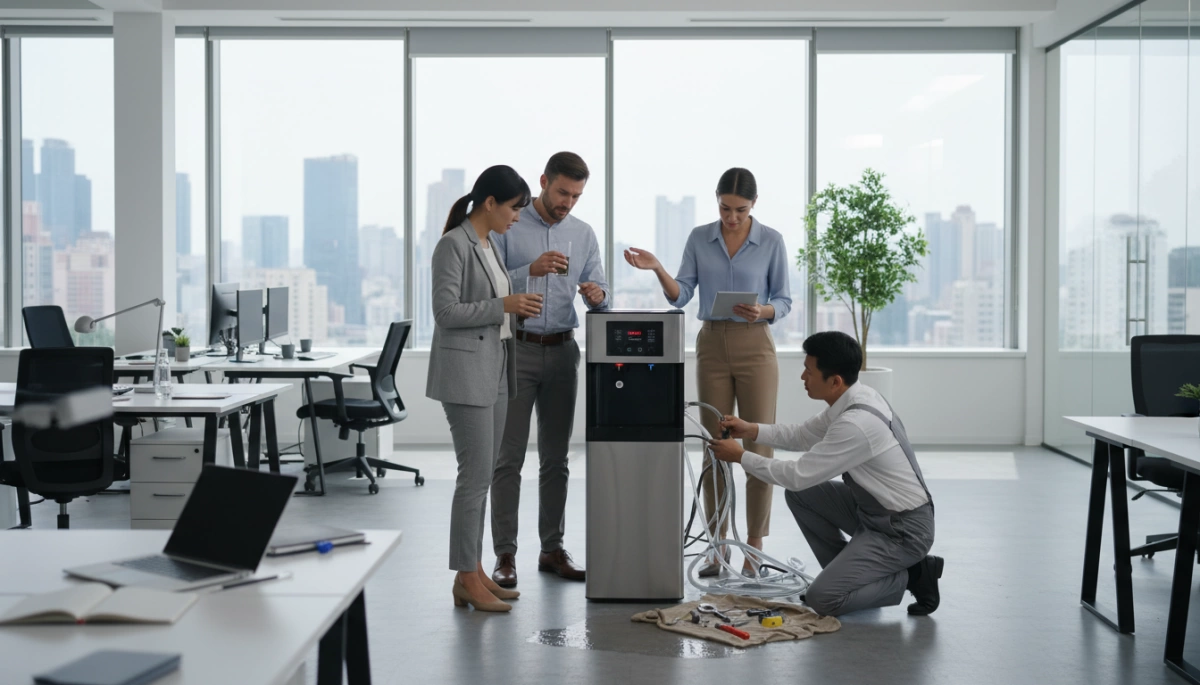
Most offices stick with whatever water setup they started with years ago—and pay for it in cost, hassle, and complaints. Here’s where things usually go wrong.
Problems With Bottled Water in Offices
Bottled water programs look simple on paper, but in day-to-day office life they’re a headache:
- Unpredictable costs: Delivery fees, fuel surcharges, and fluctuating usage make budgeting hard compared to a fixed-cost office water filter system or bottleless office water cooler.
- Storage and clutter: Full jugs, empty returns, and stacks of plastic eat up valuable office space and make kitchens look messy.
- Inconvenience and safety: Swapping heavy bottles is a lifting risk and usually falls on whoever happens to be nearby.
- Sustainability issues: More offices are moving to a sustainable office water system to cut plastic waste and align with ESG goals.
Downsides of Relying on Unfiltered Tap Water
On the flip side, just using tap water with no office water filter creates its own problems:
- Taste and odor complaints: Chlorine, musty taste, or metallic notes push people back to soda and coffee instead of water.
- Perception of quality: Even if municipal water is safe, employees often don’t trust it without at least a basic carbon-based office water filter.
- Inconsistent experience: Old pipes, different floors, and varying pressure can make one sink fine and another almost undrinkable.
If you’re considering countertop solutions, many of the best countertop water filter systems use activated carbon to fix taste and odor without overcomplicating things, like the options shown in this guide to the best countertop water filter systems.
Risks of Poor or Inconsistent Maintenance
Whether you’re running a plumbed-in water cooler for office use or a simple office water dispenser with filter, maintenance is where most setups fail:
- Filters changed late (or never): This leads to slow flow, bad taste, and potential bacteria growth.
- No clear ownership: Facilities thinks HR owns it. HR thinks IT owns it. Nobody schedules service.
- Reactive, not proactive: Systems only get attention after employees complain—or after a leak.
A low-maintenance office filtration setup with clear service schedules, NSF certified components, and simple filter access is non‑negotiable if we want reliable employee drinking water quality without constant firefighting.
Core Expectations for an Effective Office Water Filter
When I choose an office water filter system, I look at four non‑negotiables: taste, speed, simplicity, and uptime.
Consistent, Great-Tasting Drinking Water
An office water filter has to make tap water taste clean every single time, for every employee. A good carbon-based office water filter removes chlorine, bad odor, and that “office tap” aftertaste so people actually drink more water. If you’re dealing with taste issues at the office or at home, you’ve probably already seen how a solid carbon or RO setup can help, like a compact countertop ice and water purifier that upgrades basic municipal water.
High Flow Rate for Busy Periods
In a real office, everyone hits the office water dispenser with filter at the same time—right after meetings, lunch, and breaks. That means:
- Fast dispensing with no long lines
- Enough capacity for back-to-back fills
- Stable cold and hot output during peak use
A proper plumbed-in water cooler for office use is built for this kind of traffic, not just light home use.
Low-Maintenance and Simple Service
Offices need low-maintenance office filtration, not something that needs babying:
- Quick filter changes (ideally tool-free cartridges)
- Clear service intervals (6–12 months, not every few weeks)
- Simple indicators for filter replacement or issues
The less your team has to touch it, the better. Most admins don’t want to manage another “mystery system.”
Long-Term Reliability and Uptime
An office water filter system is part of your workplace infrastructure, just like Wi‑Fi and HVAC. It has to:
- Run reliably all day, every day
- Handle years of usage without frequent breakdowns
- Come with solid vendor support and warranty
For offices, a sustainable office water system beats short-term fixes. Once it’s installed, it should quietly do its job and keep your employees hydrated without drama.
Why Maximum Purification Isn’t Always Necessary in Offices
Most U.S. offices are on treated municipal water, which already meets federal safety standards. That changes what you actually need from an office water filter system. In most workplaces, the main issues are:
- Chlorine taste and odor
- Minor sediment or discoloration
- Employee skepticism about “tap water”
A good carbon-based office water filter or carbon block office filter is usually enough to:
- Remove chlorine taste and smell
- Improve clarity
- Make water taste clean and consistent so people actually drink more
You don’t always need heavy, high-waste systems like full reverse osmosis for office use just to serve regular drinking water. Over-engineered, “lab-grade” setups:
- Cost more to buy and install
- Require more frequent maintenance and filter changes
- Increase downtime risk if something fails
- Can be harder for non-technical office staff to manage
The goal in an office is simple: clear, great-tasting, safe water that employees trust, from a low-maintenance office filtration setup. That’s where smart, multi-stage carbon systems shine. For example, the same type of advanced filtration we use in our ultrafiltration faucet water filter can be scaled into a point-of-use office water cooler or office kitchen water filter without overcomplicating your workplace hydration solution.
Best Filtration Technologies for Office Settings
When I look at what actually works in U.S. offices long term, a few office water filter technologies clearly stand out. The goal is simple: better taste, strong hygiene, low hassle, and predictable costs.
Carbon-Based Office Water Filters (Taste & Odor First)
For most offices on municipal water, a carbon-based office water filter is the workhorse:
- Fixes the biggest complaints: chlorine taste, odor, and that “metallic” or “musty” office tap water flavor.
- Carbon block office filters trap:
- Chlorine and chloramine
- Many organic compounds that affect taste and smell
- Some sediment and micro‑particles
- Keeps good pressure so your office water dispenser with filter can serve multiple people quickly.
- Works well as a kitchen office water filter solution under the sink or in a plumbed‑in water cooler for office break rooms.
If you’re in an area where employees are extra picky about taste at the tap, a compact option like a UF kitchen faucet water purifier can give you a feel for filtered water quality in a smaller office kitchen setup before you roll out building-wide systems. A good example of that style is this UF kitchen faucet water purifier system that focuses on taste, clarity, and everyday use.
Why Activated Carbon Works So Well with Municipal Water
Most U.S. offices are already on safe municipal supply, so activated carbon is usually the most logical first step:
- Optimized for municipal water: It’s built to polish already-treated city water, not rescue unsafe wells.
- Big impact on employee drinking water quality: People will drink more if it smells and tastes clean.
- No overkill: You avoid the cost and complexity of full reverse osmosis for office use unless you truly need it.
For offices where you want both strong purification and convenience, some countertop reverse osmosis systems pair RO with carbon to remove more dissolved solids while still focusing on taste and ease of use, like the setups shown in this kind of countertop reverse osmosis system.
Cost, Maintenance, and Performance in Offices
From a business standpoint, low-maintenance office filtration wins every time:
- Filter life: Typical carbon cartridges last 6–12 months in many office environments, depending on capacity.
- Predictable costs: You’re buying replacement filters, not pallets of water bottles or jugs.
- Simple servicing: Quick cartridge swaps instead of dealing with heavy bottle delivery and storage.
- Stable performance: Flow rate stays strong and taste stays consistent when you keep to a basic maintenance schedule.
This is the backbone of a sustainable office water system that doesn’t surprise your finance or facilities team.
Integrated Cooling and Dispensing Office Systems
Most companies want more than just filtration—they want cold, hot, and ambient water on demand from a single unit. That’s where integrated cooling and dispensing office systems shine:
- Hot and cold filtered water dispensers support coffee, tea, and hydration from the same unit.
- Built-in carbon-based office water filters or multi‑stage office water purifiers clean the water before it hits the faucet.
- Point-of-use office water coolers connect directly to your water line, so no more bottle changes or storage rooms full of jugs.
These setups turn your hydration station into a central, always-ready workplace hydration solution.
Bottleless Coolers with Built-In Filtration
A bottleless office water cooler is usually the most cost-effective office hydration choice over time:
- Office bottled water alternative: No deliveries, no lifting, no tracking empty bottles.
- Cleaner footprint: No stacks of plastic jugs in hallways or copy rooms.
- Stable operating cost: You pay for the machine + filters + a bit of power, not rising per-bottle fees.
Most of our commercial bottleless water dispensers combine:
- A carbon-based office water filter (sometimes with sediment or UV stages)
- A hot and cold filtered water dispenser function
- Safety features like child locks on hot water and leak detection
Touchless and Sensor-Based Dispensers for Hygiene
Hygiene expectations have changed in U.S. offices. Many HR and facilities teams now ask specifically for touchless office water dispensers:
- Sensor-based dispensing: Wave a hand or position a bottle—no shared buttons.
- Reduced cross-contact: Fewer touchpoints in high-traffic areas like break rooms and shared kitchens.
- Easy to sanitize: Flat, simple surfaces for quick wipe-downs by janitorial staff.
Paired with solid filtration, touchless bottleless office water coolers support both wellness programs and office water safety standards.
Countertop vs Freestanding Office Water Filter Coolers
Both formats work; it depends on your space and employee count:
Countertop office water filter coolers
Best when:
- You have limited floor space but decent counter space.
- You’re outfitting small offices, private suites, or executive areas.
- You want a compact hydration station near a sink or within an office kitchen.
Freestanding office water filter coolers
Best when:
- You’re serving larger teams or multiple departments.
- You want a visible office hydration station in open areas.
- You need higher capacity tanks and stronger cooling for peak times (lunch, breaks, shift changes).
In most U.S. workplaces, we end up mixing both: freestanding systems in common areas plus countertop systems in kitchens or specialty zones. The key is combining the right filtration technology (usually carbon-based) with the right dispenser format so your office water filter system is easy to use, cost-effective, and reliable long term.
What Office Water Filters Should Not Replace
Even the best office water filter system has limits. A point-of-use office water cooler with filter is built for drinking and light kitchen use, not for fixing every water issue in the building.
Limits of Point-of-Use Office Water Filtration
A carbon-based office water filter or bottleless office water cooler is great for:
- Drinking water
- Coffee machines and tea
- Basic office kitchen use
It’s not designed to:
- Fix low water pressure issues in the building
- Solve rusty pipes or brown water coming from old plumbing
- Treat water for restrooms, showers, or janitorial use
Those problems sit at the building plumbing or municipal level, not the dispenser level.
When You Need Building-Wide Plumbing Solutions
You still need a building-wide or landlord-level solution when:
- There’s visible sediment, rust, or discoloration throughout the building
- You’re dealing with regular leaks, corrosion, or pipe failures
- Local code requires centralized backflow prevention and treatment
In those cases, a commercial water filtration system at the entry of the building or major plumbing upgrades are the only real fix.
Medical or Industrial-Grade Treatment Cases
Standard office hydration stations are not a match for:
- Healthcare settings that require sterile or disinfected water
- Labs that need validated water quality for testing or instruments
- Manufacturing processes that depend on tightly controlled water chemistry
Those applications typically need reverse osmosis, deionization, UV, or multi-stage treatment similar to larger commercial RO systems with documented performance and maintenance.
Ultra-Pure Individual Water Needs
If a few employees need ultra-pure water for medical devices (like certain CPAP humidifiers), specific health conditions, or lab-style use, that’s beyond what an office water dispenser with filter is meant to provide.
In those cases, the right approach is:
- A dedicated under-sink RO system at a single location
- Or personal, specialty-grade devices for those specific users
In short: an office water filter is built to deliver safe, great-tasting, everyday drinking water—not to replace building infrastructure, medical systems, or industrial water treatment.
Office Water Filters vs Bottled Water Programs
When I compare an office water filter system to a traditional bottled water program, it’s not even close in a modern U.S. office.
Cost: Fixed vs Always Rising
With a bottleless office water cooler or plumbed-in water cooler for office use:
- You pay a predictable monthly or annual cost (equipment, filter changes, basic service).
- You’re not billed per jug, per rush delivery, or per seasonal usage spike.
- Cost per gallon usually drops sharply once you have point-of-use office water coolers in place.
With bottled water delivery:
- You’re paying variable costs for jugs, deposits, fuel surcharges, and last‑minute orders.
- As staff count grows, your hydration cost scales up linearly, not efficiently.
- Managing orders, invoices, and empties eats into admin time.
If you want to see how filtration tech can replace bottled options, look at how a glass water filter dispenser can serve as an office bottled water alternative while keeping things clean and simple: glass water filter dispenser.
Sustainability and Plastic Waste
Switching to a sustainable office water system is one of the easiest wins for any office water sustainability initiative:
- No more stacks of plastic jugs or single-use bottles.
- You cut plastic waste and trucking emissions from deliveries.
- It’s a visible, credible move toward ESG goals and employee wellness and hydration.
A commercial bottleless water dispenser tied into your existing tap instantly turns your building’s supply into a low-maintenance office filtration setup instead of a plastic-heavy logistics operation.
Storage, Clutter, and Space
Bottled water programs demand:
- Floor space for full jugs
- A corner for empties waiting for pickup
- Manual lifting, swapping, and spilling risks
A hot and cold filtered water dispenser with built-in office water filter:
- Hugs the wall and frees up valuable storage space.
- Removes jug clutter from hallways and copy rooms.
- Gives you a cleaner, more professional office hydration station layout.
For most U.S. workplaces, moving from bottled to office water filtration vs bottled water is about more than taste—it’s about cutting recurring costs, plastic, and clutter while giving employees better everyday drinking water.
How Procurement Teams Should Evaluate Office Water Filter Options

When I look at an office water filter system as a procurement decision, I treat it like any other critical workplace service: predictable, compliant, and easy to scale.
1. Total Cost of Ownership (TCO)
Don’t just compare unit prices. Compare five-year cost.
| Cost Item | What to Check |
|---|---|
| Equipment price | Lease vs purchase, per-unit cost |
| Installation | Plumber fees, permits, fittings |
| Filters & consumables | Replacement frequency, filter price, shipping |
| Service & maintenance | Included visits vs billable calls |
| Bottled water savings (if switching) | Current delivery, storage, and labor costs |
Tip: For most offices, a bottleless office water cooler or plumbed-in water cooler for office beats bottled programs within 12–24 months.
2. Installation & Fit in Existing Offices
You want systems that drop into your current setup with minimal disruption.
Check for:
- Water source access: Distance to a cold-water line and drain
- Power needs: Standard 110V outlet or special requirements
- Placement: Hallway, breakroom, copy area, or kitchen
- Countertop vs freestanding: Freestanding usually needs less remodeling
If you’re already planning a kitchen upgrade or adding something like a hot water filter under sink, bundle the plumbing work to lower overall install cost.
3. Certifications & Safety Compliance
For US offices, I don’t accept systems that aren’t independently tested.
Look for:
- NSF/ANSI certifications (e.g., 42 for taste/odor, 53 for some contaminants)
- Materials safety: Food-contact grade components
- Electrical safety: UL or equivalent listing
- Local code compliance: Check with your building engineer or landlord
Label these in your spec sheet so vendors can’t sidestep them.
4. Vendor Reliability, Service & Warranty
A commercial water filtration system is only as good as the support behind it.
Ask vendors:
- Response time SLA: How fast for repairs and filter changes?
- Service model: In-house technicians vs third-party contractors
- Warranty length: On compressor, electronics, and filter heads
- Parts availability: US-based inventory and lead times
I prefer vendors who offer scheduled office water cooler maintenance and remote support instead of “call us if it breaks.”
5. Scalability for Growing or Multi-Site Offices
If you manage multiple locations or plan to grow, design for scale from day one.
Consider:
- Standardized models: Same office water dispenser with filter in every office
- Modular capacity: Ability to add more units when headcount increases
- Centralized reporting: One contract, unified billing, single point of contact
- Nationwide service coverage: So remote offices don’t get a lower standard
This is also where OEM and branding come in—if you want consistent, on-brand hydration stations across locations, make sure your vendor can deliver at volume, with stable supply and repeatable installations.
By using these checkpoints, procurement teams can lock in a cost-effective office hydration setup that’s reliable, compliant, and easy to manage long term.
Implementation Guide for Office Water Filter Systems
When we roll out an office water filter system, I treat it like any other long-term workplace infrastructure decision: plan it once, scale it easily, and keep it simple to run.
Assess office size and usage
Start with real numbers, not guesses:
- Employee count and guests: Map how many people actually use each kitchen, break room, or hydration station.
- Peak times: Coffee rush 8–10 a.m., lunch window, and mid-afternoon are your stress tests.
- Use type: Is this mainly for cold drinking water, or also hot water for tea, instant meals, and coffee brewing?
For some offices, it also helps to understand existing water quality. If you’re unsure, a basic hardness check (similar to how you’d determine if your water is hard or soft) can guide filter selection and maintenance cycles.
Choose system capacity and modular setups
For an office water filter system, I tend to follow a “modular and scalable” playbook:
- Right-sized capacity: Match flow rate (gallons per minute) and daily capacity to actual peak use, not total headcount.
- Multiple small points vs one big unit:
- Open-plan floors: several point-of-use office water coolers spaced out.
- Smaller sites: a single bottleless office water cooler with built-in filter may be enough.
- Modular design: Use systems where filters, chillers, and hot tanks can be upgraded or added without ripping out everything.
Branding and OEM options
If you care about how your break areas look (most US offices do), OEM and branding options matter:
- Custom panels and colors so units match your interior design.
- Logo placement on front panels for a consistent corporate look.
- Standardized models across sites so facilities teams deal with one playbook for parts and maintenance.
For companies building their own hydration lineups or private label solutions, OEM versions of our office water dispenser with filter units can slot right into your brand system.
Health and safety compliance
Even a simple plumbed-in water cooler for office use touches health and safety:
- NSF/ANSI certifications for filters and components (especially NSF 42/53 for taste and contaminant reduction).
- Materials: Food-contact compliant tubing, tanks, and faucets.
- Installation: Follow local plumbing codes, backflow prevention, and proper drain connections for any integrated coolers.
- Workplace safety:
- Stable placement and secure mounting.
- Safe hot-water dispensing design to reduce burn risk.
- Clear cleaning and maintenance schedule logged for inspections.
Supply, sourcing, and reliability
A sustainable office water system has to be reliable at scale:
- Standardized cartridges across locations to simplify stocking.
- Global and national logistics so filters and spare parts reach any US office on time.
- Service network or easy in-house replacement design (tool-free filter swaps, quick-shutoff valves).
- Long-term availability: Choose systems and carbon-based office filters that won’t be discontinued in a year.
If you’re already using sink water filter systems in office kitchens, aligning those with the same commercial under-sink water filter platform can cut costs and simplify maintenance across all your workplace hydration solutions.