


















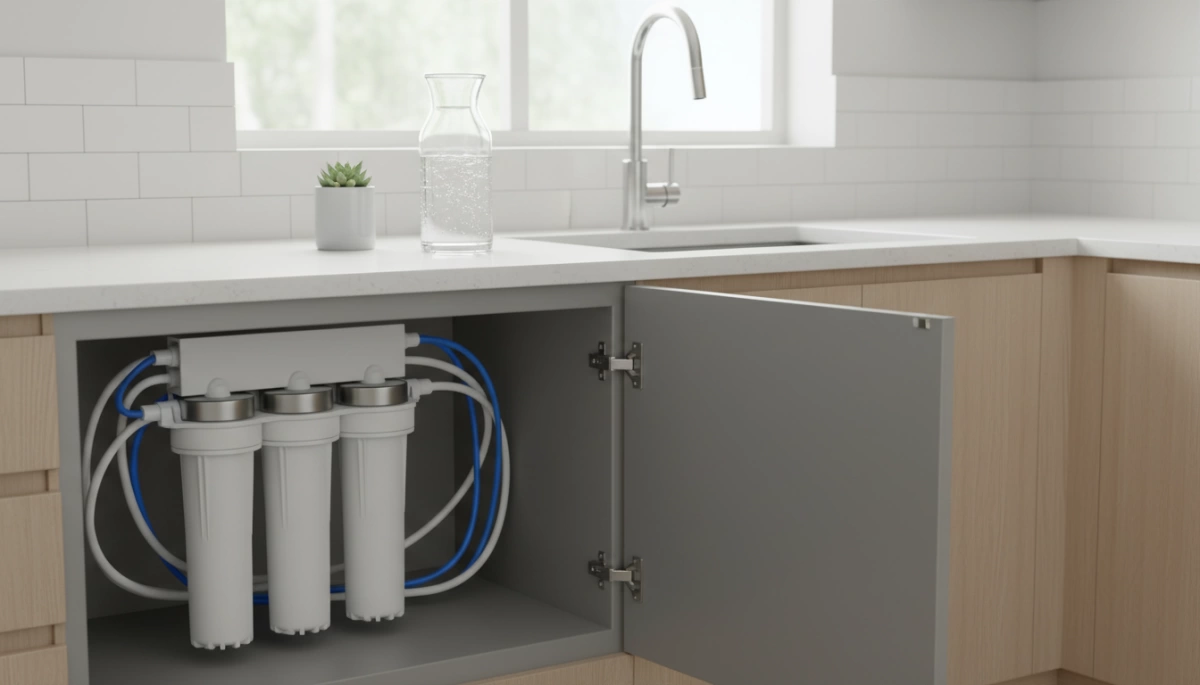
You might already suspect that your tap water isn’t as clean as it looks.
Whether it’s that swimming-pool chlorine taste, strange odors, or genuine concerns about lead and PFAS, you know your kitchen needs an upgrade.
But finding the right sink water filter system can feel overwhelming.
You have reverse osmosis options, carbon block filters, and modern tankless designs.
Which one actually removes the dangerous stuff without draining your wallet?
In this guide, I’m going to cut through the marketing noise and show you exactly how to choose the best under-sink water filtration system for your home in 2025.
You’ll learn about contaminant removal, installation realities, and how to get bottled-quality water straight from your tap.
Let’s dive right in.
Would you like me to proceed with writing the first section on “Why Choose an Under-Sink Water Filter System?”
Why Choose an Under-Sink Water Filter System?
When customers ask me where to start with water treatment, I almost always point them toward the kitchen sink. Installing a sink water filter system is the most practical upgrade you can make for your home’s health and efficiency. Instead of treating every drop of water entering the house—including what you use to flush toilets—a point of use water filter focuses precisely where it matters most: the water you actually drink and cook with.
From my perspective, the benefits over temporary solutions are clear. While pitcher filters or faucet attachments are better than nothing, they often struggle with flow rate and filter capacity. An under sink water filtration setup provides robust, consistent purification without cluttering your countertops or forcing you to wait for a gravity-fed pitcher to fill.
Key Advantages of Under-Sink Systems
- Direct Point-of-Use Filtration: Treatment happens immediately before the water exits the tap, ensuring maximum freshness for drinking, coffee, and cooking.
- Superior Performance: Unlike small faucet mounts, under-sink units use larger cartridges capable of removing tougher contaminants like lead, cysts, and VOCs.
- Cost-Effective Solution: Eliminate the recurring expense of bottled water. A single filter cartridge can replace thousands of plastic bottles, saving you money and reducing waste.
- Space-Saving Design: The entire system tucks neatly inside the cabinet, keeping your kitchen aesthetic clean and your workspace open.
Comparison: Sink Filter vs. Alternatives
| Feature | Sink Water Filter System | Pitcher Filter | Bottled Water |
|---|---|---|---|
| Filtration Power | High (Multi-stage) | Low (Basic carbon) | Varies (Often just filtered tap) |
| Convenience | Instant (On-demand) | Slow (Gravity-fed) | Requires hauling/storage |
| Counter Space | Zero (Hidden installation) | Takes up fridge space | Takes up pantry space |
| Long-Term Cost | Low ($0.02 – $0.05/gallon) | Medium | High ($1.00+/gallon) |
If you are serious about water quality, moving the filtration hardware under the counter is the logical next step for a modern, efficient kitchen.
Would you like me to detail the specific differences between Carbon Block, Ultrafiltration, and Reverse Osmosis systems next?
Types of Sink Water Filter Systems
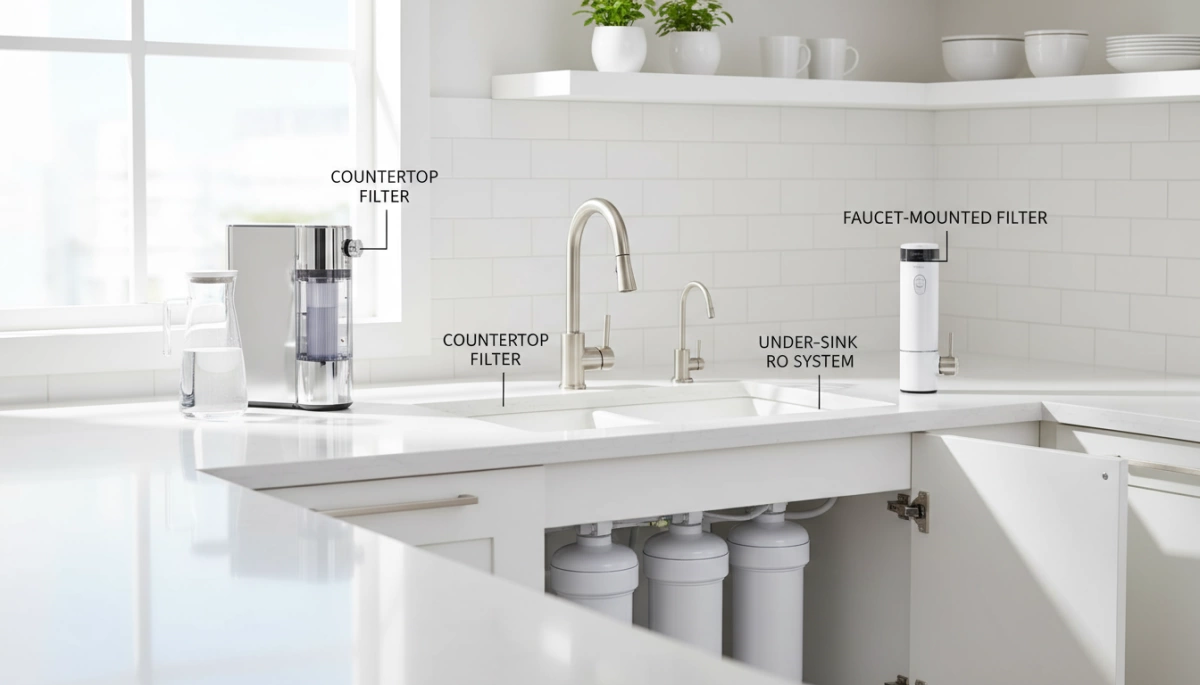
Not every home needs the same level of filtration. Choosing the right setup depends heavily on whether you are fighting hard water, chlorine taste, or invisible contaminants like lead. Here is a breakdown of the main technologies we see driving the sink water filter system market today.
Carbon Block Systems
If your main gripe is the “swimming pool” taste of city water, a carbon block point of use water filter is usually the go-to solution. These systems excel at adsorption, effectively pulling out chlorine, chloramines, and volatile organic compounds (VOCs). They are compact, don’t require a drain line, and act as a reliable “polisher” for municipal water that is already bacteriologically safe but tastes unpleasant.
Ultrafiltration (UF) Systems
UF systems provide a mechanical barrier. Using a membrane with a pore size around 0.01 microns, they physically block sediments, rust, and bacteria while retaining healthy minerals. This is a massive benefit for eco-conscious buyers because UF offers high contaminant removal efficiency for physical particles without producing the wastewater typically associated with RO systems.
Reverse Osmosis (RO) Systems
For comprehensive purification, reverse osmosis under sink units are the gold standard. They push water through a semi-permeable membrane to strip away up to 99% of dissolved solids (TDS), including fluoride, arsenic, and heavy metals. While older models were bulky, the best reverse osmosis water filter systems now feature tankless, direct-flow designs that fit easily in tight cabinets.
Advanced Multi-Function Systems
The latest trend involves combining filtration with instant temperature control and functional enhancements. These systems do more than just clean; they upgrade your lifestyle. We are seeing integrated units that offer instant boiling, chilled, sparkling, or even hydrogen-rich water from a single tap.
- Convenience: A specialized hot and cold water dispenser with built-in filtration eliminates the need for kettles and pitchers.
- Enhancement: Many high-end models now include an alkaline water filter system stage to reintroduce minerals or a UV water purifier under sink for final sterilization.
Next Step: Would you like me to detail the specific certification standards (NSF/ANSI) you should check for each of these system types in the next section?
Key Features to Look for in a Modern Sink Water Filter System
Buying a filter today isn’t like it was ten years ago. We have moved past bulky tanks and slow drips to sleek, high-tech units. When I evaluate a sink water filter system for modern American homes, I look for features that balance convenience, safety, and efficiency. Here is what you need to prioritize to get the best under sink water filter experience.
- Tankless Design: Space is premium in any kitchen. A tankless water filter system is a game changer because it eliminates the massive storage tank found in old RO setups. This on-demand design frees up cabinet space for cleaners and prevents bacteria growth in stagnant water.
- High Flow Rate: You shouldn’t have to wait a minute just to fill a pasta pot. Look for a high flow water filter—typically rated at 600 GPD (Gallons Per Day) or higher. This ensures a fast, steady stream of direct flow RO system water without pressure drops.
- Smart Technology: Modern problems require modern solutions. A smart water filtration system now often includes integrated TDS (Total Dissolved Solids) meters, leak detectors, and filter life indicators right on the faucet. This continuous innovation and development in filter logic takes the guesswork out of maintenance.
- Remineralization and Enhancement: Since Reverse Osmosis is so powerful, it removes healthy minerals too. I always recommend an alkaline water filter system stage that re-adds calcium and magnesium for better taste. For total peace of mind, some units even feature a UV water purifier under sink stage to sterilize the water right before it hits your glass.
- Certification Standards: Don’t just take a manufacturer’s word for it. Look for NSF certified water filter standards. Specifically, check for NSF/ANSI 42 (Chlorine/Taste), 53 (Lead/Health effects), and 58 (RO efficiency). With rising concerns about industrial runoff, ensuring you have a water filter to remove PFAS (ANSI 473 or P473) is increasingly critical for family safety.
Quick Comparison of Modern Standards
| Feature | Old Standard | Modern Standard |
|---|---|---|
| Footprint | Bulky tank + Unit | Compact / Tankless (Slim Profile) |
| Wastewater Ratio | 1:3 (1 gallon pure, 3 wasted) | 2:1 or 1.5:1 (High Efficiency) |
| Maintenance | Messy wrench required | Quick-Twist / Snap-in Cartridges |
| Monitoring | Guesswork / Calendar | Smart Faucet / LED Indicators |
How to Choose the Right Sink Water Filter System
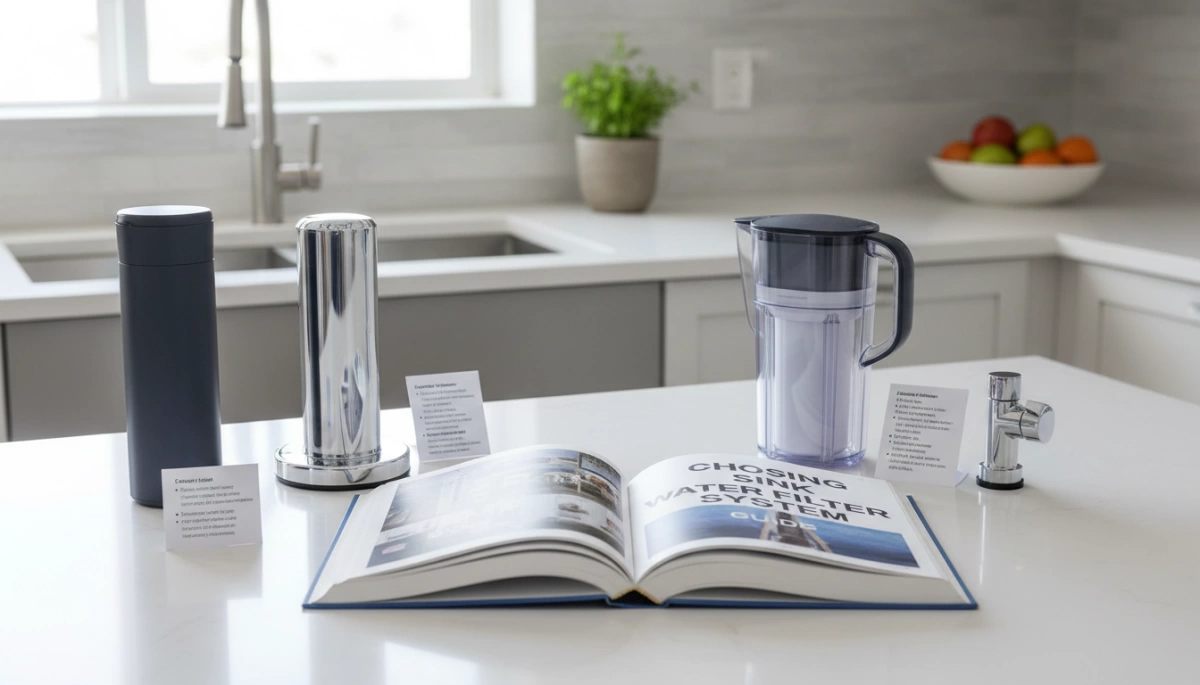
Finding the best under sink water filter for your home isn’t just about picking the unit with the sleekest faucet; it’s about matching the filtration technology to your specific water profile and lifestyle. I always tell my customers that a mismatch here leads to frustration—either you overpay for filtration you don’t need, or you end up with water that still tastes “off.”
Here is how to narrow down your options efficiently.
Assess Your Water Source: Municipal vs. Well Water
Your starting point defines your destination. The contaminants in city water are vastly different from those in a private well.
- Municipal Water: The main enemies here are usually chlorine, chloramines, and fluoride added during treatment, plus potential lead from aging pipes. A solid carbon block or a standard sink water filter system is often sufficient to fix the taste and odor.
- Well Water: This is trickier. You might face sediment, iron, hardness, or biological contaminants like bacteria. Here, you often need robust point of use water filter solutions, potentially pairing a sediment pre-filter with UV sterilization or Ultrafiltration.
Match Technology to Your Contaminant Removal Needs
Not all filters are created equal. You need to verify the contaminant removal efficiency against what is actually in your water.
| Filtration Technology | Best For | Removes | Does Not Remove |
|---|---|---|---|
| Carbon Block | Taste & Odor | Chlorine, VOCs, some heavy metals | Dissolved solids (TDS), fluoride, bacteria |
| Ultrafiltration (UF) | Bacteria Protection | Suspended solids, bacteria, parasites | Dissolved minerals, salts |
| Reverse Osmosis (RO) | Total Purification | Comprehensive contaminant removal (Fluoride, Arsenic, TDS) | Very little (removes almost everything) |
Consider Household Size and Usage
Flow rate is a “make or break” feature. If you have a family of five filling water bottles and cooking pots simultaneously, a slow-trickle system will drive you crazy.
- Small Households (1-2 people): Standard tank-based RO or basic carbon filters work fine.
- Large Families: Look for high flow water filter systems (often tankless) that can deliver 400 to 600 GPD (gallons per day). You want a glass of water filled in under 10 seconds, not 30.
Budget Factors: Initial Price vs. Filter Replacement Cost
Don’t just look at the sticker price of the machine. The real cost is in the maintenance. I always advise checking the annual filter replacement cost before buying.
- Proprietary Filters: Easier to change but often more expensive.
- Standard Housing: Cheaper, generic filters, but slightly bulkier.
Installation Type: DIY or Pro?
Modern engineering has made under sink water filtration surprisingly DIY-friendly. Most under-sink water filter systems now feature “quick-twist” cartridges and color-coded tubing that require zero plumbing experience. However, if you need to drill through a granite countertop for a dedicated faucet or lack a power outlet under the sink for a smart pump, you might want to budget for a handyman.
Installation Guide: What to Expect with Your Sink Water Filter System
Installing a sink water filter system is generally a straightforward DIY project that most homeowners can handle in an afternoon. While professional installation is always an option, modern kits are designed with quick-connect fittings and clear instructions to make the process hassle-free. Here is what you need to know before you get under the cabinet.
Essential Tools and Space Requirements
Before you buy, measure the available space under your sink. In many US kitchens, garbage disposals and dishwasher drainage lines compete for space. You need to ensure the system housing—and the storage tank if you are choosing a traditional Reverse Osmosis (RO) setup—will fit alongside your plumbing.
For a standard under sink water filtration install, gather these tools:
- Adjustable wrench and pliers for tightening connections.
- Power drill with metal/diamond bits (if you need to drill a new hole for the dedicated faucet).
- Utility knife or tubing cutter for clean cuts on plastic lines.
- Teflon tape to prevent leaks at threaded connections.
- Towel and bucket to catch minor water drips during the setup.
Step-by-Step Overview for Standard Setups
Most systems follow a similar logic, whether it is a simple carbon filter or a complex RO system installation.
- Shut off the water: Locate the cold water valve under the sink and turn it off. Open your kitchen faucet to relieve pressure.
- Install the Feed Water Adapter: Disconnect the cold water riser tube and install the T-valve adapter included with your kit.
- Mount the Faucet: If your sink doesn’t have an existing hole (like a soap dispenser hole), drill one. Secure the dedicated drinking faucet to the countertop.
- Mount the System Module: Screw the filter manifold to the side of the cabinet wall to keep the floor clear and make filter changes easier.
- Connect the Tubing: Follow the color-coded guide to connect lines between the water source, the filter inputs/outputs, the tank (if applicable), and the faucet.
- Flush the System: Turn the water back on and let it run for the manufacturer-recommended time (usually 5–15 minutes) to clear out carbon fines and air pockets.
Navigating Common Challenges
The biggest hurdle is usually limited space. If your under-sink area is cramped, consider a tankless unit or a direct-flow system that eliminates the bulky storage tank. For those upgrading to a premium, multi-functional unit, such as an under-sink soda, cold, and hot water distribution system, ensure you also have access to a standard electrical outlet nearby to power the chilling and heating elements.
Another common issue is water pressure. If your home’s water pressure is below 40 PSI, a standard RO system might struggle to produce water efficiently. In this case, you may need a permeation pump or a booster pump to ensure the system functions correctly without wasting excessive water.
Would you like me to create a comparison table showing the installation difficulty and maintenance needs of Carbon, UF, and RO systems next?
Maintenance and Filter Replacement for Your Sink Water Filter System
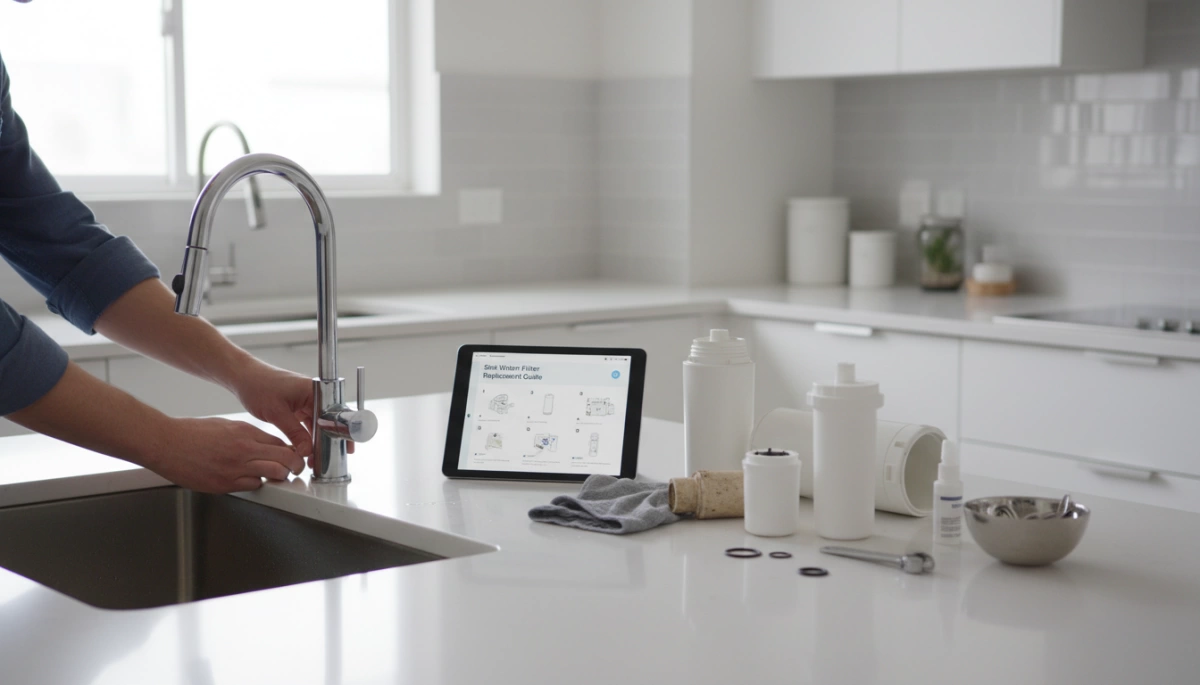
Buying the hardware is just the first step; maintaining your sink water filter system is what guarantees clean water year-round. If you ignore the schedule, contaminant removal efficiency drops, and you risk bacteria growth inside the very unit meant to protect you. We design our systems to make this process as painless as possible, but you still need to stay on top of it.
Typical Filter Lifespan by System Type
Not all filters are created equal. The lifespan depends heavily on your local water quality and daily usage volume. Here is a general breakdown of what to expect for under sink water filtration components:
| Filter Stage | Typical Lifespan | Primary Function |
|---|---|---|
| Sediment Pre-Filter | 3–6 Months | Traps rust, dirt, and sand to protect downstream filters. |
| Carbon Block | 6–12 Months | Removes chlorine, taste, and odors. |
| UF Membrane | 12 Months | Filters out bacteria and colloids. |
| RO Membrane | 24–36 Months | Removes dissolved solids and heavy metals. |
Recognizing Signs That It Is Time to Change Filters
Modern setups often act as a smart water filtration system, featuring LED faucet indicators or beeping alarms when capacity is reached. However, if your system is manual, watch for these physical signs:
- Drastic Drop in Water Pressure: As filters trap contaminants, they clog, slowing down the flow.
- Return of Chlorine Taste: If the water starts tasting like the municipal supply again, the carbon is exhausted.
- Turbidity: If the water looks cloudy or has floating particles, the structural integrity of the filter may be compromised.
Easy-Maintenance Designs: Quick-Twist vs. Multi-Housing
In the past, changing a filter meant wrestling with a wrench and a wet, slippery housing sump under a dark cabinet. Today, we prioritize quick-twist cartridges. These encapsulated designs allow you to replace the filter in seconds with a simple quarter-turn motion—no tools required and no water spills.
For instance, a compact UF kitchen faucet water purifier system often uses these streamlined cartridges that snap in and out effortlessly, making it ideal for tight spaces. This contrasts sharply with old-school multi-housing systems, which are cheaper upfront but cumbersome to service.
Estimating Annual Operating Costs
When calculating the filter replacement cost, look beyond the sticker price of the system.
- Standard Carbon/UF Systems: generally cost between $40 and $80 annually for replacements.
- Reverse Osmosis Systems: may cost $80 to $150 annually due to the multi-stage requirements, though the expensive RO membrane is changed less frequently.
Investing in high-capacity filters might cost slightly more initially, but they lower the frequency of maintenance, saving you time and hassle in the long run.
Would you like me to help you compare the specific maintenance schedules and costs of our top-selling RO versus UF models?
Top Benefits of High-Capacity and Tankless Sink Water Filter Systems
In the world of under sink water filtration, the technology has shifted massively toward efficiency and speed. Traditional systems with bulky storage tanks are quickly being replaced by modern, high-capacity designs. If you have a busy household, a tankless water filter system isn’t just a luxury; it’s a practical upgrade that solves the bottlenecks of older filtration methods.
Faster Flow and Larger Daily Output
The biggest complaint I hear about standard reverse osmosis (RO) units is the “trickle.” Filling a large pot for pasta or a coffee carafe used to take forever. High-capacity systems change the game by offering a high flow water filter experience.
Instead of relying on a reservoir that runs dry, a direct flow RO system produces water on demand. We measure this in Gallons Per Day (GPD).
- Traditional RO: Typically 50–75 GPD.
- Modern Tankless: Often 400, 600, or even 800+ GPD.
This means you get a steady, fast stream immediately. Unlike older setups where you might struggle with fluctuating reverse osmosis water filter tank pressure as the reserve depletes, tankless pumps deliver consistent performance every time you open the tap.
Reduced Wastewater Generation
Efficiency is a major selling point for the modern sink water filter system. Older RO units were notorious for wasting water, sometimes sending 4 to 5 gallons down the drain for every 1 gallon of purified water produced.
High-efficiency tankless models utilize advanced internal pumps and recirculation technology to drastically cut this waste. Most current models boast a 1.5:1 or even 2:1 pure-to-drain ratio. This makes the kitchen sink water purifier much more environmentally friendly and lighter on your water bill.
Compact Footprint for Modern Kitchens
Real estate under the kitchen counter is valuable. Between garbage disposals, cleaning supplies, and trash bins, there isn’t room for a massive 4-gallon storage tank.
A tankless best under sink water filter solves this by condensing the entire system into a single, slim box that is about the size of a computer tower. This “all-in-one” design minimizes tubing clutter and eliminates the risk of secondary contamination that can sometimes occur inside stagnant storage tanks.
Comparison: Traditional Tank RO vs. Tankless High-Capacity
| Feature | Traditional Tank RO System | Tankless High-Capacity System |
|---|---|---|
| Water Flow | Slow (limited by tank pressure) | High Flow (Continuous) |
| Space Required | Large (requires separate tank) | Compact (Save ~70% space) |
| Wastewater Ratio | High (1:3 or 1:4) | Low (1.5:1 or 2:1) |
| Maintenance | Complex (tank sanitization needed) | Easy (Quick-twist filters) |
| Freshness | Stored water (sitting in tank) | Freshly filtered on demand |
Next Step
If you are tired of losing cabinet space or waiting for your water pitcher to fill, I recommend measuring your under-sink area today to see if a compact, tankless model will fit your layout.