














Anatomy of a Startup: The 3-Second Sequence
When we engineer high-performance tankless systems like the Driplife G2-600 or G3-800, we are essentially choreographing a complex hydraulic ballet that happens in the blink of an eye. You turn the faucet, and within moments, you have a steady stream. However, that brief pause—often less than three seconds—is physically necessary. It represents the transition from a dormant state to high-pressure filtration. Here is exactly what happens inside the “black box” during that critical startup window.
Pressure Drop & Signal Transmission
The moment you twist the handle on a smart faucet, the system detects a sudden drop in line pressure. In our integrated waterway designs, this hydraulic latency is minimized because there are fewer connection points for pressure to dissipate. The pressure sensor immediately sends an electrical signal to the main control board, confirming that demand exists. This signal transmission happens in milliseconds, acting as the “wake-up call” for the entire unit.
Valve Actuation: The Solenoid Switch
Once the signal is received, the inlet solenoid valve actuation occurs. This is the mechanical “click” you might hear. This valve is the gatekeeper; it snaps open to allow raw feed water to enter the pre-filtration stages. If this valve is slow or sticky, the entire system lags. We use fast-acting solenoids to ensure that water hits the booster pump exactly when the motor engages, preventing dry running and reducing the delay between handle turn and water flow.
Pump Ramp-Up: Overcoming Osmotic Pressure
This is where the heavy lifting happens. A standard residential line might sit at 40 PSI, but to push water through a dense 0.0001-micron RO membrane, we need significantly more force. The RO booster pump ramp-up must occur instantly, elevating pressure to the optimal working range (often peaking between 80-100 PSI internally depending on feed conditions) to overcome the osmotic pressure barrier.
- Standby: 0 PSI differential.
- Active: The pump fights the natural resistance of the water trying to stay on the “dirty” side of the membrane.
- Result: The high-torque motors in our 600 and 800 GPD models are designed to hit this peak load almost immediately, unlike smaller pumps that “whine” up to speed.
Membrane Stabilization for Full Flow
As the pump hits peak pressure, the RO membrane undergoes membrane flux stabilization. Initially, the water molecules are disorganized. Under high pressure, they are forced through the microscopic pores, stabilizing into a laminar flow. This is the final step of the startup sequence where the output transitions from a trickle to the full flow rate—approximately 1.5 liters per minute for the 600 GPD model or 2.1 liters per minute for the 800 GPD unit.
The Physics of Backpressure
Finally, we must account for backpressure. The membrane itself acts as a massive restrictor. The system isn’t just pushing water through an open pipe; it is pushing against a wall that only lets specific molecules pass. This resistance creates the necessary pressure to separate Total Dissolved Solids (TDS) from pure water. The brief lag you experience is simply the physics of the pump building enough energy to win that battle against backpressure and deliver purified water to your glass.
Tank vs. Tankless: Comparing Response Times
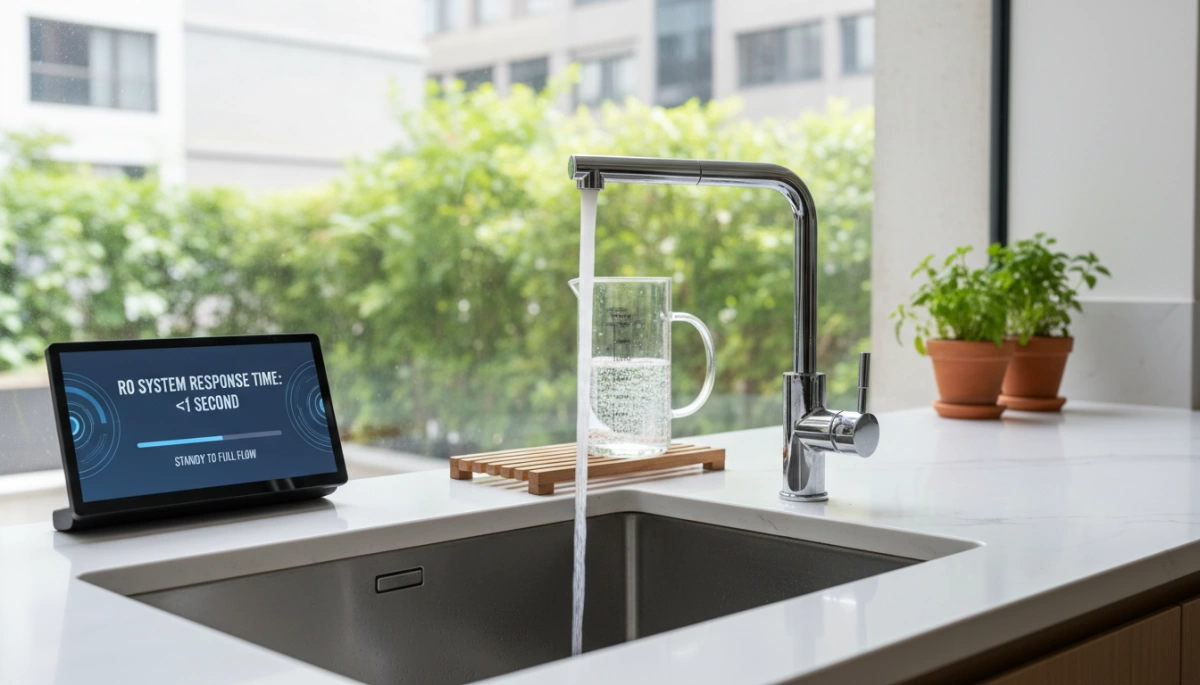
When we analyze the RO System Response Time from Standby to Full Flow, the user experience differs significantly between traditional storage setups and modern on-demand units. It comes down to the physics of how pressure is delivered to the faucet.
Traditional Tank Systems: Instant but Fading
Old-school systems rely on a pressurized storage tank. When you open the faucet, a rubber bladder inside the tank pushes water out immediately using stored pneumatic energy. This provides an immediate output RO system feel initially. However, this speed is deceptive.
- Pressure Drop: As the tank empties, the internal pressure drops rapidly.
- Inconsistent Flow: The flow rate slows down significantly while filling large pots.
- Stagnation: The “instant” water has been sitting in a rubber bladder, potentially for hours.
While the initial burst is fast, you lose that modern convenience RO experience as the stream weakens. Furthermore, because the water isn’t freshly filtered at the moment of dispensing, users should understand what a reverse osmosis water filter removes to ensure the stored water maintains its purity over time.
Tankless RO Systems: The ‘Spin-Up’ Reality
Tankless systems, like our Driplife G2 and G3 models, operate on a different principle. There is no stored energy. When you turn the handle, the system must detect the pressure drop, signal the pump, and build osmotic pressure. This sequence creates a brief moment of hydraulic latency known as tankless RO flow lag.
This “spin-up” creates a curve where the system goes from zero to steady-state filtration in a matter of seconds. Instead of fading like a tank system, a tankless unit ramps up to a consistent, powerful stream and stays there indefinitely.
Why High GPD Pumps Reduce Lag
The key to eliminating the perception of lag is raw power. In smaller tankless units (under 400 GPD), the RO booster pump ramp-up can feel sluggish. We engineered the Driplife G2-600 and G3-800 with massive flow capacities to counteract this.
- High Torque: Our 600 and 800 GPD pumps overcome osmotic backpressure almost instantly.
- Rapid Stabilization: The system achieves high GPD flow rate dynamics within moments, delivering up to 2.1 liters per minute (G3 model).
- Consistent Delivery: Once the pump hits peak speed, you get no lag RO delivery for as long as the faucet is open.
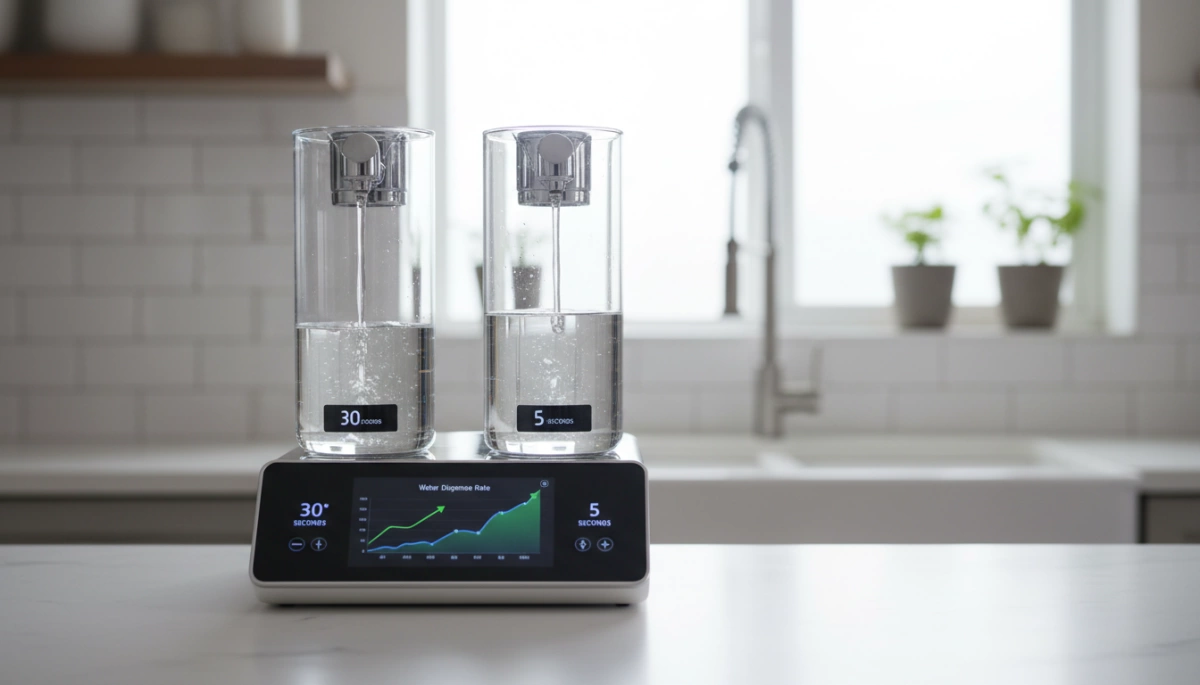
By utilizing high-capacity pumps, we compress the RO System Response Time from Standby to Full Flow into a negligible timeframe, ensuring you get a fresh cup of water in about 6 to 8 seconds without the pressure drop associated with tanks.
TDS Creep: Water Quality During Ramp-Up
Understanding Salt Diffusion in Standby
When a reverse osmosis system goes into standby, the high-pressure pump shuts off, and the internal pressure equalizes. Without that driving force pushing water through the 0.0001-micron membrane, natural physics takes over. Dissolved solids (salts and minerals) begin to migrate from the concentrated “waste” side of the membrane to the clean filtered side. This phenomenon is known as TDS creep in RO systems.
It is essentially a diffusion process where nature tries to balance the concentration of solids on both sides of the barrier. Factors like ambient heat can accelerate this, as the impact of water temperature on filtration efficiency plays a significant role in how fast molecules move. In a tankless setup, this means the water sitting inside the membrane housing during idle times slowly absorbs these solids.
The First 5 Seconds: Is it Safe?
When you flip the handle after the system has been sitting overnight, you might notice a higher reading on your TDS meter for the first few seconds. This is that “creep” water exiting the line. While usually safe to drink if your source is municipal tap water, it lacks the crisp, ultra-pure taste of steady-state filtration.
- Taste difference: The initial flow might taste slightly “flat” or mineral-heavy.
- Safety: It is filtered, but the rejection rate is temporarily lower until pressure builds.
- Duration: In high-performance units like our G3-800, this phase is incredibly short because the high flow rate clears the line almost instantly.
Automatic Flushing Solutions
We engineered our tankless systems to mitigate this issue so you don’t have to manually run the water before filling your glass. The goal is to ensure membrane flux stabilization happens before you even take a sip.
- Smart Auto-Flush: Our systems run an automatic flush cycle upon startup and after use. This blasts water across the membrane surface to sweep away concentrated brine, preventing solids from settling and diffusing.
- Real-Time Feedback: The smart faucet on models like the Driplife G3 displays the TDS level in real-time. You can physically watch the number drop within seconds as the system transitions from standby to full performance.
- Integrated Design: By minimizing the water path with our integrated waterway board, we reduce the volume of water that can be affected by standby diffusion, ensuring you get fresh water faster.
Troubleshooting Slow Response Times
If you notice your RO system response time from standby to full flow is lagging significantly beyond the standard few seconds, it’s usually not a mystery—it’s physics. When I see a system struggling to hit peak pressure immediately, I look for four specific culprits that create unnecessary hydraulic latency.
Air Locks: The Sponge Effect
Air is compressible; water isn’t. When air gets trapped in your system—often after a filter change or initial setup—it acts like a sponge. When the pump kicks on, that air pocket compresses before the water actually moves, creating a noticeable delay in output. In tankless systems like our G3-800, bleeding the system properly ensures the RO booster pump ramp-up translates directly into water flow, not just compressing an air bubble.
Cold Feed Water & Viscosity Issues
Temperature plays a massive role in high GPD flow rate dynamics. In colder months, feed water viscosity increases, essentially making the water “thicker.” Pushing cold water through a tight 0.0001-micron RO membrane requires more energy and time than warm water. You might notice a slight dip in speed during winter because the osmotic pressure barrier is harder to overcome. This is a natural physical limitation, not necessarily a mechanical failure.
Clogged Pre-Filters Starving the Pump
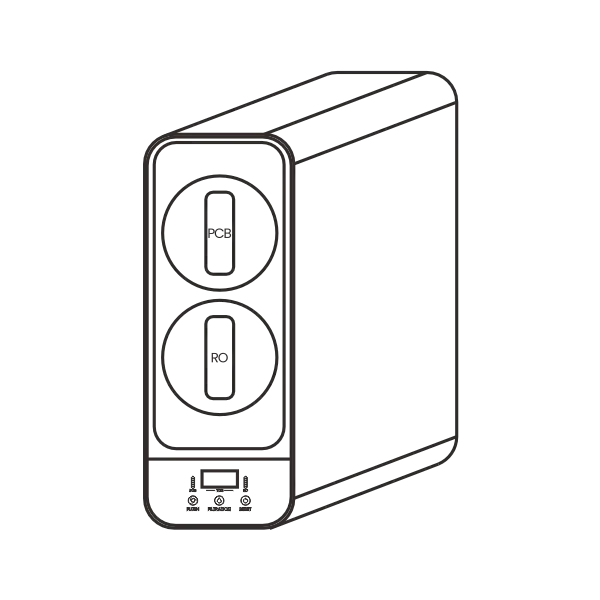
A pump can only push what it receives. If your PCB (Composite) filter is clogged with sediment or rust, it restricts the flow to the booster pump. This “starvation” means the pump takes longer to build the necessary pressure, causing a lag in steady-state filtration. Keeping an eye on filter life—which our smart faucets monitor automatically—is crucial. If you suspect a restriction in your setup, reviewing how to install a water filter faucet correctly can help ensure no lines are kinked, allowing for optimal flow.
Weak or Sticky Solenoid Valves
The inlet solenoid valve actuation is the gatekeeper. When you turn the handle, this electronic valve snaps open to let water in. If this valve becomes sticky due to scale buildup or electrical weakness, it delays the entire start sequence. Instead of an instant “click-and-flow,” you get a hesitation that ruins the user experience metric of on-demand water.
Optimizing for Instant Performance
When we talk about RO System Response Time from Standby to Full Flow, we are really talking about eliminating friction—both mechanical and hydraulic. Achieving instant start RO performance requires fine-tuning every variable that sits between the water main and your glass. Whether you are upgrading a legacy setup or dialing in a modern tankless unit, minimizing hydraulic latency is the key to getting fresh water without the wait.
Using Permeate Pumps on Tank Systems
For those still relying on traditional tank-based setups, the biggest enemy to speed is backpressure. As the storage tank fills, it pushes back against the membrane, slowing down production. Installing a permeate pump is the standard fix here. It utilizes the energy from the wastewater to push purified water into the tank, isolating the membrane from that backpressure. This improves permeate pump efficiency and ensures the system refills faster, though it doesn’t solve the inherent stagnation issues of tank storage.
Dialing in Feed Water Pressure (35+ PSI)
Pressure is the driving force behind reverse osmosis. If your incoming water pressure is too low, the system struggles to overcome the osmotic pressure barrier, leading to a sluggish start.
- Minimum Requirement: We recommend a feed pressure of at least 35 PSI to ensure the internal booster pump doesn’t have to overwork during the RO booster pump ramp-up.
- Sweet Spot: While our Driplife systems function between 14.5 and 58 PSI, operating closer to the upper end of that range guarantees you hit that 600 or 800 GPD flow rate the moment the valve opens.
- Viscosity: Keep in mind that feed water viscosity effects in colder months can naturally slow down flow, making adequate pressure even more critical.
Smart Sensors vs. Mechanical Switches
Speed is often lost in the signal. Old-school RO systems rely on mechanical auto-shutoff valves that depend on physical pressure changes to activate. This creates a noticeable delay. Modern units utilize electronic smart sensors that detect a pressure drop the millisecond the faucet is turned. This digital signal triggers the high-pressure pump instantly, drastically reducing system response time RO compared to the lazy reaction of mechanical switches.
Reducing Friction with Integrated Waterways
The physical design of the system plays a massive role in flow dynamics. Traditional systems use a maze of tubing and connectors, where every bend and fitting creates drag. We utilize an integrated waterway design in our tankless models. By molding the water channels directly into a single manifold, we eliminate dozens of connection points. This reduction in internal friction means the pump’s energy is used strictly for filtration, not pushing water through a labyrinth of tubes. You can understand more about how this internal structure impacts efficiency, ensuring no lag RO delivery and a leak-free experience.
FAQ: Common Questions About RO Lag
Is a 3-second delay normal for tankless RO?
Yes, a slight hesitation is completely normal and expected behavior for tankless RO flow lag. Unlike traditional tank systems that rely on pre-pressurized storage, our tankless units must activate an electric pump the moment the sensor detects demand. That brief 1-to-3-second window is the RO booster pump ramp-up phase, where the system energizes the solenoid and builds enough pressure to push water through the 0.0001-micron membrane. It is a sign that your system is generating fresh water on demand rather than dispensing stale water from a tank.
Does the delay affect water taste?
The mechanical delay does not impact flavor, but the physics of TDS creep in RO systems might be noticeable if the unit has been in standby for a long time. During long periods of inactivity, a small amount of salt can diffuse through the membrane. While our high-performance RO systems are designed to minimize this, we recommend letting the water run for a few seconds after an overnight standby. This flushes the initial volume and ensures the membrane flux stabilization provides the crisp, clean taste you expect.
How do I fix a pulsating RO pump?
A pulsating noise or flow is distinct from startup lag and usually indicates RO system intermittent operation. This “chugging” effect often occurs when the feed water pressure is unstable or if a clogged PCB pre-filter is restricting flow to the pump. First, check the smart indicator on your unit; if the filter life is low, replace it to restore proper flow dynamics. If the filters are new, ensure your home’s water pressure is within the operating range of 14.5–58 psi to prevent the low-pressure switch from cycling the pump on and off.