
















If your tap water tastes like a swimming pool, smells a little “off,” or you’re worried about lead, PFAS, chlorine, and other contaminants, you’re not alone. More people than ever are looking for the best countertop water filter to fix their water without drilling holes, calling a plumber, or breaking their lease.
The good news? A quality countertop water filtration system can give you cleaner, better-tasting water in minutes—right on your counter—whether you live in an apartment, own a home, or need something portable for an office or RV.
In this guide, you’ll see exactly:
- Which countertop water filter types actually remove what (chlorine vs. heavy metals vs. PFAS vs. TDS).
- How to choose between carbon block filters, reverse osmosis countertop systems, and gravity-fed filters.
- What really matters: NSF certifications, filter life, maintenance costs, and long-term value.
- How manufacturers like driplife support both home users and brands with OEM and private label countertop purifiers.
If you want safer, great-tasting water on demand—and you don’t want a complicated installation—this breakdown of the best countertop water filters will show you exactly where to start.
What Is a Countertop Water Filter?
If you’re tired of weird-tasting tap water but don’t want to drill into cabinets or mess with plumbing, a countertop water filtration system is exactly what you’re looking for.
A countertop water filter is a point-of-use filtration system that sits on your kitchen counter and connects directly to your faucet or works as a standalone unit. It cleans your tap water right where you use it, without a permanent installation, special tools, or a plumber. Think of it as a “plug and play water filter” for your sink.
Most countertop water filters fall into three main designs:
- Diverter-style countertop filters
- Connect to your existing faucet with a small diverter valve
- You turn a switch or pull a knob to “divert” tap water through the filter
- Filtered water comes out of a dedicated spout on the countertop unit
- Ideal if you want a no installation water filter with full sink access
- Freestanding countertop water filters
- Sit on the counter and connect via a small tube to the faucet, or use an integrated mini tap
- Often use carbon block water filter cartridges or multi-stage filtration
- Great for renters who want a renter friendly water filter that’s easy to move
- Tank-filled / pour-in countertop filters
- You manually fill a top tank, and gravity pulls water through filters into a lower tank
- No faucet connection needed at all
- Perfect when you need a portable countertop water filter or you’re dealing with low water pressure
The big advantage of a countertop water filtration system is simple:
- No drilling, no permanent install – You keep your security deposit, avoid landlord drama, and skip under-sink gymnastics.
- Fast setup – Most units connect in minutes, using basic adapters that fit standard US faucets.
- Easy to move – Take it with you when you move apartments, travel in an RV, switch offices, or set it up in a dorm.
- Flexible use – Use it in:
- Small apartments with limited cabinet space
- Home kitchens where you don’t want to touch existing plumbing
- Offices where bottled water is getting expensive
- RVs, vacation homes, or dorm rooms that need a no-install, plug and play water filter
In short, a countertop water filter gives you cleaner, better-tasting water at the sink you actually use, without committing to a permanent system. It’s built for real life: renting, moving, sharing spaces, and making the most of whatever tap water you have to work with.
Why Choose a Countertop Water Filter?
If you’re dealing with “city water” that tastes like a pool or well water that looks a bit sketchy, a countertop water filtration system is one of the fastest, lowest-commitment upgrades you can make to your kitchen.
Real Tap Water Problems Most People Notice
Most U.S. homes run into at least one of these:
- Chlorine taste and smell – that “swimming pool” flavor from city disinfection
- Odd odors – metallic, earthy, or “musty” smells from pipes, organics, or sulfur
- Visible sediment – tiny particles, rust flakes, or cloudiness in the glass
- Stale or flat taste – especially in older buildings with old plumbing
A countertop water filter system with a good carbon block can noticeably cut chlorine, improve taste and odor, and trap fine particles so your water actually looks and tastes clean.
Countertop Filters vs Other Home Water Purifiers
Here’s how a countertop water filtration system stacks up against other common options:
| System Type | Install Needed | Performance | Convenience | Typical Cost* |
|---|---|---|---|---|
| Countertop water filter | No drilling, quick hookup | Medium–High (depends on tech) | Very easy daily use | $$ (unit) / $ filters |
| Pitcher filter | None | Low–Medium (mostly taste) | Frequent refills | $ / $$ |
| Faucet mount filter | Small adapter | Medium | Can be bulky on spout | $ / $$ |
| Under-sink filter / RO | Plumbing work | High | Great, but not portable | $$$$ + install |
| Whole-house filter | Pro install | House-wide but broad, not targeted | Set-and-forget | $$$$–$$$$$ |
*Approximate relative ranges, not exact prices.
Key reasons I push no installation water filter systems for most renters and first-time buyers:
- No plumber, no drilling, no messing with your landlord’s fixtures
- Installs in minutes, removes in seconds when you move
- Much better performance than a basic pitcher or faucet mount in most cases
Cost Savings vs Bottled Water
If you’re buying bottled water regularly, a countertop water filter pays for itself fast.
Simple example (per household):
| Item | Approx. Cost |
|---|---|
| 1 bottle of water (16–20 oz) | $1–$2 |
| 1 case/week for a year | ~$300–$600/year |
| Quality countertop filter | ~$80–$300 upfront |
| Filter replacements/year | ~$40–$150 |
Even on the higher end, you usually spend less per year than buying cases of bottles, and you get:
- Unlimited filtered water from your tap
- Better taste on-demand, not just what’s in the fridge
- No hauling cases from the store
If you want a setup that combines chilled, filtered water and compact design, look at modern table-top RO water purifiers similar to those used in table top RO water purifier systems.
Environmental Benefits: Less Plastic, Less Waste
Switching to a countertop water filtration system is one of the easiest eco moves you can make:
- Fewer plastic bottles – cut hundreds (or thousands) of bottles per year
- Less transport and packaging waste – no more shrink wrap, cardboard, or pallets
- Long-life filters – many units use a single cartridge every 6–12 months instead of daily disposables
In short, the best countertop water filter gives you cleaner, better-tasting water, saves serious money over bottled, and dramatically cuts plastic waste—with almost zero hassle to set up or move.
What Makes the Best Countertop Water Filter?
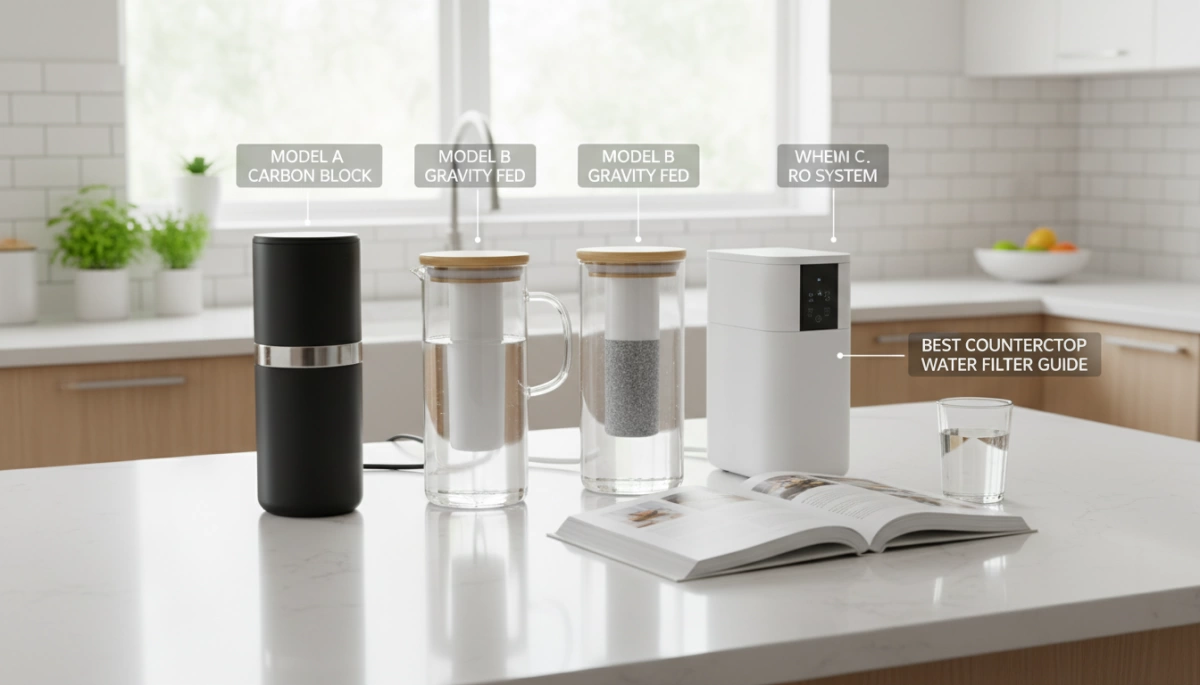
When I’m choosing (or designing) the best countertop water filter, I always look at a few core factors first. These are what actually decide if a system will work for your home long term, not just look good on your kitchen counter.
Filtration Technology Comes First
The heart of any countertop water filtration system is the media inside the cartridge:
- Carbon block water filter
- Best for: chlorine taste and odor, some VOCs, some pesticides.
- Great if your main complaint is “my tap water tastes like a pool.”
- Reverse osmosis countertop system (RO)
- Best for: high TDS, heavy metals, fluoride, PFAS, nitrates, and more.
- If you’re serious about overall purity, a TDS reduction RO system is usually the top choice.
- Multi‑stage filters
- Combine carbon, sediment, and specialty media (like KDF or ion exchange).
- Good balance of performance and cost for most city water.
- Gravity‑fed countertop filters
- Non‑electric, can handle boil advisories or off‑grid use.
- Work well where water pressure is low or you don’t want to connect to a faucet.
Pick the tech based on your water quality and goals, not just marketing claims. For example, if you’re dealing with very high TDS and multiple chemical contaminants, a countertop RO water filter will do a very different job than a simple carbon block unit.
Performance, Certification & Consistency
A home water purifier is only as good as the contaminants it actually reduces:
- Look for real data on:
- Chlorine and chloramine
- Lead, mercury, and other heavy metals
- PFAS, pesticides, and industrial chemicals
- Fluoride (if you specifically want it reduced)
- TDS for RO systems
- Prioritize NSF/ANSI certifications:
- NSF 42 – Aesthetic (taste, odor, chlorine).
- NSF 53 – Health‑related contaminants (lead, cysts, some VOCs).
- NSF 58 – Reverse osmosis system performance (TDS reduction, specific contaminants).
- NSF 401 – “Emerging contaminants” like some pharmaceuticals and PFAS.
For RO buyers, it’s worth learning more about how portable reverse osmosis systems handle TDS and contaminant reduction in real-world use; this guide on portable reverse osmosis systems, benefits & tips breaks it down in plain language.
Flow Rate & Daily Capacity
Good filtration is important, but so is actually being able to fill a pot of water in under five minutes:
- Flow rate
- Diverter‑style carbon systems: usually 1–2 GPM.
- Countertop RO: often 0.3–0.8 GPM (slower but more thorough).
- Gravity systems: drip-style, so expect slower output.
- Daily capacity
- Check how many gallons per day the system is designed to handle.
- For a family, I usually aim for 50–100+ gallons per day rated capacity, even if you won’t hit that daily—this keeps performance stable.
If you cook a lot, make coffee/tea all day, or have kids refilling bottles nonstop, don’t underestimate flow rate and capacity. Slow filters tend to get “ignored” and people slip back to unfiltered tap or bottled water.
Filter Lifespan & Ongoing Costs
The best countertop water filter for apartments or homes has to be affordable to run, not just cheap to buy:
- Check filter cartridge lifespan:
- Carbon: commonly 3–12 months, depending on size and quality.
- RO membranes: often 1–2 years, with pre/post filters swapped more often.
- Look at cost per gallon, not just sticker price:
- Add up replacement filter costs over 1–3 years.
- Pay attention to:
- Easy access to replacement filters in the US
- Clear indicators (time-based, LED, app, or manual tracking)
If filters are hard to find or too expensive, people stretch them too long—and performance drops, especially for heavy metals and PFAS.
Ease of Installation & Everyday Use
For a renter friendly water filtration setup, “no tools, no drilling” matters a lot:
- Diverter‑style countertop filters:
- Screw onto your faucet; switch between tap and filtered water with a knob.
- Good “plug and play water filter” option for most standard kitchen faucets.
- Freestanding or tank‑filled units:
- Some RO and gravity systems just sit on the counter and only need power (for RO) or filling (for gravity).
- Perfect no installation water filter for offices or dorms.
- Check:
- How fast and clean you can swap filters
- Whether it fits non‑standard faucets (or comes with adapters)
- If your landlord will be okay with any temporary connections
If it’s annoying to use, you’ll stop using it. The best system is the one you and your family actually stick with every day.
Design, Size & Fit in Your Kitchen
A kitchen counter water purifier needs to match how you actually live:
- Footprint & height
- Will it fit under upper cabinets?
- Does it crowd your microwave, coffee maker, or air fryer?
- Tank size (for RO or gravity systems)
- Bigger tanks mean fewer refills but more counter space.
- BPA‑free materials
- I always make sure housings and tanks are BPA free and made from food‑grade materials.
- Look and layout
- In modern US kitchens, style matters. Stainless, white, black, or minimal designs blend in better with most appliances.
If you’re in a small apartment or condo, a portable countertop water filter with a slim profile can make a huge difference—it gives you clean water without sacrificing precious counter space.
Types of Countertop Water Filters
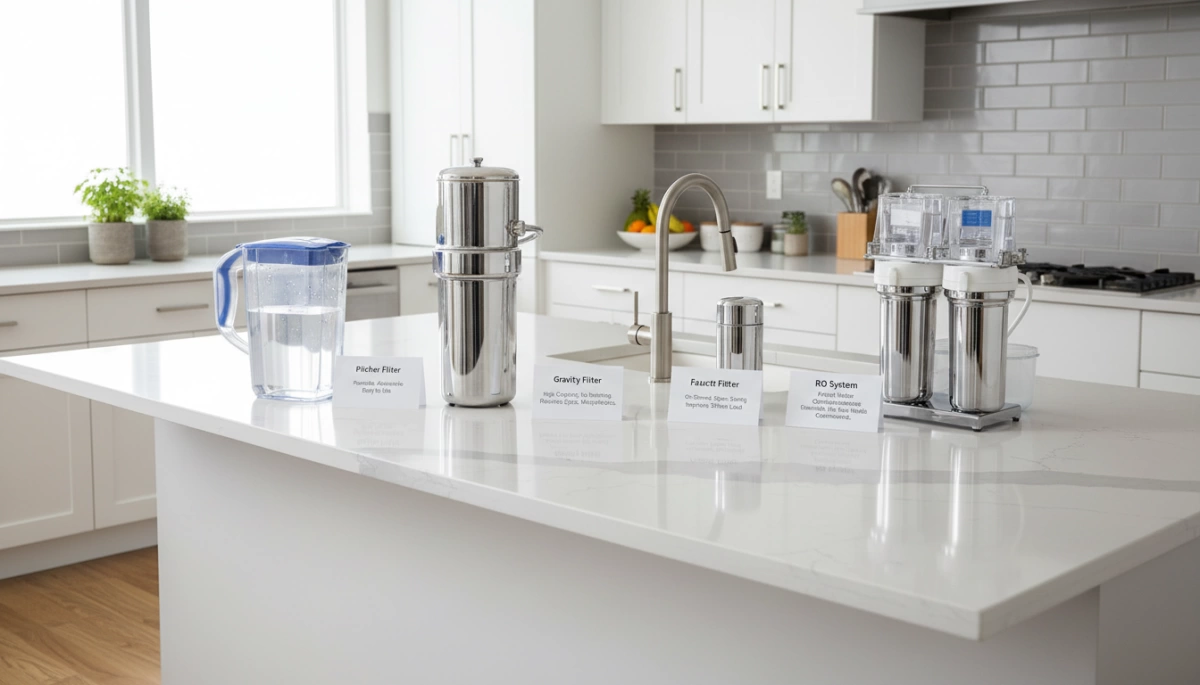
When you’re hunting for the best countertop water filter, it really comes down to picking the right type for your water quality, budget, and kitchen setup. Here’s how the main countertop water filtration system options break down.
Carbon Block Countertop Filters
Best for: City water, better taste, chlorine, and everyday use.
A carbon block water filter sits on your counter and connects to your faucet with a small hose or diverter. Inside, a dense carbon block grabs onto chemicals and impurities as water passes through.
What they’re good at
- Chlorine taste and odor removal
- Reducing many volatile organic compounds (VOCs)
- Improving overall taste and smell so tap water actually feels “clean” to drink
Pros
- Very budget friendly countertop water filter option
- Simple, no installation water filter (great for renters and apartments)
- Good flow rate for drinking, coffee, cooking
- Compact and easy to move if you change apartments
Cons
- Not designed for TDS reduction (total dissolved solids)
- Limited against tougher contaminants like fluoride or very high PFAS and heavy metals unless combined with extra stages
- Works best on treated city water, not harsh well water on its own
Countertop Reverse Osmosis (RO) Systems
Best for: High TDS, heavy metals, PFAS, fluoride, and more serious water issues.
A reverse osmosis countertop system pushes water through a semi-permeable membrane that screens out very small particles and dissolved solids. These units usually sit on the counter, connect to the faucet, and often include a small storage tank.
What they’re good at
- Serious TDS reduction RO system performance
- Strong reduction of lead, arsenic, chromium, and many PFAS
- Often great for fluoride reduction when properly designed
Pros
- Some of the highest contaminant removal you can get in a countertop unit
- Ideal if your water report shows multiple issues (metals, chemicals, high TDS)
- Solid upgrade if you’re thinking countertop RO vs under sink RO but don’t want drilling or plumbing work
Cons
- Higher upfront cost vs basic carbon units
- Waste water during the RO process (common to all RO systems)
- Slower flow; you usually fill bottles or a jug instead of running it like a faucet
- More filters to replace over time
If you want to go deeper into how RO works and why it’s so popular for home use, I break it down in this guide on the benefits of reverse osmosis water for home: benefits of reverse osmosis water for home.
Gravity-Fed Countertop Water Filters
Best for: Off‑grid, emergency use, low water pressure, and simple setups.
A gravity fed countertop filter is a non-electric water filter with an upper tank and a lower tank. You pour water into the top, gravity pulls it through one or more filters, and clean water collects in the bottom.
What they’re good at
- Emergency prep, cabins, RVs, and areas with unreliable tap pressure
- Slow but thorough filtration with large capacity
- Great when you don’t want to hook up to a faucet at all
Pros
- No power, no plumbing, no pressure needed
- Often large volume for families
- Works well as a backup or off‑grid kitchen counter water purifier
Cons
- Slower filtration rate; you need to think ahead and keep the tank filled
- Tall units can take up more counter or sideboard space
- Performance depends heavily on filter quality and design
Multi-Stage & Hybrid Countertop Systems
Best for: People who want balanced performance (taste + safety) in one system.
Multi-stage and hybrid countertop water filtration system setups combine several technologies in one unit—for example, carbon block + sediment filter + RO membrane + post-carbon polishing. These are often the most “complete” home water purifier options in countertop form.
What they’re good at
- Tackling both basic taste/odor issues and serious contaminants
- Tailored solutions (e.g., adding fluoride or lead-specific media)
- Serving as a high capacity countertop water filter for families
Pros
- Flexible design that can be tuned to your local water issues
- Better overall contaminant coverage than single-stage filters
- Strong fit for families, apartments, and office water purification
Cons
- Higher price compared with basic carbon units
- More complex filter replacements and maintenance
- You need to pay attention to replacement schedules to keep performance up
Quick Pros & Cons by Water Type and Budget
If your tap water is generally safe city water and you just hate the taste:
- Go for a carbon block countertop filter
- Lowest cost, fastest install, very renter friendly
If your water report shows high TDS or heavy metals:
- Consider a countertop RO water filter or a multi-stage hybrid with RO
- Higher upfront cost, but far better contaminant removal
If you’re off‑grid, on a well, or want backup for emergencies:
- Look at a gravity water filter with solid multi-stage cartridges
- No electricity or pressure needed, good for long-term storage
If you’re planning to build or private-label your own portable countertop water filter line, working with a professional water filter supplier that understands U.S. buyer expectations and NSF standards is crucial. You can see how we support brands as a water filter supplier here: professional water filter supplier solutions.
Top Countertop Water Filters Compared
When people ask me for the best countertop water filter, I always break it down by facts: what it removes, how long it lasts, and what it costs to live with over time. Here’s a quick side‑by‑side so you can see the differences in one shot.
Countertop water filter comparison table
| Model Type | Typical Price Range | Key Tech / Stages | Main Contaminants Targeted | NSF/ANSI* Focus | Filter Life (Est.) | Best For |
|---|---|---|---|---|---|---|
| Entry-Level Carbon Block Countertop | $60 – $120 | Single / dual carbon block | Chlorine, taste & odor, some VOCs | 42, 53 (varies by brand) | 3–6 months / 300–600 gal | Better taste on city water, tight budgets |
| Mid-Range Multi-Stage Countertop | $120 – $250 | Sediment + carbon + specialty media | Chlorine, lead, some PFAS, some heavy metals | 42, 53, some 401 | 6–12 months / 600–1,000 gal | Most households, renters, small offices |
| Premium Countertop RO System | $250 – $600 | RO membrane + pre/post carbon + options | TDS, heavy metals, fluoride, PFAS, nitrates, more | 58 + 42/53 (varies) | 12–24 months (stages differ) | High TDS, well water, serious filtration |
| Gravity-Fed Countertop Filter | $150 – $400 | Gravity + ceramic / carbon block | Sediment, bacteria**, chlorine, some metals | Some 42/53 (brand-specific) | 6–12 months / 1,000+ gal | Off-grid, emergencies, low water pressure |
*Look for specific NSF/ANSI listings on each product label.
**Depends heavily on brand and element type.
Side‑by‑side: contaminant removal, certification, filter life
Entry-Level Carbon Block Countertop Filters
- Strengths:
- Solid chlorine removal filter for better taste and smell
- Simple no-installation water filter setup
- Good value if your city water is already treated
- Limitations:
- Limited protection for lead, PFAS, and fluoride
- Filter changes every few months if your family drinks a lot
Mid-Range Multi‑Stage Countertop Filters
- Strengths:
- Multi‑stage media gives broader coverage (chlorine, lead, some PFAS, VOCs)
- Longer filter life and better flow for everyday use
- Often NSF certified water filters under multiple standards
- Limitations:
- Still not a full solution for very high TDS or problem well water
- More expensive cartridges than basic carbon units
Premium Countertop RO Systems
- Strengths:
- True TDS reduction RO system that cuts salts, metals, fluoride, and many chemicals
- Great for PFAS reduction, nitrates, arsenic, and other stubborn contaminants
- Often lab-tested with detailed reverse osmosis removal data you can review
- Limitations:
- Higher upfront cost
- RO wastes some water; slower output than straight carbon
- You’ll replace pre/post filters more often than the RO membrane
Gravity-Fed Countertop Filters
- Strengths:
- Non-electric water filter – works during outages, camping, or off-grid
- High-capacity elements that can run for thousands of gallons
- Flexible countertop water filtration system for cabins and RVs
- Limitations:
- Slower; you “batch fill” the top tank
- Performance and certifications vary widely by brand
Best countertop water filter by budget
1. Best Budget / Entry-Level
- Who it fits: Small households, apartments, students, light water drinkers
- What to look for:
- Solid carbon block water filter with NSF/ANSI 42 for chlorine
- Simple diverter‑style or freestanding apartment water filter
- Low-cost replacement cartridges with clear gallon ratings
2. Best Mid‑Range All‑Rounder
- Who it fits: Typical families, offices, renters who drink a lot of water
- What to look for:
- Multi‑stage system with sediment + carbon + heavy‑metal media
- NSF/ANSI 42 + 53 (and ideally 401 for emerging contaminants)
- 600–1,000 gallon capacity and easy plug and play water filter setup
3. Best Premium / High-Contaminant Option
- Who it fits: Homes with high TDS, questionable wells, or specific contaminants
- What to look for:
- Reverse osmosis countertop system with at least 3–4 stages
- Documented reduction of PFAS, fluoride, heavy metals, and nitrates
- Strong support docs, including clear stage descriptions (like this breakdown of RO filter elements and what each stage does)
- Higher capacity and reasonable wastewater ratio
If you’re in the U.S., my usual rule is simple:
- On treated city water and just hate the taste? Go mid‑range carbon / multi‑stage.
- On well water or high TDS with real contaminant concerns? Go premium countertop RO and check the lab reports before you buy.
Best Countertop Water Filter for Your Needs
When you’re trying to pick the best countertop water filter, you shouldn’t start with the product—you should start with how you actually use water every day. Below, I’ll break it down by real-life use cases so you can match the right countertop water filtration system to your needs, budget, and kitchen setup.
Best countertop filter for better taste and smell
If your main issue is chlorine taste, odd smells, or slightly cloudy water, you don’t need to overpay for RO.
What to look for:
- Carbon block water filter (not just granular carbon)
- Certified chlorine removal filter (NSF/ANSI 42)
- Flow rate around 0.5–1.0 GPM so you’re not waiting on a glass of water
- Simple, no installation water filter design—diverter-style or freestanding
Why this works:
- Carbon block is great for taste, odor, and basic chemical reduction
- Affordable upfront and cheap filter changes
- Ideal as a kitchen counter water purifier for most city tap water
If you’re in an apartment or small home and mainly care about taste and smell, a compact countertop carbon filter is the most cost-effective choice.
Best countertop filter for high TDS, heavy metals, PFAS, or fluoride
If your water has high TDS, potential PFAS, lead, or you want fluoride reduction, you should be looking at a reverse osmosis countertop system.
What to look for:
- True TDS reduction RO system (not just “RO-like”)
- NSF certified water filter claims for lead, PFAS, and other contaminants
- Multi-stage: sediment + carbon + RO membrane + polishing filter
- Clear performance data showing % reduction for specific contaminants
This type of countertop RO water filter pulls out:
- Heavy metals (lead, arsenic, chromium)
- PFAS and other “forever chemicals”
- Fluoride
- Most dissolved solids (TDS), which improves taste and clarity
If you want premium performance with plug-and-play convenience, a high-end countertop reverse osmosis water purifier like a 3-in-1 RO cold and hot water system (for example, a unit similar in concept to this countertop 3-in-1 RO cold and hot water purifier) is the sweet spot for U.S. homes dealing with multiple contaminants.
Best countertop water filter for families & high daily use
For families, you care about capacity, speed, and low hassle.
What to prioritize:
- High capacity countertop water filter (2,000–6,000+ gallons per filter)
- Strong flow rate so filling pots, bottles, and pitchers isn’t a chore
- Easy-to-read filter life indicators (LED or app-based is a bonus)
- Durable, BPA free countertop filter housing for everyday use
- Simple twist-off or slide-out filter cartridges
Ideal setups for families:
- Multi-stage carbon block countertop systems for city water
- Countertop RO systems if your local water report flags multiple contaminants
If you’re cooking a lot, filling water bottles for kids, or running a home office, invest in a home water purifier that balances high flow, long filter life, and low maintenance.
Best portable or travel-friendly countertop water filter
If you move often, travel in an RV, or split time between locations, you want a portable countertop water filter that’s:
- Compact and lightweight
- Easy to connect/disconnect (or completely freestanding)
- Compatible with common U.S. faucets or usable as a non-electric water filter
Good options:
- Small gravity fed countertop filter for off-grid or RV trips
- Compact diverter-style systems you can toss in a bag
- Travel-friendly units similar to a portable hydrogen-rich water bottle or cup concept, like this style of portable hydrogen-rich water cup, if you want personal hydration on the go
If you’re on the road or in temporary housing, prioritize portability and quick setup over max capacity.
Best renter-friendly countertop filtration for small kitchens
For renters and small-city apartments, a renter friendly water filter must:
- Require no drilling and no permanent modifications
- Offer plug and play water filter installation (attach to faucet or stand alone)
- Have a small footprint for tight counters
- Look clean and modern—your filter is basically part of your kitchen decor
Top picks by style:
- Diverter-style countertop filters: great if you have a standard faucet and want instant on/off control
- Self-contained RO countertop systems: perfect when you want premium purification with zero plumbing work
- Slim gravity filters: ideal when you have limited pressure or want total independence from the faucet
If you’re in an apartment or dorm, the best countertop water filter for apartments is one you can set up in minutes, remove without leaving a mark, and move with you when you upgrade your place.
Installation and Maintenance Tips for the Best Countertop Water Filter
Keeping a countertop water filtration system running smoothly comes down to a clean setup, proper priming, and simple, consistent maintenance. Here’s how I handle it so the water always tastes right and the flow stays strong.
Step-by-Step Setup: Diverter-Style Countertop Filters
For a diverter-style, no installation water filter that hooks to your faucet:
- Check your faucet type
- Works best with standard, removable aerator faucets.
- If you have a pull-out/pull-down sprayer, you may need an adapter or a freestanding unit instead.
- Remove the faucet aerator
- Unscrew the tip of the faucet (where the water comes out).
- Clean off any old debris or scale before installing the diverter valve.
- Install the diverter valve
- Screw the diverter valve onto the faucet by hand.
- Use the included adapters if the thread doesn’t match.
- Hand-tight is usually enough—don’t over-tighten.
- Connect the tubing to the countertop water filter system
- Push the tubing firmly into the inlet port until it seats fully.
- Place the unit where it’s stable and easy to access on your counter.
- Check for leaks
- Turn on cold water slowly.
- Flip the diverter to send water into the filter.
- If you see drips, turn off water, re-seat the connections, and try again.
If you’re not comfortable with faucet hookups at all, a freestanding, tank-filled system might be easier.
Setup Tips: Freestanding Countertop Filters
For gravity-fed or tank-style countertop water filters:
- Rinse all parts
- Rinse upper and lower tanks, lids, and spigots in clean tap water.
- Hand wash with mild soap if needed, then rinse thoroughly.
- Install filter elements
- Screw or press filters into the upper chamber as directed.
- Make sure gaskets are seated properly to avoid bypass and leaks.
- Set the unit in place
- Choose a flat, stable area on the counter with enough clearance to fill the top tank.
- Test the spigot to make sure it opens and closes smoothly.
- Fill and check
- Fill the upper tank with cold water and check for leaks around the spigot and filter ports.
How to Flush and Prime New Countertop Filters
New filters always need flushing to clear carbon dust and air pockets:
- Carbon block filters
- Run cold water through the system with the diverter engaged for 5–10 minutes.
- Expect gray or cloudy water at first; that’s normal carbon dust.
- Don’t drink until the water runs clear and the air spurts stop.
- RO countertop systems
- Follow the manufacturer’s first-use flush (often 1–3 full tank cycles).
- Discard the first batches—this clears preservatives and air from the membrane.
- Gravity-fed filters
- “Prime” each element under running water if the instructions require it.
- Fill the upper chamber and discard the first full batch of filtered water.
If you’re also considering other point-of-use options like faucet filters, you might find this step-by-step faucet water filter installation guide helpful because the process is similar.
How Often to Replace Countertop Filters
Filter life depends on your water quality, usage, and filter type:
- Typical replacement ranges
- Carbon block: every 3–6 months or around 300–800 gallons.
- RO pre-filters: every 6–12 months.
- RO membranes: every 2–3 years with normal use.
- Gravity filters: around 6–12 months or as specified by gallons.
- Signs it’s time to change
- Noticeably slower flow rate.
- Taste or odor returns (chlorine, musty, or metallic).
- Visible sediment or discoloration in the housing.
As a rule, I tell customers: follow the gallon rating or the time limit—whichever comes first, especially if you’re filtering city water with a lot of chlorine or sediment.
Simple Maintenance Routines for Consistent Flow and Taste
To keep your countertop water filter performing like new:
- Monthly quick checks
- Wipe down the housing and tubing with a damp cloth.
- Check for leaks at the diverter, tubing, and connections.
- Make sure the unit is sitting level and secure.
- Every 1–3 months
- For gravity units, clean the upper and lower tanks with mild soap, then rinse well.
- For RO systems, wipe the exterior and check the tubing for kinks.
- Never use harsh chemicals or abrasive cleaners inside the system.
- Every filter change
- Clean the inside of housings and tanks before installing the new filter.
- Inspect O-rings and gaskets; replace if cracked or flattened.
These small, regular steps keep the water tasting fresh and protect your investment in a high-capacity countertop water filter.
Troubleshooting Common Countertop Water Filter Issues
If something feels off, it’s usually something simple. Here’s how I walk through it:
1. Low water pressure or slow flow
- Check if the filter is at the end of its life.
- Make sure the faucet is fully open and the diverter is in the correct position.
- Inspect tubing for kinks or sharp bends.
- For gravity systems, confirm the upper tank is at least half full.
2. Leaks at the faucet or connections
- Make sure the diverter valve is hand-tight and straight.
- Check for missing or damaged rubber washers.
- Reseat the tubing by pushing it firmly into quick-connect fittings.
- Avoid using plumber’s tape unless the manufacturer specifically recommends it.
3. Off-taste or odor after installation
- Confirm you fully flushed and primed the new filters.
- If you haven’t used the system for several days, flush 1–2 minutes before drinking.
- If taste still seems off after proper flushing, the filter may be defective or not matched to your local water (for example, heavy sulfur well water may need a specific media).
4. Air in the lines or sputtering water
- Normal after installing a new filter or moving the system.
- Just run water for a few minutes until the sputtering fades and flow stabilizes.
- For gravity filters, gently tap the housing to release trapped air bubbles around the cartridges.
Keep these steps handy, and your countertop water filter system will stay renter friendly, low-maintenance, and reliable—without needing a plumber or a full under-sink install.
driplife: Premium Countertop Water Filters from a Trusted Manufacturer
At driplife, I focus on one thing and doing it well: building reliable, high-performing countertop water filtration systems that brands and importers can trust for the long haul. We’re a specialized Chinese countertop water filter manufacturer and supplier, and our entire setup—engineering, materials, and production—is built around the growing demand for the best countertop water filter options in the U.S. and global markets.
Specialist in Countertop Water Filtration Systems
Because we’re focused on countertop units instead of “everything water,” we’re able to:
- Design no-installation water filters that are truly plug-and-play for apartments, offices, and rentals
- Optimize countertop water filtration system performance around real-world U.S. use: chlorine-heavy city water, taste and odor complaints, emerging contaminants like PFAS
- Support ongoing product performance with documented testing, detailed specs, and post-sale help through our technical support resources
This focus is why many of our OEM and private label partners position their models as the best countertop water filter for apartments, small kitchens, and offices.
Key Technologies and Materials We Use
To keep our partners competitive, we build countertop systems around proven, upgradeable tech:
- Carbon block water filters for chlorine, taste, odor, and many VOCs
- Multi-stage filter cartridges combining sediment, carbon, and specialty media for lead, PFAS, and heavy metal reduction
- Countertop RO system designs with TDS reduction, optional remineralization, and smart flow control
- BPA-free countertop filter housings and food-grade wetted materials, designed to meet key international standards
Every design is built with OEM flexibility in mind, so you can tune performance, stages, and aesthetics to your target market.
Core Product Lines for Homes, Offices & Small Commercial
We’ve developed several countertop lines that cover most U.S. use cases:
- Home & apartment countertop water filters – compact footprints, modern styling, easy filter swaps, ideal for renters and small kitchens
- Office countertop water purifiers – higher daily capacity, stronger housings, options to pair with hot or sparkling dispensers (ideal next to an instant hot water faucet system)
- Small commercial countertop systems – for salons, clinics, coworking spaces, and boutique food/beverage settings needing consistent, filtered water on the counter
Each line can be configured as basic carbon, multi-stage, or RO-based depending on your positioning and price point.
Why Importers and Brands Choose driplife Long-Term
Importers, DTC brands, and distributors stay with driplife because we make it easier to build and maintain a profitable countertop filtration category:
- OEM & private label ready – custom branding, packaging, and even housing molds for a truly owned product line
- Stable quality and repeatable batches – strict quality control, aging tests, and performance verification on core models
- Certification support – assistance with NSF-style test reports, documentation, and compliance support for your target market
- Scalable production capacity – from test batches to large, recurring orders without changing specs or cutting corners
If you’re building or expanding a countertop water filtration system lineup and want a manufacturing partner that actually specializes in this category, driplife is built for exactly that.
OEM & Private Label Countertop Water Filters with driplife
If you’re looking to launch or scale a countertop water filtration line under your own brand, driplife makes it simple to plug into a proven supply chain. As a specialized Chinese countertop water filter manufacturer and supplier, I focus on building OEM and private label countertop water filters that are ready for the U.S. market—both from a performance and branding point of view.
OEM & Private Label Countertop Water Filter Options
I offer full OEM and private label support for a wide range of countertop water filtration systems, including:
- Countertop carbon block water filters for basic taste, odor, and chlorine reduction
- Countertop reverse osmosis (RO) systems for high TDS, PFAS, fluoride, and heavy metal reduction
- Gravity-fed countertop filters for off-grid, emergency, or low-pressure use
- Multi-stage hybrid countertop filters that combine carbon, sediment, and specialty media
You can choose from existing driplife platforms or fully customized designs, depending on how unique you want your product line to be in the home water purifier and apartment water filter segments.
Custom Branding, Design & Filtration Configuration
My goal is to give your brand a product that looks and performs like it was built just for you. I support:
- Custom branding
- Full-color logos, labels, and packaging
- Brand-specific user manuals and quick-start guides
- Matching branding across countertop, under-counter, and other systems (for brands with full lines)
- Custom housing design
- Different shapes, footprints, and finishes to fit small kitchens, office break rooms, and RVs
- BPA-free countertop filter housings, with options for premium materials and finishes
- Tailored “no installation water filter” designs for renters and DTC brands focused on simplicity
- Custom filter stage configuration
- 1–5 stage setups (sediment, carbon block, KDF, RO membrane, remineralization, etc.)
- Targeted media blends for lead removal, PFAS reduction, and fluoride reduction
- Configurations tuned for high TDS water, city water with strong chlorine taste, or light well water polishing
If your brand is focused on fluoride treatment, I can align countertop models with the types of solutions discussed in this guide to the best fluoride water filters and their efficiency.
Manufacturing Capabilities, QC & Certification Support
Behind every private label countertop purifier, there has to be reliable manufacturing and quality control. That’s the backbone of what I offer:
- Manufacturing capabilities
- High-volume production for national retailers and subscription-based DTC brands
- Flexible MOQs for new product launches or test markets
- Scalable capacity for seasonal peaks and promotional campaigns
- Quality control & testing
- Incoming material inspection, in-line production checks, and final performance testing
- Batch tracking to support retailer and regulatory requirements
- Consistency across every run, so your customers get the same taste and flow rate every time
- Certification support
- Engineering designs aligned with NSF/ANSI standards for chlorine, lead, and structural integrity
- Documentation support to help your team or third-party labs complete NSF or other compliance testing
- Manufacturing and process controls built around export requirements for the U.S. and other key markets
How Retailers, DTC Brands & Distributors Work with driplife
Whether you sell on Amazon, run your own DTC site, or supply regional dealers, I set up the OEM countertop water filter program around your channel:
- Retailers & big-box
- Shelf-ready packaging, barcodes, and planogram-friendly designs
- Multiple price tiers (budget friendly countertop water filter up to premium RO systems)
- DTC and subscription brands
- Branded replacement filter programs with predictable margins
- Compact, renter friendly water filtration systems optimized for parcel shipping
- Distributors & wholesalers
- Bulk countertop water filter production with stable lead times
- Support for private label lines across home, office, and light commercial applications
From initial concept and CAD housing design to filter media selection and final packaging, I treat every OEM and private label countertop water filtration system as if it were my own brand—because my reputation is tied to your success.
Frequently Asked Questions About the Best Countertop Water Filter
Carbon vs. RO Countertop Filters: Which Should I Pick?
It depends on your water and your goals:
- Pick a carbon block countertop water filter if:
- Your main complaints are chlorine taste, odor, and mild discoloration
- You’re on treated city water with no major contamination issues
- You want no installation, low cost, and faster flow
- You don’t care about lowering TDS (total dissolved solids)
- Pick a reverse osmosis (RO) countertop system if:
- You need strong reduction of TDS, heavy metals, PFAS, fluoride, nitrates, or unknown contaminants
- You live near industrial or agricultural areas or have older plumbing (lead risk)
- You want water that’s as clean as possible for kids, immunocompromised family members, or baby formula
If your budget allows and your water is questionable, I always lean toward a countertop RO water filter plus a small post-carbon stage for taste.
Do Countertop RO Systems Waste Water and Strip Minerals?
Yes, but there’s context:
- Wastewater (reject water):
- Most TDS reduction RO systems send some water down the drain to flush away contaminants
- Typical ratio: 2–4 gallons waste per 1 gallon purified (newer models can be better)
- You can reuse reject water for toilet flushing, mopping, or some outdoor use to reduce waste
- Mineral removal:
- RO removes many dissolved minerals (calcium, magnesium, etc.), so TDS drops significantly
- For most people in the U.S., losing these minerals is not a health issue if diet is normal
- If you care about taste or mineral content, choose a remineralization filter stage after RO
If you want more background on why filtration matters, I recommend reading about why a water filter is important in daily life on driplife’s site: why water filter important.
Are Countertop Filters Safe for Well Water or Only City Water?
You can use a countertop water filtration system for well water, but you need to be more careful:
- Good use cases for well water:
- Carbon + sediment stages to reduce iron taste, sulfur smell, and particles
- RO systems for nitrates, arsenic, or high TDS, if the well is otherwise microbiologically safe
- Important precautions:
- Many countertop systems do NOT disinfect; they’re not a substitute for a UV system or chlorine shock if your well has bacteria
- You should get a lab test (not just a cheap strip test) if you’re on a private well
- Check that the manufacturer explicitly says the unit is suitable for well water
If your well has bacteria or coliform, fix that at the source first with disinfection or whole-house treatment, then polish with a countertop filter.
How Long Do Countertop Filters Last and What Voids the Warranty?
Lifespan depends on the type and your usage:
- Typical filter lifespans:
- Carbon block countertop filters: 3–12 months or 300–1,000+ gallons
- RO membranes (in a reverse osmosis countertop system): 18–36 months with proper pre-filtration
- Sediment pre-filters: 3–6 months, sometimes less on dirty water
- What often voids the warranty:
- Using the filter beyond the rated life or ignoring replacement reminders
- Running hot water through the unit
- Using the system on unsafe well water with iron, sediment, or bacteria way above spec
- DIY modifications, non-original filters, or improper installation
- Freezing, dropping, or otherwise physically damaging the housing
Check the warranty terms; I design and position my systems so maintenance is straightforward and you’re not guessing when to change filters.
What Should I Check in My Local Water Report Before Choosing a Filter?
Before you pick the best countertop water filter for your home, pull your local Consumer Confidence Report (CCR) from your water utility (or use an online database). Focus on:
- Disinfectants & byproducts:
- Chlorine / chloramine, THMs, HAAs → carbon block filter is key
- Metals:
- Lead, copper, arsenic → certified lead reduction or RO system
- PFAS & emerging contaminants:
- Look for PFAS, PFOA, PFOS → choose a filter with tested PFAS reduction
- TDS level:
- High TDS (often above ~300–400 ppm) → consider a TDS reduction RO system
- Hardness & scaling:
- Very hard water → RO or at least scale-resistant components
Match your countertop water filtration system to the actual issues in that report, not just marketing claims. That’s how you end up with the right mix of performance, cost, and peace of mind.