












What Is TDS in Water?
When people ask if they need a TDS water filter, they’re really asking what’s actually dissolved in their drinking water and whether they should remove it.
What Does TDS Stand For?
TDS stands for Total Dissolved Solids.
In plain language, it’s the total amount of dissolved substances in your water that you can’t see:
- Minerals
- Salts
- Metals
- Organic matter
TDS is a quick way to estimate how “mineral-heavy” or “clean” your water is before using a total dissolved solids water filter or RO system.
What Makes Up TDS in Tap Water?
Most tap water in the U.S. has TDS from natural and man-made sources, including:
- Dissolved minerals: calcium, magnesium, potassium, sodium
- Inorganic salts: chlorides, sulfates, bicarbonates, nitrates
- Trace metals: iron, manganese, sometimes copper or lead (from plumbing)
- Other components: small amounts of organics from soil, pipes, or treatment chemicals
Some of these are beneficial minerals, others are just buildup-causing hardness, and a few can be unwanted contaminants if levels are high. This is why people look for a water filter that reduces TDS or a TDS water filter system rather than guessing.
How TDS Is Measured (ppm) and Why It Matters
TDS is usually measured in ppm (parts per million) or mg/L (milligrams per liter).
Most home users check it with a TDS meter for home water testing:
- Low TDS: 0–100 ppm – very low mineral content
- Moderate TDS: 100–300 ppm – common
Is High TDS in Water a Problem?
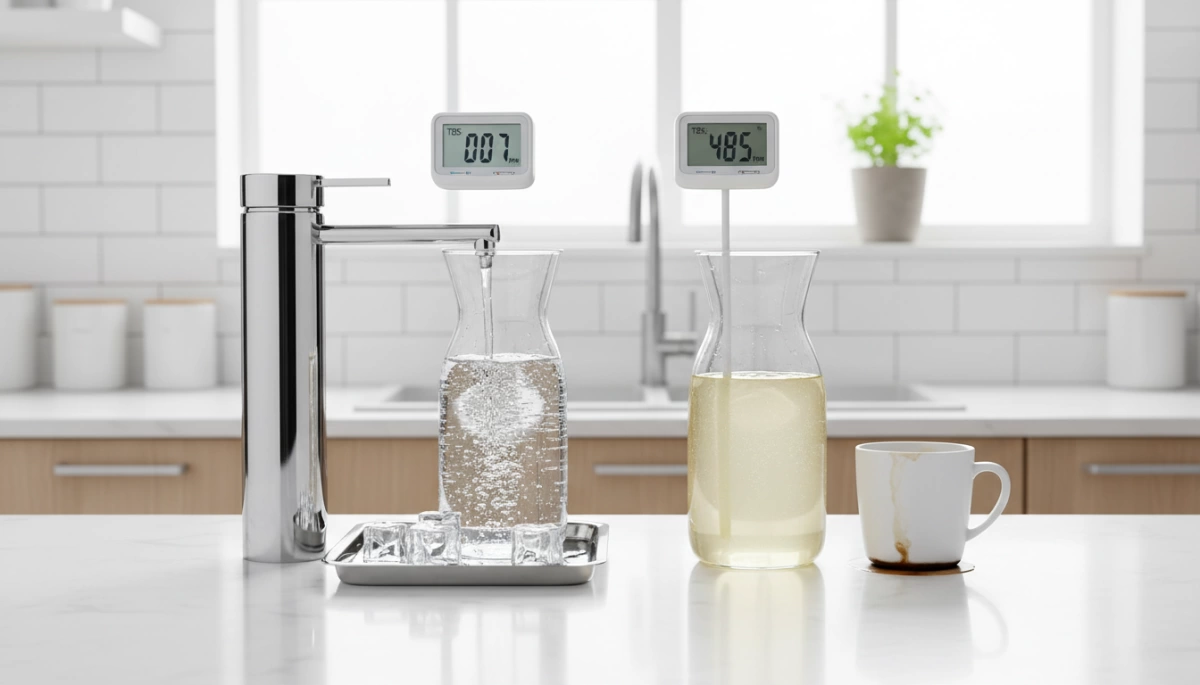
Acceptable TDS Levels in Drinking Water (ppm)
TDS (total dissolved solids) is usually measured in ppm (parts per million). For most U.S. homes, these ranges are a good rule of thumb:
- 0–50 ppm – Very low TDS, often RO or distilled water; can taste “flat”
- 50–150 ppm – Ideal range for drinking water for most people
- 150–300 ppm – Generally acceptable, common in many U.S. cities
- 300–500 ppm – Still usable but you may notice taste and more scale
- >500 ppm – Many people start looking for a TDS water filter system
- >1000 ppm – Too high for normal drinking; you need treatment (often RO)
The safe TDS level for drinking water depends on your taste and plumbing, but once you’re above 500 ppm, it usually makes sense to think about high TDS water solutions like reverse osmosis.
TDS vs Water Safety and Health
This part confuses a lot of homeowners, so I’ll keep it straight:
TDS does NOT automatically mean unsafe water.
A higher TDS number might just mean more calcium, magnesium, and bicarbonates (common in hard water).TDS meters don’t tell you what’s in the water, only how much is dissolved.
You can have:- High TDS but safe (just mineral-rich)
- Low TDS but unsafe (if there’s bacteria, lead, PFAS, etc.)
If your main concern is health and safety, you still need proper filtration and sometimes a full water test, not just a TDS reading. A good starting point is using a drinking water filter for everyday use and then testing if something seems off with smell or color. For example, pairing a TDS meter with a solid drinking water filter setup can cover both taste and basic quality.
How TDS Affects Taste, Odor, and Scale Buildup
Where TDS really shows up is in taste, odor, and how your home appliances age:
Taste
- 50–250 ppm: Often tastes “fresh” and balanced
300 ppm: Can taste salty, bitter, or metallic
- Very low TDS (<30 ppm): Can taste “empty” or flat
Odor
- TDS itself is often odorless
- But minerals and related issues (like sulfates or iron) can cause metallic or “rotten egg” smells
Scale and buildup
- Higher TDS, especially calcium and magnesium, means:
- White crust on faucets and showerheads
- Scale inside kettles, coffee makers, and water heaters
- Reduced efficiency and shorter life for appliances
- Higher TDS, especially calcium and magnesium, means:
If your main complaint is bad taste and scale, a water filter that reduces TDS (like RO or ion exchange) can make a big difference in both drinking experience and maintenance. For kitchens that also need chilled drinking water, people often pair TDS filtration with chilled water dispensers for home use to get both comfort and better taste in one setup.
Do All TDS Water Filters Reduce TDS?
Not every “water filter” is a TDS water filter. Most basic filters improve taste and odor, but they barely touch total dissolved solids (TDS).
Filters That Do NOT Significantly Reduce TDS
These are great for taste, chlorine, and some contaminants, but they usually do not lower TDS levels in drinking water in any meaningful way:
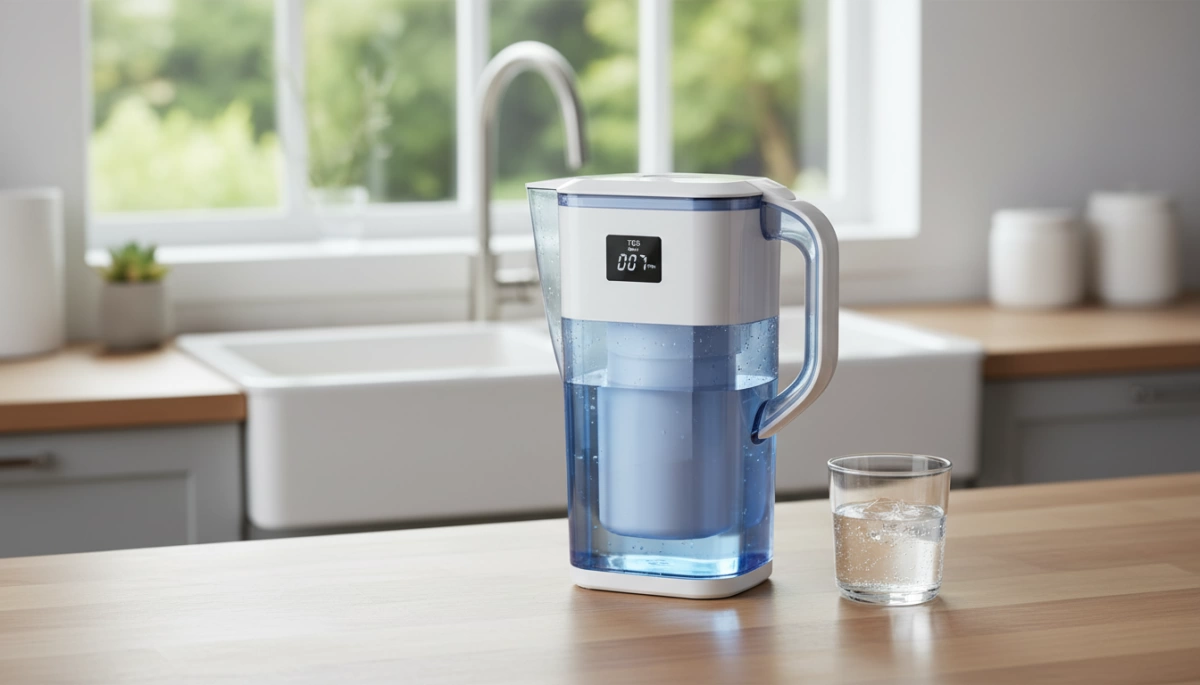
- Carbon pitcher filters (Brita-style)
- Faucet-mounted filters
- Standard countertop and under-sink carbon systems
- Fridge filters
They’re ideal if your TDS level is already in a safe range, and you just want better taste, less chlorine, or basic sediment removal. If you only care about taste and microbiological safety, pairing carbon with a good UV water treatment system can be enough.
Water Filters That CAN Reduce TDS
If you actually want a water filter that reduces TDS, you need one of these technologies:
- Reverse osmosis (RO) – Most common and effective TDS water filter system for home use
- Ion exchange – Used in softeners and some total dissolved solids water filters (swaps calcium/magnesium with sodium or hydrogen)
- Distillation – Boils and re-condenses water, leaving most dissolved solids behind
These options can bring high TDS water down to much lower levels, especially important for well water TDS treatment and hard water.
How Different TDS Water Filter Technologies Compare
Here’s a quick comparison of TDS reduction rate and typical use:
- RO systems (countertop or under-sink)
- TDS reduction: 90–99%
- Best water filter for TDS if you want clean, low-TDS drinking water at the tap
- Ion exchange systems
- TDS reduction: can be high, but mainly changes hardness and ion balance, not always used just for drinking
- Distillers
- TDS reduction: very high, but slow and energy-intensive
If your goal is reverse osmosis TDS reduction for daily drinking water at home, a countertop RO water filter or under sink TDS water filter is usually the most practical setup for U.S. households.
Reverse Osmosis as a TDS Water Filter
How RO Membranes Remove Dissolved Solids
Reverse osmosis (RO) is the most reliable TDS water filter system when you need a big drop in total dissolved solids. An RO membrane uses extremely tiny pores (around 0.0001 microns) and pressure to push water through while holding back:
- Dissolved salts and minerals (calcium, magnesium, sodium)
- Heavy metals (lead, arsenic, chromium)
- Nitrates and many other inorganic contaminants
In a home setup, RO is usually paired with carbon and sediment filters, similar to how a reverse osmosis filter pitcher works in stages, but with much stronger TDS reduction.
Typical TDS Reduction Rate with RO Systems
A quality RO system for home drinking water will typically:
- Cut TDS by 90–98% under normal household conditions
- Drop tap water from, say, 400–600 ppm down to roughly 10–50 ppm
- Keep performance stable as long as pre-filters and the RO membrane for TDS removal are replaced on schedule
If your input water is very high in TDS (well water or hard city water), adding pre-filters and proper pressure helps keep that reduction rate high and consistent.
Pros and Cons of RO as a TDS Water Filter
Pros:
- Best TDS reduction among common home filters
- Great for high TDS water solutions, salty or mineral-heavy water
- Improves taste, lowers scale, and handles many contaminants at once
Cons:
- Wastes some water during the filtration process (varies by model)
- Removes beneficial minerals along with excess TDS (water can taste “flat”)
- Higher upfront cost vs. basic carbon or pitcher filters
- Requires periodic filter and membrane changes and under-sink space
If your priority is aggressive TDS reduction and cleaner, softer-tasting drinking water, a well-designed reverse osmosis TDS reduction system is usually the best water filter for TDS in a U.S. home.
How to Choose the Right TDS Water Filter
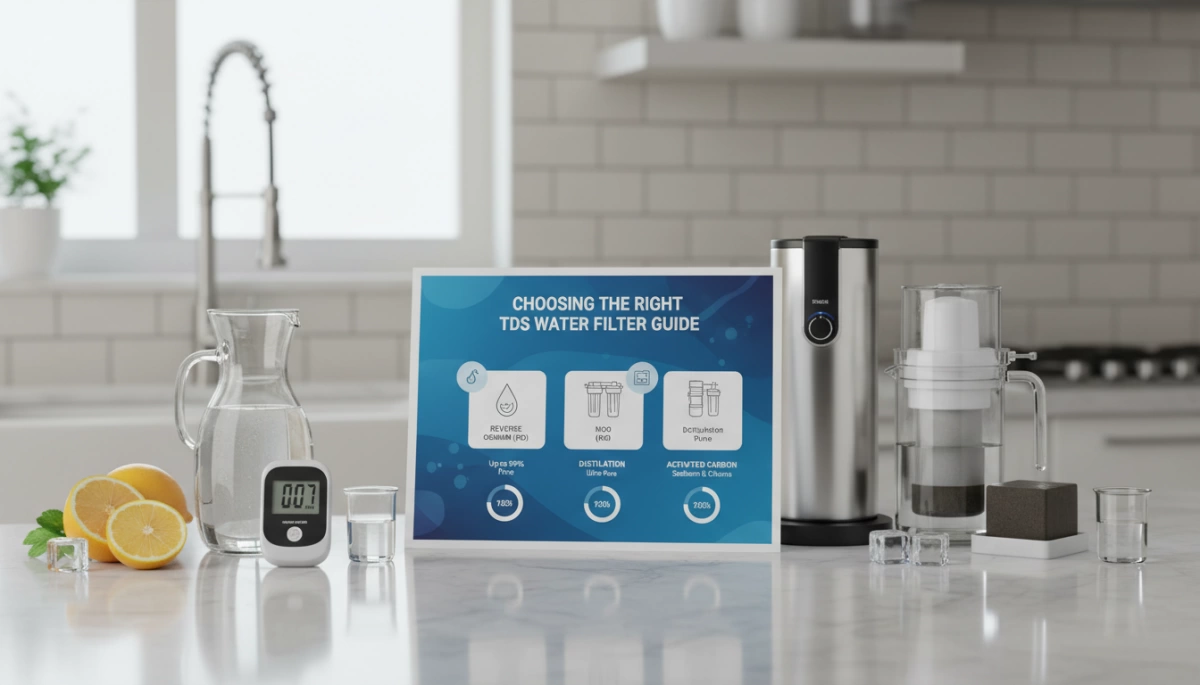
When You Actually Need TDS Reduction
You don’t always need a total dissolved solids water filter. I only push TDS reduction when it’s truly useful:
- TDS above ~300–500 ppm and you hate the taste (salty, bitter, metallic).
- Well water or rural supply with high hardness, scale, or visible deposits.
- Appliances scaling up fast (kettles, coffee makers, humidifiers).
- Sensitive uses: espresso setups, aquariums, home lab, or medical needs.
In these cases, a reverse osmosis (RO) system for home drinking water or a strong ion exchange system is usually the right move.
When You Don’t Need to Lower TDS
If your water checks these boxes, don’t overspend on a heavy TDS water filter system:
- TDS is below ~150–250 ppm and tastes clean.
- City water that already meets safe TDS level for drinking water and you just want better taste or chlorine removal.
- You mainly care about chlorine, odor, or some chemicals, not minerals.
In that case, a solid under-sink water purification system with good carbon filtration is enough and cheaper to run. I normally recommend starting with a simple under-sink water purification system before jumping to RO if your TDS is already low.
Key Features to Look For in a TDS Water Filter
When TDS reduction is truly needed, I look at this short checklist:
| Feature | Why It Matters |
|---|---|
| Verified TDS reduction rate | Aim for 90–95%+ with reverse osmosis TDS reduction. |
| Filter stages & media | RO membrane + carbon + sediment + (optional) remineralization. |
| Certification (NSF/ANSI) | Proves claims on TDS, taste, and safety are legit. |
| Filter & membrane life | Clear gallon or month ratings, easy replacements. |
| Flow rate & tank/counter type | Match your kitchen use: under-sink, countertop RO water filter. |
| Operating cost per gallon | Filters + membrane + wastewater ratio for long‑term savings. |
If I were setting this up at home, I’d narrow it down to a best water filter for TDS that combines:
- RO membrane for TDS removal
- Simple cartridge changes
- Clear TDS before/after numbers on the spec sheet.
Best TDS Water Filter Options for Home Use
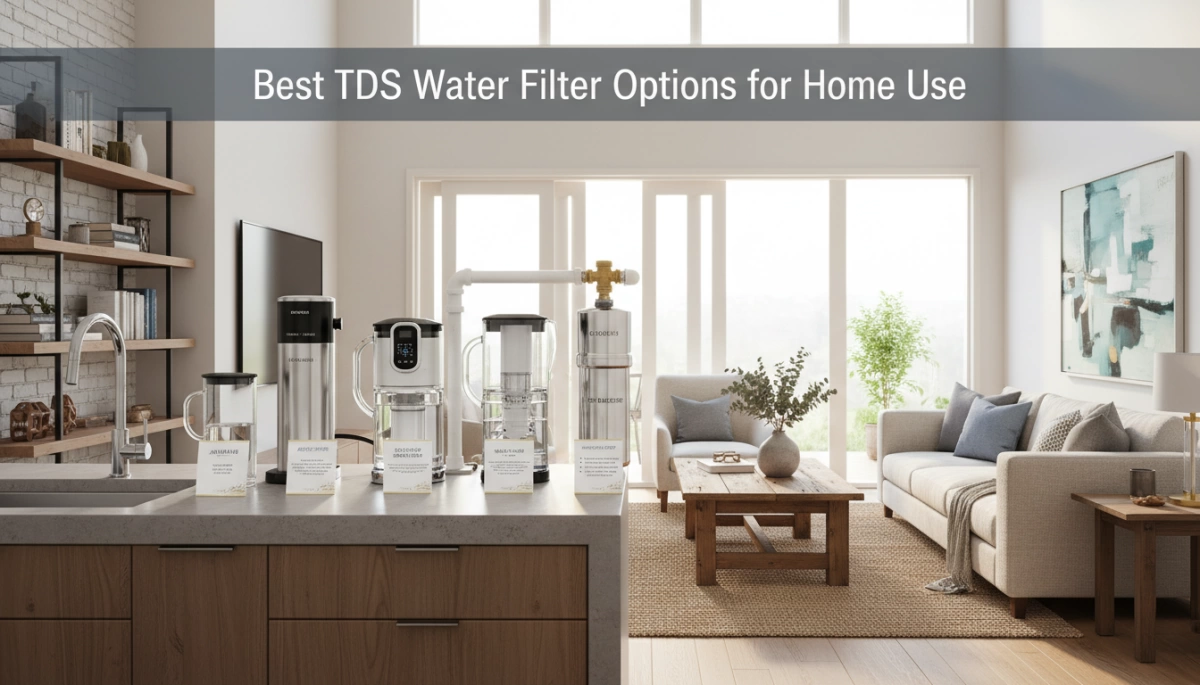
When you want to cut TDS (total dissolved solids) at home, you’re basically choosing between countertop RO systems, under-sink RO, and in some cases whole house TDS filtration. Each setup fits a different type of home, budget, and water problem.
Countertop RO TDS Water Filters for Kitchens
A countertop RO water filter is the easiest way to get low‑TDS drinking water without plumbing work.
Best if you:
- Rent or move often
- Don’t want to drill or modify cabinets
- Only care about drinking/cooking water (not showers, laundry, etc.)
Key perks of a countertop RO system:
- Plug-and-play: Sits on the counter, connects to a faucet or has its own tank
- Strong TDS reduction: Often 90–95%+ TDS removal
- Great for small kitchens & apartments
- Clear taste upgrade if your tap water tastes salty, metallic, or “chalky”
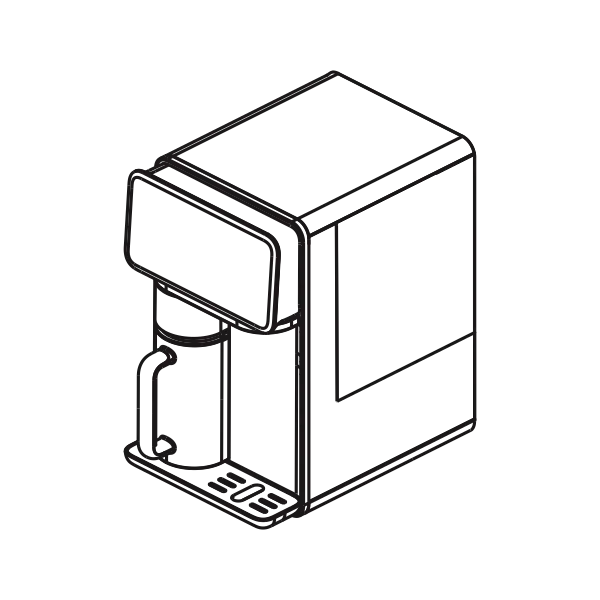
If you want a deeper dive into countertop benefits, I recommend checking a dedicated breakdown of a modern countertop reverse osmosis water filter and how it handles TDS, chlorine, and taste.
Under-Sink & Whole House TDS Water Filters
If you want a cleaner look and higher capacity, under-sink RO systems are usually the best water filter for TDS in U.S. homes.
Under-Sink RO TDS Water Filter
- Mounts under the kitchen sink
- Delivers low‑TDS water to a dedicated faucet
- Ideal for families that cook a lot, fill bottles daily, make coffee/tea, etc.
Why homeowners like under-sink RO for TDS:
- High TDS reduction (90–99% depending on feed water)
- Hidden installation, no counter space used
- Constant supply of purified water for drinking and cooking
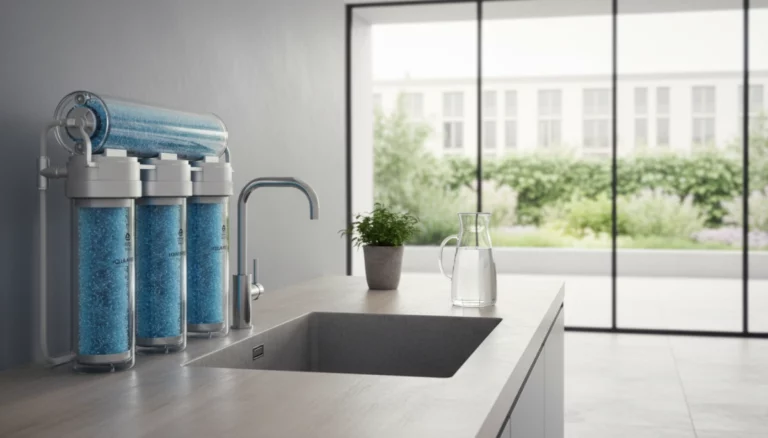
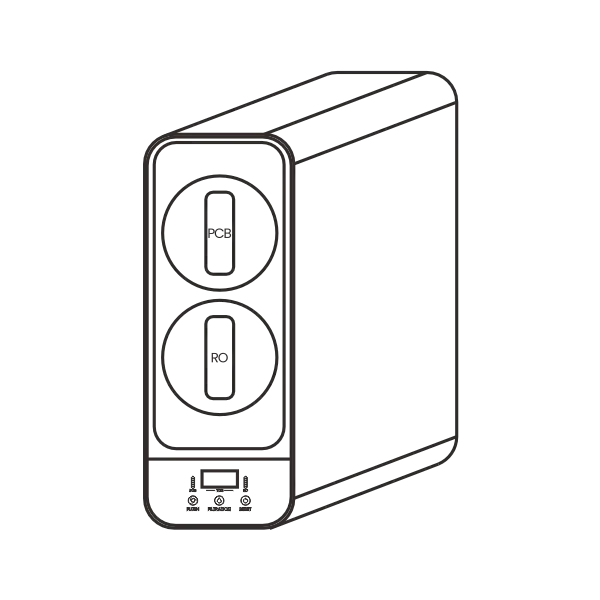
To see how a typical under-sink RO layout works and what features to expect, you can look at a modern under-sink RO system setup.
Whole House TDS Filtration
Whole house TDS reduction is less common and usually only worth it when:
- You have very high TDS causing heavy scale (e.g., >800–1000 ppm)
- You’re dealing with well water that ruins fixtures, heaters, and appliances
- You’re ready for a higher upfront and ongoing cost
Typical approaches:
- Whole house RO for serious TDS control (most effective but higher cost and wastewater)
- Ion exchange/softeners: Lower hardness (part of TDS), great for scale, but don’t always fix total TDS taste issues
Filter Maintenance, RO Membrane Life & Running Costs
Any TDS water filter system lives or dies on maintenance. RO works great only if you keep up with basic filter swaps.
Typical Lifespan (Residential Use)
| Component | Usual Replacement Cycle* |
|---|---|
| Sediment pre-filter | 6–12 months |
| Carbon pre-filter | 6–12 months |
| RO membrane (TDS reduction) | 2–5 years (depends on TDS & use) |
| Post-carbon/polishing filter | 12 months |
*Heavy use or very high TDS water can shorten these times.
What Affects Membrane Life & TDS Performance
- Feed TDS level: Higher TDS = membrane works harder
- Chlorine/chloramine: Needs good carbon pre-filtration or it will damage the membrane
- Sediment/iron: Well water often needs pre-treatment to avoid clogging the membrane
- Filter neglect: Skipping pre-filter changes kills membranes fast
Typical Running Costs (Ballpark)
Countertop RO:
- Lower water use, small filters
- Roughly $60–$150 per year in filters for most families
Under-sink RO:
- Slightly larger capacity
- Usually $80–$200 per year depending on brand, usage, and local water quality
Whole house RO:
- Highest operating cost (pre-treatment, pumps, bigger membranes, more wastewater)
- Usually only justified in very high TDS or problem well water areas
Quick Tips to Keep TDS Water Filter Costs Down
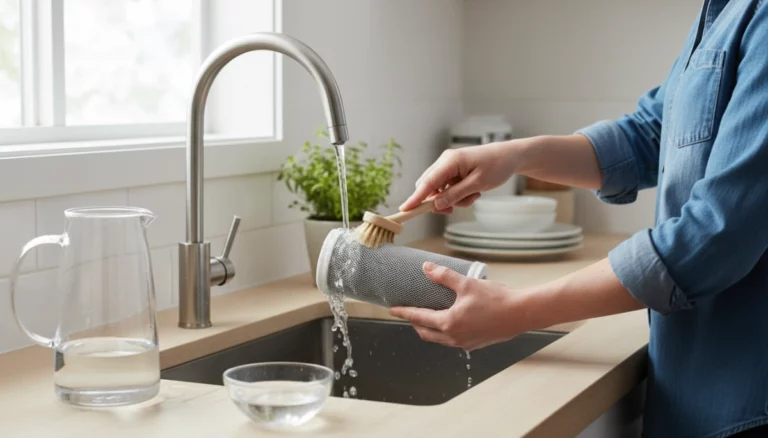
- Test TDS regularly with a simple TDS meter for home water testing
- Change pre-filters on time to protect the RO membrane
- Choose systems with standard-size filters (cheaper to replace than proprietary cartridges)
- Size the system to your actual usage, not just the biggest GPD number on the box
If you’re in the U.S. and want straightforward, low‑TDS drinking water at home, a countertop RO or under-sink RO TDS water filter system will give you the best combo of performance, cost, and simplicity.
TDS Water Filters for Well and High‑TDS Water
Challenges With Well Water TDS
If you’re on a private well in the U.S., high TDS (total dissolved solids) is common. The issues usually show up as:
- Salty, metallic, or bitter taste
- White scale buildup on faucets, heaters, and appliances
- Staining (orange, brown, or white crust) in toilets and tubs
- Corrosion of plumbing and fixtures over time
High TDS in well water is often a mix of hardness minerals (calcium, magnesium), iron, manganese, sulfate, chloride, and sodium. TDS alone doesn’t tell you what is in the water, so I always recommend a lab test before choosing any TDS water filter system.
Pre‑Treatment Before RO for Very High TDS
For very high TDS well water (often 800–2,000+ ppm), a reverse osmosis (RO) system usually needs help to last:
- Sediment filter – removes sand, rust, and grit that would clog the RO membrane fast.
- Carbon filter – cuts chlorine (if present from disinfection), odor, and some organics.
- Water softener or anti‑scale – if hardness is high, this protects the RO membrane from heavy scale.
- Iron/manganese filter – needed if your test shows high iron or manganese, which can foul RO quickly.
If you use a tank‑based RO setup, make sure the RO tank pressure is set correctly, because low or high tank pressure will destroy flow and performance over time; we’ve broken this down in detail in our guide on reverse osmosis tank pressure and setup.
Choosing a TDS Water Filter for Rural or Hard Water Areas
For rural homes, farms, and cabins, I usually narrow it down like this:
- TDS under ~500 ppm, main issue is hardness
- Consider a water softener for the whole house + a drinking water filter (like RO or high‑end under‑sink filter) at the kitchen sink.
- TDS 500–1,000 ppm
- Under‑sink RO system for drinking and cooking is often the best value.
- Add a softener or scale solution if appliances are getting beat up by hardness.
- TDS above 1,000 ppm or serious salinity
- Go with a proper RO system sized to your usage, with full pre‑treatment.
- In some extreme cases (very salty wells), a whole‑house RO or even blending with delivered water may be needed.
For hard well water, I design systems around:
- Your actual TDS number (from a meter and lab test)
- What’s in that TDS (iron, hardness, sodium, etc.)
- Your usage (family size, number of bathrooms, well pump capacity)
That’s how you end up with a TDS water filter system that actually fixes the problem instead of just burning through filters and membranes.
Commercial & Project TDS Water Filter Solutions
When you’re running a business, TDS control isn’t optional—it’s tied directly to product quality, equipment life, and compliance.
Commercial RO and TDS Control for Businesses
For most commercial setups, a reverse osmosis (RO) TDS water filter system is the backbone of water treatment. We design systems around your actual demand, not generic specs:
- Restaurants & cafés – Stable TDS levels for better coffee, ice clarity, and consistent taste
- Hotels & offices – RO systems for drinking stations, pantries, and premium filtered water taps
- Car washes & laundromats – Lower TDS to cut spotting, soap use, and scaling in lines and heaters
We size commercial RO based on:
- Peak flow demand
- Feed water TDS and hardness
- Required outlet TDS range for your process
TDS Water Filtration for Food, Beverage & Labs
Food, beverage, and lab applications are picky about total dissolved solids:
- Food & beverage production – Controlled TDS for repeatable flavor, consistent mixing ratios, and shelf stability
- Breweries & specialty coffee – Dialed-in TDS profiles for extraction and taste
- Laboratories & testing facilities – Low-TDS or near-zero TDS as a base for ultrapure polishing
For these, we usually combine:
- RO systems for major TDS reduction
- Polishing stages (carbon, ion exchange, or DI) when ultra-low TDS is required
Designing Custom Systems for Large Projects
For larger projects, we don’t just ship a unit—we engineer the entire TDS water filter solution:
- Full water analysis and TDS profiling
- Custom skid-mounted RO systems with pre-treatment (sediment, carbon, softening if needed)
- PLC / controller integration for TDS monitoring and automatic flushing
- Scalable layouts for campuses, manufacturing plants, or multi-building installs
If you’re building a high-end office or mixed-use project, pairing centralized RO with point-of-use filtered water taps in key areas can boost user experience and cut plastic bottle use. You can see how we approach this kind of install in our filtered water tap solutions for modern buildings.
OEM & Private Label TDS Water Filter Manufacturing
If you’re looking to launch or expand a water brand in the U.S., I can support you end‑to‑end with OEM and private label TDS water filter systems built around reverse osmosis and advanced TDS reduction.
Custom TDS Water Filter & RO System Design
I don’t sell “one box fits all.” I design custom TDS water filter systems and RO systems for TDS removal around your market and channels:
- Custom RO configurations (1–5 stages, remineralization, UV, pump/no pump)
- Product formats: countertop RO water filter, under sink TDS water filter, and commercial TDS water filter setups
- Target TDS reduction level (e.g., 90–98% reverse osmosis TDS reduction) based on local feed water
- Options for well water TDS treatment, hard water TDS, and high TDS municipal sources
You tell me the TDS levels in your drinking water and your price point; I match that with the right RO membrane for TDS removal, filter stack, and housing design.
Branding & Private Label Options
Everything is built to support your brand, not mine:
- Full private label water filtration system: logo printing on housings, faucet, RO tank, and packaging
- Custom box design, manuals, and QR code labels for support and reorders
- Flexible branding across a product line: entry-level total dissolved solids water filter up to premium multi-stage systems
If you’re building a line of dispensers or home units, I can match the look and feel of your other products and even pair with table‑top water dispensers for a complete branded solution.
Quality Control, Certifications & Bulk Production
I run production like a serious OEM TDS water filter manufacturer, not a hobby shop:
- Strict incoming testing on RO membranes, housings, and fittings
- 100% pressure and leak testing on assembled TDS water filter systems
- Support for NSF‑style, CE, and food‑grade material compliance depending on your market
- Stable bulk RO production with MOQs that make sense for U.S. distributors and e‑commerce brands
For brands that also sell ultrafiltration faucet water filters, I can keep QC and materials consistent across both UF and RO lines so your customers get the same water quality experience across your catalog.
TDS Water Filter FAQs
Safe TDS Level in Drinking Water
For most U.S. homes, this is the basic guideline I use:
- 0–50 ppm – Very low TDS (RO/distilled); safe, but can taste “flat.”
- 50–150 ppm – Ideal range for most people (good balance of minerals and taste).
- 150–300 ppm – Acceptable for drinking; may start to taste “hard.”
- 300–500 ppm – Still considered safe TDS level for drinking water, but taste and scaling get worse.
- >500 ppm – I strongly recommend a TDS water filter system (usually RO) for better taste and less scale.
TDS alone doesn’t tell you if water is “safe,” but it’s a fast way to flag if you should look deeper.
How to Test TDS at Home
You can easily track TDS levels in drinking water yourself:
- Buy a TDS meter for home water testing (usually $10–$30).
- Turn it on, dip the probe into a clean glass of water, and wait 2–5 seconds.
- The reading in ppm (mg/L) is your total dissolved solids level.
- Test tap water, filtered water, and RO water to compare before/after.
If you’re using carbon filters and want to know what they remove (even if they don’t change TDS much), it’s worth understanding what carbon filters actually remove from water with guides like this breakdown of what carbon filters remove from water.
Do You Need to Remove All TDS?
In most U.S. homes, no:
- You do not need zero TDS for normal drinking water.
- A bit of calcium, magnesium, and other minerals is totally fine and often preferred.
- Ultra-low TDS (like lab or aquarium water) is only needed for special uses: medical, labs, some manufacturing, CPAP, etc.
For everyday drinking, I usually target 50–150 ppm after filtration as the sweet spot.
How Often to Replace RO Membranes and Filters
For a typical RO system for home drinking water, I stick to this schedule:
- Sediment & carbon pre-filters: Every 6–12 months
- RO membrane for TDS removal: Every 2–5 years (depends heavily on incoming TDS and hardness)
- Post-carbon/polishing filter: Every 12 months
If you see your TDS reduction rate dropping (for example, tap 300 ppm, RO water used to be 20 ppm, now it’s 80 ppm), it’s usually time to check pre-filters and then the membrane.
TDS Meters vs Full Water Testing
A TDS meter is:
Good for:
- Tracking RO performance (TDS before and after RO)
- Watching filter performance over time
- Quick checks on well water TDS or hard city water
Not good for:
- Detecting specific contaminants (lead, PFAS, pesticides, bacteria, etc.)
For health and safety, I always recommend:
- Use a TDS meter as a quick performance tool.
- Use a full lab water test (or certified local lab) when:
- You’re on a private well
- You have very high TDS or strange taste/odor
- There are known contamination issues in your area
Together, a TDS meter plus full testing gives you both the big picture and the fine detail on your TDS water quality and overall safety.