














If you’re evaluating manufacturers for your next multi function water dispenser, you already know the real challenge isn’t the outer shell—it’s the water path design inside.
How do you route hot, cold, ambient, sparkling, and ice through one compact chassis without cross-contamination, temperature drift, noisy pressure spikes, or endless service calls?
That comes down to one thing: whether the OEM truly understands internal hydraulic architecture, thermal isolation, and hygiene‑first circuit design—or is just stacking modules and hoping for the best.
In this guide, we’ll break down how advanced water path design for multi function water dispensers turns a complex machine into a stable, safe, and reliable platform for your brand—and how partners like Driplife engineer that performance from the inside out.
Anatomy of a Multi Function Water Path Design
When I design a water path for a multi function water dispenser, I start from a single inlet and engineer how that one connection feeds every function—hot, cold, ambient, sparkling, and ice—without losing performance or safety.
Central Manifold System
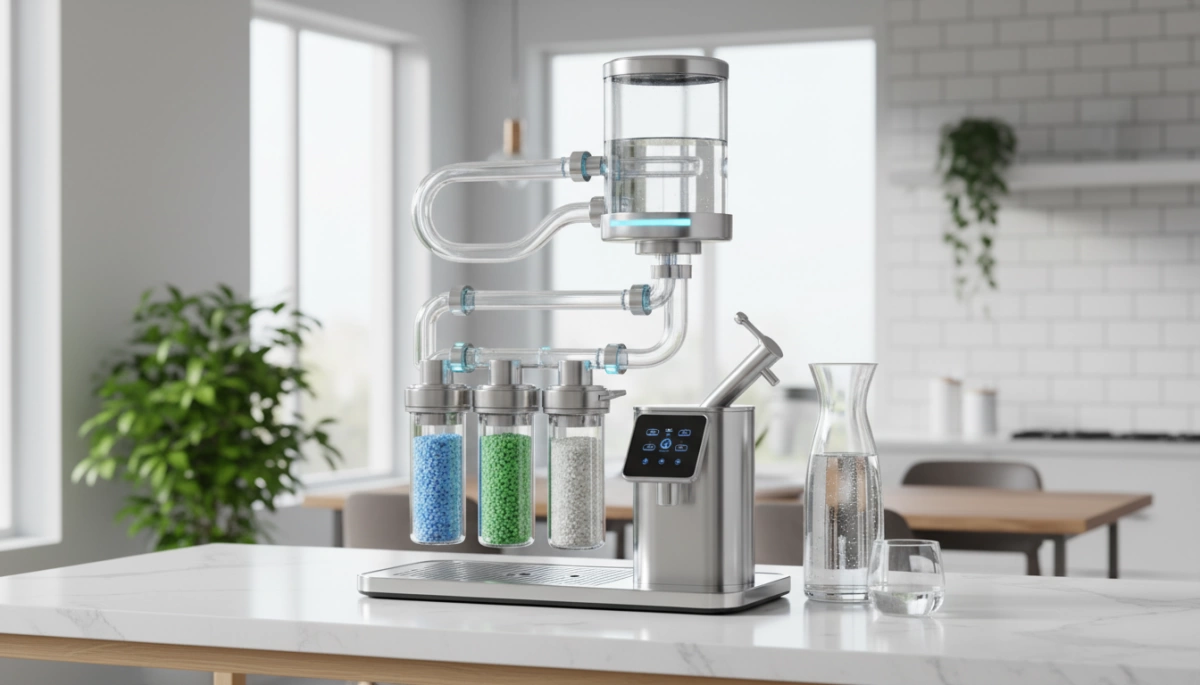
At the core of the internal plumbing architecture is a central manifold system. This compact block routes the incoming mains water into multiple dedicated paths:
- A hot water loop
- A chilled cold water circuit
- An ambient line
- A high‑pressure sparkling water path
- A feed line for ice making
This central manifold design keeps the internal plumbing organized, reduces fittings and leak points, and makes the multi output water routing predictable and easy to service.
Splitting One Inlet into Multiple Paths
From a single inlet, I use a structured, multi stream manifold routing approach:
- Each function (hot, cold, ambient, sparkling, ice) gets its own branch.
- Branch diameters are sized based on target flow rate and pressure drop.
- Critical functions like hot and sparkling get priority routing with shorter, more direct paths.
This water path design for multifunction dispensers ensures each outlet behaves consistently, even when several are used at the same time.
Solenoid Valve Manifolds and Flow Control
To control each branch independently, I rely on a solenoid valve manifold:
- Each outlet (hot, cold, ambient, sparkling, ice) gets its own solenoid valve.
- The control board opens and closes valves in milliseconds for precise dosing.
- Grouping valves on a manifold improves pressure stability and reduces wiring and hose clutter.
This solenoid valve manifold control is what allows exact dispensing volumes and prevents cross function water path interference when multiple users tap the dispenser.
Fluid Dynamics and Pressure Management
Inside a compact countertop dispenser, fluid dynamics in water dispensers matter more than most people realize. I focus on:
- Minimizing sharp bends and sudden diameter changes to avoid turbulence.
- Keeping line lengths as short as possible to reduce pressure loss.
- Using smooth internal surfaces to limit friction and noise.
By designing for stable pressure and predictable flow, I avoid issues like splashing, noisy pours, and inconsistent fill times.
Balancing Mains Pressure with Outlet Flow
Most US buildings supply relatively high mains pressure, which is great for capacity but bad for user experience if unmanaged. To balance this, I:
- Add a primary pressure regulator near the inlet.
- Use branch-specific flow restrictors to tune each outlet line.
- Design for consistent performance even when inlet pressure fluctuates.
This pressure management in compact appliances is what keeps a premium dispenser feeling controlled and professional instead of chaotic.
Flow Restrictors, Regulators, and User Experience
Finally, I use flow rate control systems to shape how the water actually pours:
- Flow restrictors smooth out and cap maximum flow.
- Regulators maintain a stable pressure window for sparkling and hot circuits.
- Each outlet is tuned for its purpose—faster for ambient, slower and safer for hot.
The result is a clean water routing layout where every outlet feels intentional: steady pour speed, no sudden bursts, and a reliable, repeatable user experience every time someone uses the multi function water dispenser.
Thermal Isolation in Water Path Design for Multi Function Water Dispensers
In multi function dispensers, thermal isolation in the water path design is what keeps “hot” truly hot and “cold” truly cold. In the U.S., office users want near-boiling water for tea and instant meals while also expecting chilled and ice-cold water from the same compact unit, so I design the internal plumbing architecture around tight temperature control and safety.
Hot water loop design and heater choice
For the hot water loop design, I usually pick between two options based on use case:
- Tankless instant heating modules: Great for offices and homes that want fast hot water with lower standby energy use. These need short, direct hot water paths and precise flow control to keep outlet temperature stable.
- Boiler tanks: Better for locations with heavy tea/coffee demand, where you need a reserve of hot water. The piping layout focuses on minimizing dead volume and keeping hot lines insulated from cold and sparkling paths.
In both cases, I keep the hot loop as compact as possible and use flow rate control systems to avoid temperature swings at the faucet.
High temperature water path materials
For high temperature circuits, I rely on:
- Food grade silicone tubing in flexible sections where I need tight bends without kinking.
- Stainless steel water lines near heaters and boilers for durability, heat resistance, and better hygiene.
- BPA free, high-temp rated fittings and valves that won’t leach or deform over time.
This mix of materials gives me a safe, sanitary water path design that holds up under real-world U.S. usage where hot water is used all day, not just occasionally.
Cold water and ice circuit routing
On the cold side, I route water through a dedicated cooling circuit and, if needed, an ice-making loop:
- Compressor-based cooling paths with coils tightly coupled to the cold tank or direct-chill block.
- Short, insulated cold water lines that avoid hot components and power electronics.
- Careful hose management so lines don’t kink or rub, which could restrict flow or cause warm spots.
If the system includes advanced filtration, I integrate the cold loop with a filter stage similar to what’s used in our countertop water filter systems so you get chilled, clean water in a small footprint.
Insulation and preventing thermal transfer
Preventing thermal transfer between hot and cold water paths is non‑negotiable if we want a premium user experience:
- Dedicated routing channels for hot, cold, and ice lines to avoid close contact.
- Targeted insulation on hot lines, cold coils, tanks, and manifolds.
- Physical spacing between hot heaters and cold compressor components.
- Smart layout of the central manifold system so hot water doesn’t pre-warm cold outlets.
When the thermal isolation is done right, you get fast hot pours, consistently cold water, and reliable ice from a compact countertop unit without temperature cross-talk or wasted energy.
Sparkling Water Path Design Challenges
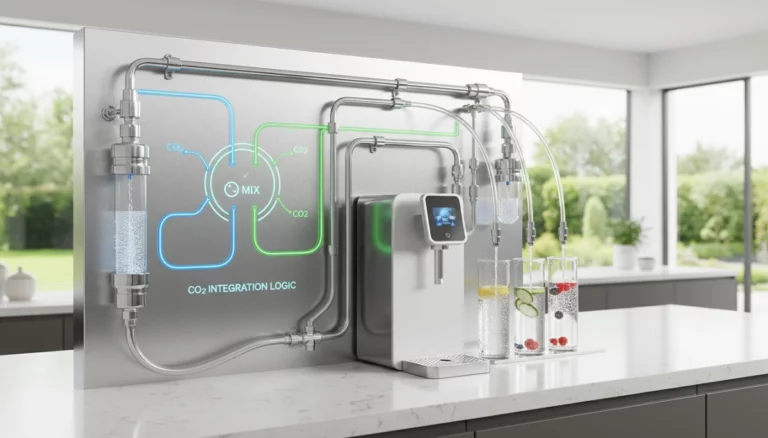
Designing the sparkling water path in a multi function water dispenser is where things get tricky. We’re pushing high pressure CO2 and water through compact internal plumbing, and any weak point shows up fast in the user experience.
Carbonation chamber and CO2 mixing
For a strong, consistent fizz, we focus heavily on the carbonation chamber design. We use a sealed mixing chamber where water and CO2 are blended under controlled pressure, instead of trying to inject gas directly at the nozzle. This approach gives us:
- More stable carbonation levels from cup to cup
- Better control over bubble size and mouthfeel
- Less impact from incoming water temperature, which also helps protect overall filtration efficiency at different water temperatures
High pressure sparkling circuits
Because sparkling water paths run at higher PSI than still water, we build them with reinforced tubing and compression-grade seals:
- Reinforced food-grade tubing rated for high PSI sparkling circuits
- Upgraded O-rings and gaskets that resist CO2 attack over time
- Dedicated check valves to keep CO2 from migrating into ambient or cold lines
This industrial-style water path design engineering means fewer leaks, fewer callbacks, and better long-term stability for busy US offices and kitchens.
First cup and gas loss issues
Flat “first cup” pours are a common complaint with cheaper dispensers. We minimize gas loss by:
- Shortening the sparkling water route from carbonation chamber to outlet
- Avoiding dead volume where CO2 can separate from water
- Using a tight, direct manifold configuration just for sparkling water
On top of that, we keep a dedicated sparkling path and nozzle outlet. That separation prevents cross contamination with hot, cold, or ambient water, and it keeps carbonation levels higher so every glass comes out crisp, not flat.
Hygiene Focused Water Path Architecture
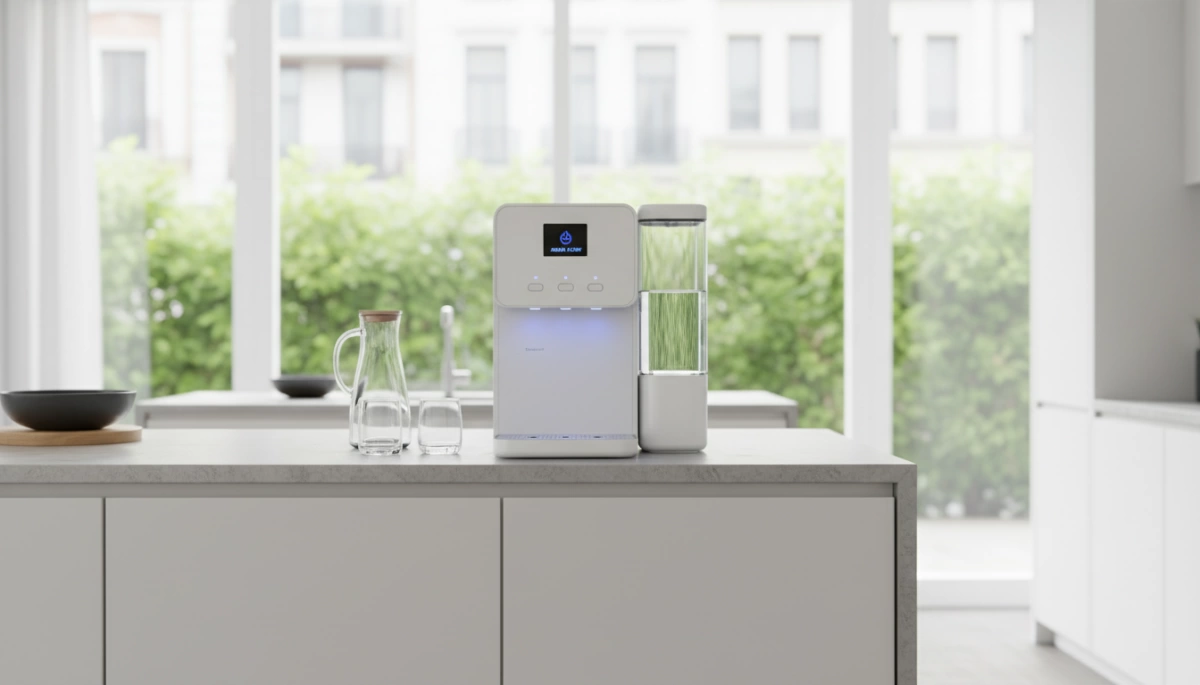
A hygiene focused water path design is non‑negotiable if you’re putting a multi function water dispenser in an office, gym, or home kitchen. I engineer our internal plumbing architecture around three rules: no stagnation, no cross‑contamination, and no questionable materials anywhere water flows.
Zero dead leg water path design
In a good water path design, every inch of tubing sees regular flow. Any “dead leg” – a capped‑off branch or rarely used loop – lets water sit, warm up, and grow bacteria. When I review a dispenser layout, I look for:
- Branches that don’t lead directly to a nozzle or valve
- Long stub lines feeding rarely used modes
- Sensor tees or sampling points without full flush
We either reroute those sections so they’re in the main flow path or shorten and integrate them into the central manifold system. The result is a true zero dead leg plumbing design that self‑flushes during normal daily use.
Cross contamination prevention and separated outlets
Hot, cold, ambient, and sparkling lines must stay physically and hydraulically separated inside a multi function water dispenser. I use:
- Dedicated tubing runs from the manifold to each function
- Separate nozzle outlets for hot, chilled, and sparkling water
- Internal air gaps and splash shields around the dispensing area
This cross contamination prevention system stops flavored or carbonated water from backing into the cold line, and keeps hot water from warming up the cold circuit. For customers who care a lot about clean, great‑tasting water at every tap in the house, I usually pair this with upstream filtration such as a countertop reverse osmosis hot and cold water filter system.
Backflow prevention and hygienic materials
To protect the mains and internal circuits, I specify multiple backflow prevention layers:
- Check valves and non‑return valves at key branches
- One‑way valves on sparkling and hot loops
- Properly rated backflow prevention devices at the inlet
On the material side, every water contact part in my designs is built around:
- BPA free water contact materials and food grade silicone tubing
- Stainless steel water lines in hot and high‑pressure zones
- Antibacterial nozzle design and easy‑wipe contact surfaces
This hygienic internal hydraulic architecture is what keeps a dispenser safe, easy to maintain, and trusted for everyday drinking in the U.S. market.
Integrated Water Circuit Design for OEM and ODM Projects
When I design water path systems for OEM and ODM multi function water dispensers, I treat the internal plumbing like a modular platform, not a one-off build. That mindset is what keeps performance high, testing straightforward, and future customization easy.
Compact Internal Plumbing Layout
For compact countertop dispensers in U.S. offices, homes, and hospitality, space is always tight. A good integrated water path design:
- Uses a central manifold system to keep hot, cold, ambient, sparkling, and ice lines grouped and short.
- Routes tubing in clean, layered runs so service techs can visually trace the multi output water routing in seconds.
- Minimizes bends and transitions to avoid pressure drop, noise, and uneven flow between outlets.
This kind of compact internal plumbing layout is especially important when the dispenser also integrates advanced filtration similar to what we use in our portable reverse osmosis systems.
Cable And Hose Management
Poor cable and hose management is one of the fastest ways to ruin a good water path design. To keep the internal plumbing architecture reliable:
- I separate power and control cables from water hoses to avoid wear points and heat transfer.
- I specify bend radius limits and clip locations so silicone and BPA free tubing never kinks.
- I use color-coded or labeled lines so installers can’t mis-route hot, cold, and sparkling paths during assembly.
Leak Detection And Hydrostatic Testing
Before any dispenser leaves production, the internal flow management has to prove itself under stress. For each design, I define:
- Hydrostatic pressure testing protocols where we hold the system above normal mains pressure for a defined time to catch weak joints, fittings, and manifold seals.
- Integrated leak detection strategies, from simple drip trays and float switches up to electronic leak sensors in high-value B2B hydration systems.
This reduces warranty claims and protects our OEM partners’ brands once units hit the field.
Air Tightness For Sparkling Water Paths
Sparkling water path design raises the bar even higher. For high pressure sparkling water circuits:
- I specify air tightness and CO2 tightness testing on every sparkling loop, not just sample units.
- I focus on reinforced tubing, proper O-ring materials, and crimped or threaded fittings that hold pressure over years, not months.
- Any manifold and valve configuration that handles CO2 is validated for pressure decay and micro-leaks to keep carbonation stable and prevent flat pours.
Customizable Path Modules And Treatment Stages
For OEM and ODM clients, flexibility is critical. I build the water path as a set of plug-and-play modules:
- Filter blocks, remineralization cartridges, UV sterilization, and post-carbon polishing can be added or skipped by model or region.
- Mineralization and filtration modules are placed in the sequence that best matches local water quality and taste expectations in the U.S.
- The same core water path design engineering can support basic cold/ambient models and premium multi function water dispensers with hot, cold, sparkling, and mineralized outputs.
By standardizing the core plumbing design and treating filtration and remineralization as configurable modules, I give OEM and ODM partners a reliable, scalable hydraulic architecture that can be tailored to each customer segment without rebuilding the entire dispenser plumbing design every time.
Performance, Reliability and Service in Water Path Design
When I design a water path for a multi function water dispenser, I treat performance, reliability, and service as one package. If the internal plumbing architecture is right from day one, you get stable flow, fewer breakdowns, and lower lifetime service costs.
Long-Term Durability and Low Maintenance
For long-term durability, I focus on:
- Robust materials: Food grade silicone tubing and stainless steel water lines in high-stress zones so the path holds up under heat, cold, and pressure.
- Cleanable geometry: Smooth bends, minimal fittings, and sanitary water dispensing system layouts to reduce spots where scale and biofilm can form.
- Maintenance-friendly layout: A maintenance friendly water path where filters, flow restrictors, and solenoid valve manifolds sit in accessible modules instead of being buried behind panels.
This kind of water path design engineering keeps uptime high for busy U.S. offices, gyms, and hospitality locations.
Reducing Scale and Fouling in Hot and Cold Loops
Scale is one of the biggest reliability killers in hot water loop design. To reduce scale and fouling:
- I integrate filtration and, when needed, advanced lead and contaminant reduction filters ahead of the internal plumbing.
- I use controlled flow rate control systems so water doesn’t sit stagnant in hot or cold loops.
- I design the hot side around smooth, short paths and consider water treatment or softening where hardness is high.
On the cold side, insulated cold water circuit routing and proper draining help prevent slime, odors, and flow loss over time.
Easy Access to Filters, Valves and Key Components
For OEM and ODM water dispenser manufacturing, I always push a “front-service” mindset:
- Quick-change filter cartridges positioned behind a front door.
- Accessible manifolds and solenoid valve manifold control blocks mounted on brackets you can reach without pulling the whole unit out.
- Clear routing labels on hoses and harnesses so a tech can trace the multi output water routing in minutes.
This cuts service time, lowers labor cost, and keeps units in service instead of sitting offline.
Smart Sensors, Flow Meters and Internal Path Engineering
Smart sensors and flow meters are now part of premium water dispenser performance:
- Flow meters and pressure sensors help optimize fluid dynamics in water dispensers, adjusting solenoid timing to keep pour speeds consistent.
- Leak sensors placed under the central manifold system and high-pressure sparkling lines catch issues early before they become warranty claims.
- Usage data from sensors guides predictive maintenance, so you swap filters and key parts before they fail.
When the internal flow management and multi stream manifold routing are engineered correctly, you see fewer leaks, fewer carbonation issues, and far fewer callbacks. That is how solid water path reliability and durability directly lower service costs and protect your warranty position.
Design Collaboration With Water Path Manufacturers
When I design a multi function water dispenser, the real performance comes from tight collaboration with water path manufacturers who understand advanced water path design engineering, not just basic plumbing.
Translating Requirements Into Water Path Specs
I start by turning product ideas into clear specs for the internal plumbing architecture, including:
- Target outlet types: hot, cold, ambient, sparkling, and ice
- Required flow rates, temperatures, carbonation levels, and noise limits
- Space limits for a compact countertop dispenser layout
- Hygiene targets: zero dead leg plumbing design, cross contamination prevention, and backflow prevention check valves
This becomes a detailed water path spec: central manifold system layout, solenoid valve manifold control logic, sensor locations, filtration and remineralization stages, and service access.
Key Questions To Ask an OEM/ODM
When I vet an OEM or ODM water dispenser manufacturer, I always ask:
- “Show me past multi function water dispenser plumbing projects with central manifolds and multi output water routing.”
- “How do you handle fluid dynamics in water dispensers and pressure management in compact appliances?”
- “What’s your standard approach for contamination prevention design between hot, cold, ambient, and sparkling lines?”
- “What hydrostatic pressure testing protocols and air tightness leak testing do you follow for high pressure sparkling water path circuits?”
If they can’t answer these clearly, they’re not ready for premium water dispenser performance.
Reviewing Manifolds, P&IDs, and Routing
I don’t just accept a pretty 3D model. I review:
- Manifold and valve configuration drawings
- P&IDs and detailed routing diagrams for every loop
- Locations of flow rate control systems, flow meters, sensors, and check valves
I look for clean water routing with minimal dead legs, logical maintenance access, and hygienic internal hydraulic architecture using stainless steel water lines and food grade silicone tubing.
If we’re adding advanced filtration or remineralization, I align their design with how U.S. customers already think about purified vs filtered water performance.
Validating Hygiene, Safety, and Performance
Before I sign off, I expect data, not promises:
- Certified tests for backflow prevention and cross contamination prevention system performance
- Hygiene validation: zero dead leg verification, cleanability, and results from microbial testing
- Durability data: long-term cycling of hot, cold, and high pressure sparkling loops
- Field-simulated testing: scale buildup, fouling, and real-world water quality scenarios
I also push for evidence on maintenance friendly water path design, like how fast filters can be swapped and how easily key components can be serviced without disturbing sealed sparkling circuits.
Co-Developing Next-Gen Multi Function Dispensers
The best results come when we co-develop:
- We define new central manifold system concepts for multi stream manifold routing.
- They optimize fluid dynamic optimization, valve logic, and compact routing.
- Together we build industrial water dispenser engineering that actually reduces warranty claims.
By treating the OEM as a true engineering partner, not just a factory, I can bring next generation, sanitary water dispensing systems to U.S. offices and homes that are cleaner, more reliable, and easier to live with every day.