










Carbon Fiber Filter Lifespan and Performance
When I talk with OEMs and brand teams, the same question always comes up: how long will a carbon filter really last under high-flow, real-world conditions? Traditional carbon block CTO and granular activated carbon (GAC) designs are hitting their limits—channeling, early pressure drop, and unpredictable adsorption breakthrough curves are now the main bottlenecks to longer service life and better user experience.
In my own lines, we’ve shifted to activated carbon fiber (ACF) modules because the structure is fundamentally different. Instead of relying on compressed blocks or loose granules, ACF’s high specific surface area and uniform microporous structure deliver stable adsorption kinetics at higher flow rates, with far less risk of channeling or dead zones. The result is a longer carbon fiber filter lifespan, more consistent chlorine removal lifespan, and a flatter degradation curve across the service interval.
In this analysis, I’ll focus on carbon fiber vs GAC performance from a lifespan and throughput perspective: how adsorption capacity evolves over time, how the carbon fiber filter degradation curve and adsorption breakthrough curve behave under realistic flow rates, and how brands can plan replacement timing and filter capacity around measurable data instead of guesses. The goal is simple: help you design or source long-life carbon fiber water filters that actually meet their rated water filter service life expectancy in the field, without sacrificing high-flow filtration efficiency or user satisfaction.
Carbon Fiber Filter Lifespan Starts With Pore Structure
Activated carbon fiber (ACF) is built very differently from standard granular activated carbon (GAC), and that structure is what drives carbon fiber filter lifespan. ACF forms a tight, uniform web of fibers loaded with accessible pores, so water doesn’t have to fight its way through a thick block. That means longer water filter service life expectancy at the same flow rate, or higher flow with the same capacity.
Micropores vs. Macropores: ACF vs. GAC
In ACF, most of the adsorption happens in micropores that sit right on the fiber surface. This shortens the path contaminants have to travel, which boosts ACF adsorption kinetics and keeps the adsorption breakthrough curve flatter for longer. Traditional GAC and carbon block CTO depend more on macropores and internal pathways, so part of the bed never fully gets used before residual chlorine breakthrough shows up.
Specific Surface Area and Holding Capacity
Because of its structure, the specific surface area of carbon fiber is extremely high and actually usable. More of that area is in play from day one, so you get stronger chlorine reduction capacity and better lifecycle adsorption performance instead of a sharp drop-off. In practice, that lets me design long-life carbon fiber water filters that hit NSF/ANSI 42–style chlorine performance with a smaller footprint, which is a big win for faucets, under-sink systems, and even bathroom sink filters that need compact, high-flow cartridges.
The “Sponge Effect” and Dead Zones in Traditional Media
Conventional GAC beds and dense CTO blocks act like a hard sponge: the outside overloads first while the inside stays underused. Channeling, hard packing, and dead zones mean you’re paying for carbon that never sees water. ACF’s fiber network reduces those dead spots and keeps the mass transfer zone more even across the media, so adsorption capacity over time is more predictable and replacement timing for carbon fiber filters is easier to plan for U.S. homeowners and OEM buyers.
Carbon Fiber Filter Lifespan Performance Over Time
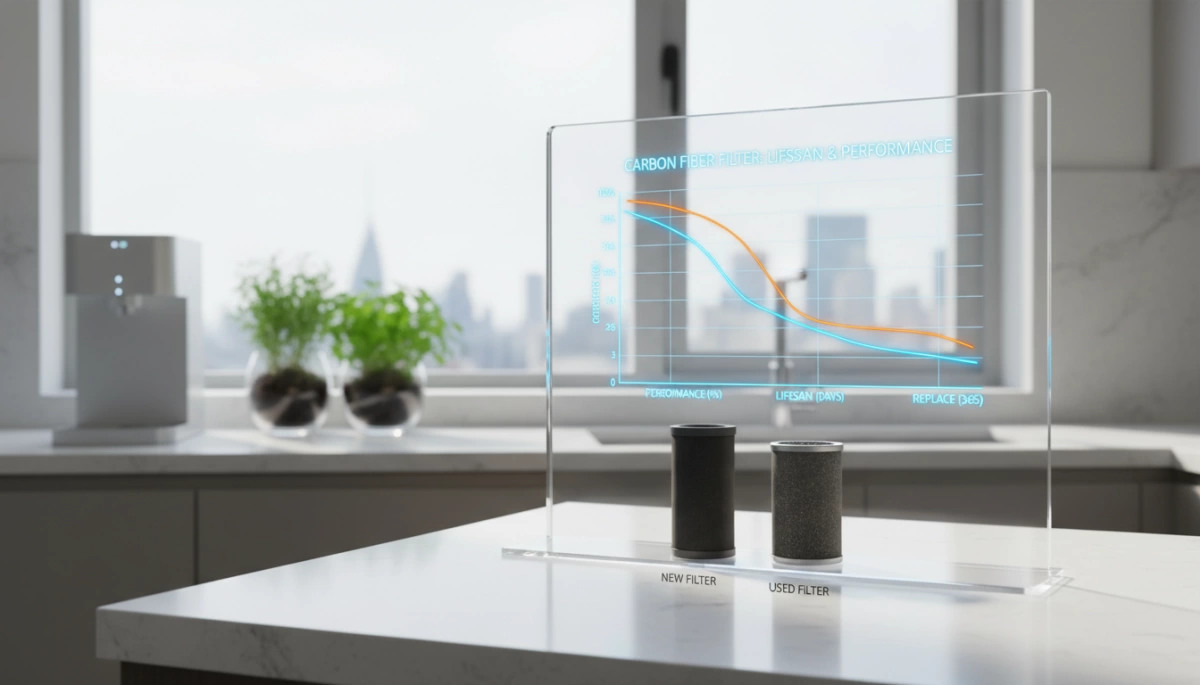
Carbon fiber filter lifespan follows a clear performance curve: fast start, long stable phase, then a sharp drop. When we look at the adsorption degradation curve, we see three phases:
- Peak: Right after install, activated carbon fiber (ACF) delivers very fast ACF adsorption kinetics. Chlorine, taste, and odor drop almost instantly thanks to the high specific surface area of carbon fiber and its microporous structure.
- Plateau: For most of the water filter service life expectancy, performance stays steady. Differential pressure drop in filters remains low, high-flow filtration efficiency stays strong, and the adsorption breakthrough curve is flat. This is where long-life carbon fiber water filters really stand out vs standard CTO carbon block.
- Breakthrough: As the contaminant holding capacity is reached, we see residual chlorine breakthrough and a steeper carbon fiber filter degradation curve. At this point, we set our replacement timing so users are swapping on performance, not guesswork.
For chlorine removal lifespan, we design our ACF modules to meet or exceed NSF/ANSI 42 compliance standards on chlorine reduction capacity. When we build OEM water filter manufacturing programs for U.S. brands, we size the ACF media so the filter still passes chlorine reduction benchmarks near the end of its rated gallons, not just at the beginning. For shower or faucet formats, pairing ACF with certified components similar to those in our NSF-certified water filter solutions keeps claims clean and audit-ready.
When carbon fiber is composited with other media, we can add targeted heavy metal reduction without giving up flow. For example:
- ACF + specialty resin for lead and heavy metals
- ACF + fine sediment layers to protect the microporous structure
This composite setup tightens the mass transfer zone in carbon filters, stretches lifecycle adsorption performance, and lets us offer long lasting faucet filter options with clear, data-backed replacement timing for U.S. households.
Variables That Impact Carbon Fiber Filter Lifecycle
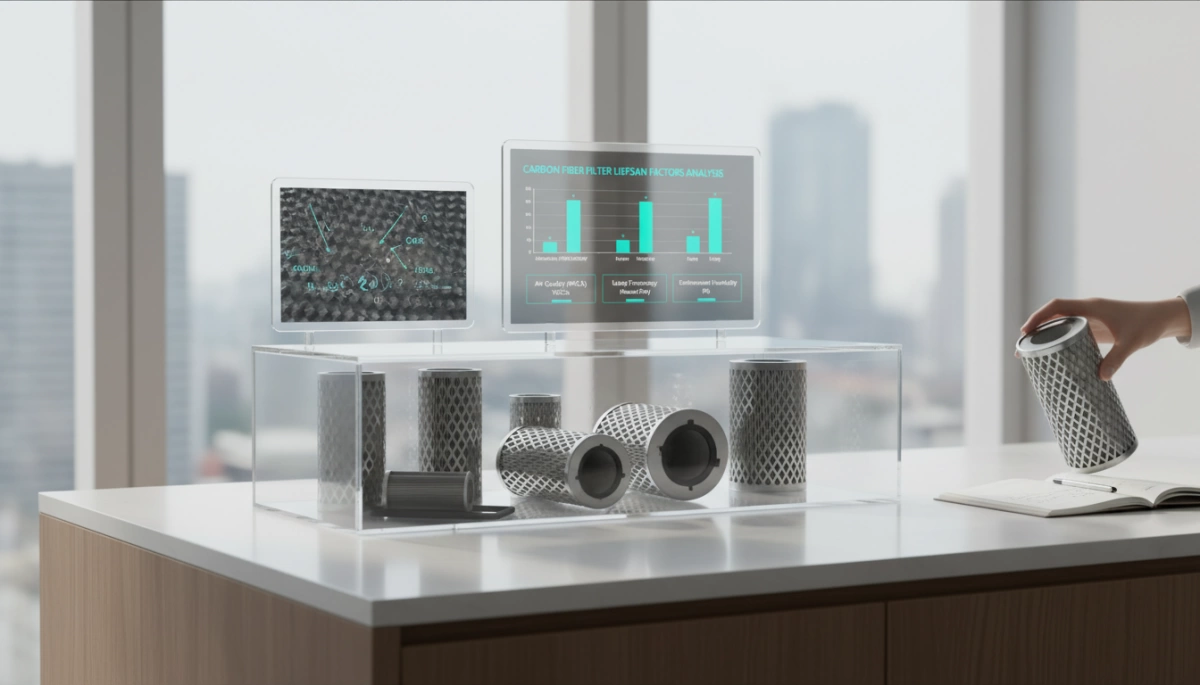
When I plan carbon fiber filter lifespan for U.S. homes and food-service accounts, I always start with how the filter is actually used day to day. Three real-world variables matter most.
Influent Water Quality, Turbidity, And Sediment Load
The dirtier the incoming water, the faster any carbon media gets used up.
- High turbidity and sediment load plug the outer layers of the carbon fiber and shorten effective service life.
- Well water, old city pipes, or homes with frequent main breaks usually need a sediment prefilter so the activated carbon fiber lifespan is used for adsorption, not just catching grit.
- If you see cloudy water, rust color, or sludge in your old filters, you should tighten your filter replacement timing or add a pre-stage.
Flow Rate, Contact Time, And High-Flow Performance
Carbon fiber handles high-flow filtration better than traditional GAC or CTO blocks, but physics still applies.
- Higher flow rate means less contact time, which can bring chlorine removal lifespan and adsorption capacity over time down if the filter is undersized.
- For long lasting faucet filter setups, I size ACF so it maintains high-flow filtration efficiency without a big pressure drop, even as the media loads.
- When you run multiple fixtures at once (kitchen, fridge, ice maker), you want a carbon fiber design that keeps pressure stable while still hitting your residual chlorine breakthrough targets.
Intermittent Vs Continuous Use And Wetting Behavior
How often the filter is on and off also changes the carbon fiber filter lifecycle.
- Intermittent use (typical in homes) lets the carbon fiber “rest,” which can slightly improve adsorption kinetics between uses but also raises the risk of stagnation and biofilm if replacement is pushed too far; this is where smart replacement timing really matters.
- Continuous use in food-service, office, or ice-maker lines keeps the media flushed and stable, but the total gallons processed add up quickly, so we calculate water filter service life expectancy by flow hours instead of just months.
- If you’ve had mold or odor issues in older systems, pairing ACF with proper wetting and regular replacement reduces the risk of the kind of growth problems described in this guide on mold in old water filters.
By dialing in these real-world variables—water quality, flow rate, and use pattern—I can set realistic, profitable filter capacity planning targets for carbon fiber that protect both water quality and your replacement margins.
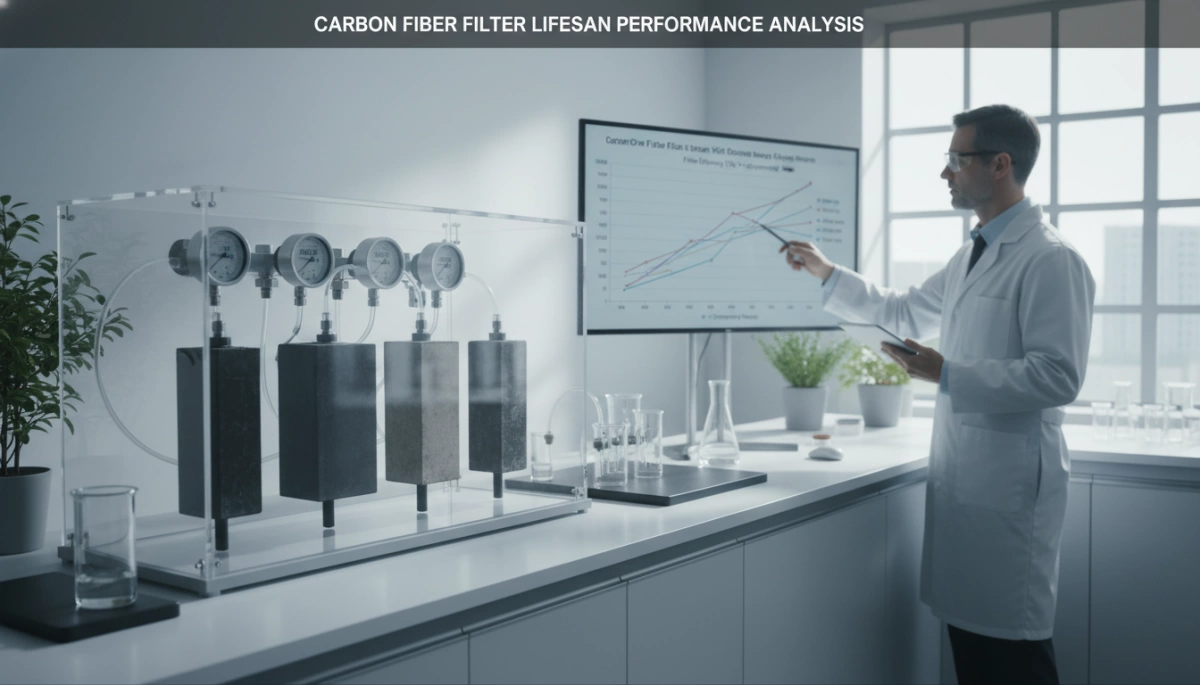
Lab Testing For Carbon Fiber Filter Durability
We stress-test every carbon fiber filter module so brands know the real water filter service life expectancy before launch. Our goal is simple: prove how long the activated carbon fiber lifespan holds up at high flow without surprise failures in the field.
Differential Pressure And Degradation Curve
We track the carbon fiber filter degradation curve by running long-cycle pressure tests:
- Constant-flow rigs measure differential pressure drop in filters from day one to end-of-life.
- We flag the point where pressure rise starts to impact user flow (typically a few psi above baseline).
- The result is a clear adsorption breakthrough curve paired with a flow curve, so you see both taste performance and usability over time.
Iodine Value And Microporous Structure
To verify adsorption capacity over time, we use iodine value metrics as a fast proxy for microporous structure analysis:
- Fresh and aged ACF samples are tested to confirm specific surface area of carbon fiber and remaining contaminant holding capacity.
- This ties directly to chlorine reduction capacity, especially for products targeting chlorine taste and odor control.
Case Study: ACF Module Vs Standard Market Filter
In side-by-side testing, our ACF modules are run against a common GAC or CTO competitor under the same influent and flow:
- ACF keeps lower pressure drop and a flatter carbon fiber filter degradation curve across most of the service life.
- Residual chlorine breakthrough happens later, which extends the practical chlorine removal lifespan and stretches replacement timing for homeowners.
Wet-Molding And Batch Consistency
Our wet-molding carbon technology locks the fibers in place and stabilizes performance batch-to-batch:
- Tight density control keeps the mass transfer zone in carbon filters short while avoiding early clogging.
- Each production lot is validated for high-flow filtration efficiency, iodine value, and pressure drop, so OEM water filter manufacturing partners can set confident 3–6 month replacement cycles without guesswork.
Planning Carbon Fiber Filter Lifespan And ROI
When I plan carbon fiber filter replacement cycles for brands, I start from real-world service life, not lab theory. A carbon fiber filter lifespan plan has to balance chlorine removal lifespan, adsorption capacity over time, and actual usage patterns in U.S. homes or foodservice sites.
Defining Replacement Timing And Service Cycles
To set accurate replacement timing and service cycles, I look at:
- Target gallons at NSF/ANSI 42 levels for chlorine reduction capacity
- Typical U.S. faucet or under-sink flow rates (0.5–2.0 GPM)
- Expected daily water use per tap (kitchen, office, or restaurant)
From there, I match the adsorption breakthrough curve to a clear schedule: for example, “replace every 3 months or 400 gallons,” with a safety margin before residual chlorine breakthrough or noticeable pressure drop. This keeps water filter service life expectancy honest and predictable for both OEM partners and end users.
ROI Of Long-Lasting Carbon Fiber Filters
For B2B buyers, the ROI of long-life carbon fiber water filters comes from:
- Fewer service calls and truck rolls
- Less inventory churn and warehouse handling
- Higher customer satisfaction from stable taste and high-flow filtration efficiency
Compared with standard carbon block CTO, a well-designed ACF module can deliver longer service life at the same footprint, especially when it’s paired with upstream technologies like efficient countertop reverse osmosis systems that reduce the sediment load on the carbon stage.
Custom Fiber Density For 3–6 Month Targets
Because we control wet molding carbon technology and media design, I can customize fiber density and bed depth to hit tight lifespan targets:
- Higher fiber density and specific surface area for 6‑month, high-capacity filters
- Leaner media load for 3‑month, lower-cost replacement SKUs
- Tuned differential pressure drop in filters to keep faucet performance strong
This lets OEM water filter manufacturing partners build a clean consumable strategy around carbon fiber filter lifespan—clear upgrade tiers, predictable replacement timing, and lifecycle adsorption performance that actually matches what the box promises.