

















Understanding TDS in RO Water
If you’ve ever checked your water report or used a TDS meter, you’ve probably wondered: What do these TDS numbers actually mean, and how do they relate to RO water?
What TDS Means in Everyday Drinking Water
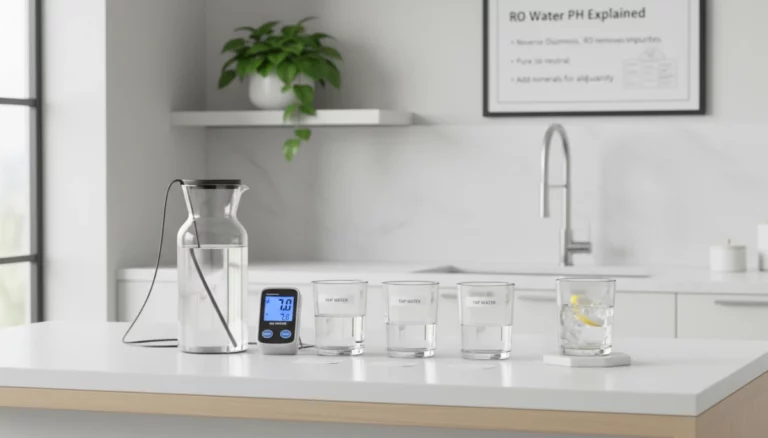
TDS (Total Dissolved Solids) is the sum of all dissolved minerals, salts, and trace metals in your water. It’s usually measured in ppm (parts per million).
In everyday tap water, TDS mainly comes from:
- Natural minerals (calcium, magnesium, sodium)
- Treatment chemicals (like residual chlorine)
- Old pipes and plumbing (possible metals)
- Local contamination (agriculture, industry, aging infrastructure)
Key point:
- Low TDS = fewer dissolved solids
- High TDS = more dissolved solids (can affect taste and sometimes safety)
TDS itself doesn’t tell you exactly what those solids are, but it does give a quick snapshot of how “heavy” or “clean” your water feels.
How RO Systems Reduce TDS and Improve Purity
A reverse osmosis (RO) system forces water through a semi-permeable membrane that blocks most dissolved solids. In real-world use, a good RO purifier can:
- Cut TDS by 90–95% (sometimes more, depending on source water)
- Remove a large share of salts, heavy metals, and other dissolved impurities
- Work together with pre-filters and post-filters for better taste and safety
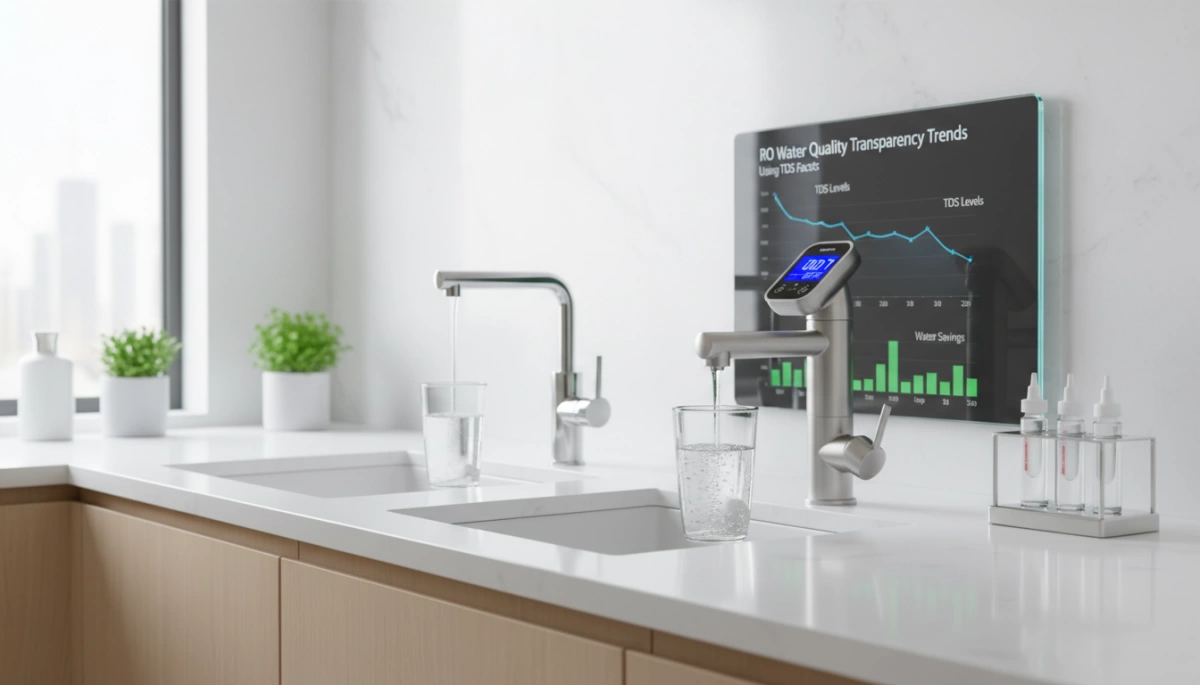
When you see a TDS display faucet showing a much lower number than your tap, that’s your visual water purity confirmation that the RO system is doing its job.
Ideal TDS Range for Good RO Drinking Water
For most homes in the US, after RO filtration:
- 50–150 ppm: Common “sweet spot” for safe, good-tasting RO water
- Below ~30 ppm: Very low TDS, often tastes “flat” or “too light” for some people
- Above ~200 ppm after RO: Often a red flag that your RO membrane or filters need attention
There’s no single “perfect” TDS level, but:
- Good taste + stable TDS + proper filtration = what you’re really aiming for.
Limits of TDS as a Water Quality Metric
Here’s where RO water quality transparency needs to be honest:
What TDS can show:
- Overall load of dissolved solids
- RO performance trends over time (TDS creep, membrane wear)
- When something is off with your filtration (sudden TDS jump)
What TDS cannot show:
- Specific contaminants like PFAS, pesticides, or many organic chemicals
- Microbiological issues (bacteria, viruses)
- Chlorine levels, odor-causing compounds, or all heavy metals individually
So while real-time TDS monitoring is powerful, it’s not a full lab report. It’s one key metric in your RO water safety verification, not the whole story.
Why TDS Still Matters for RO Water Transparency
Even with its limits, TDS is still one of the most practical transparency tools for home RO systems:
- It gives instant, visible proof that your RO is reducing dissolved solids.
- It lets you track RO membrane performance and filter replacement timing.
- It builds consumer trust in RO systems by moving from “just trust us” to data you can see at the faucet.
- It supports informed water filtration choices without needing lab tests every month.
That’s why TDS display faucets, integrated TDS meters in RO purifiers, and digital TDS faucet displays are becoming standard: they turn something you used to guess into something you can watch, measure, and trust every day.
RO Water Transparency Evolution
For years, home filtration was a “trust us” purchase. You installed an RO system, hoped it worked, and maybe checked a report once a year. That doesn’t fly anymore. With PFAS headlines, lead scares, and high TDS tap water issues in many U.S. cities, people now want real RO system transparency, not marketing claims.
When news stories exposed contaminants slipping through old plumbing and aging infrastructure, expectations for RO water purification changed fast. Families started asking: “How do I actually know my water is safe today?” That push is exactly what turned water quality visibility and real-time TDS monitoring into must-have features instead of nice-to-have extras.
Social media and online reviews accelerated this shift. Users post their TDS levels in drinking water, compare screenshots, and call out brands when the numbers don’t match the promise. That public pressure rewards systems that offer visual water purity confirmation and punishes ones that still ask for blind trust.
Because of this, we’ve moved from loose, manual checks with a handheld TDS pen to integrated TDS meter faucets that show the number every time you turn on the tap. A TDS display faucet gives point-of-use TDS measurement right where you drink—no guessing, no tools, no extra steps. In my view, this is the core of the tds transparency RO trend: visible numbers, daily reassurance, and RO brands being held accountable in real time.
TDS Display Faucets Explained
How TDS display faucets actually work
A TDS display faucet has a small inline RO TDS sensor installed right before the spout. As water flows through, the sensor measures the total dissolved solids (TDS) in real time and sends that data to a digital TDS faucet display on the handle or faucet body. You turn on the tap, and within a few seconds you see the TDS level in your RO water—no separate pen-style meter, no guessing, just instant visual water purity confirmation at the point of use.
Real-time TDS monitoring at the faucet vs tank readings
A built-in TDS meter in the RO purifier faucet shows you the quality of the water you actually drink, not just what’s sitting in the tank. Tank readings can be:
- Mixed with older water
- Affected by storage time and temperature
Point-of-use TDS measurement at the faucet gives real-time TDS monitoring of the final water, after it’s passed through all filters, tubing, and the faucet itself. That’s real RO system transparency, not lab conditions.
Instant visual proof of RO performance
With a smart RO faucet and digital display, you don’t have to “trust” that your RO is working—you see it. A quick glance at the TDS levels in drinking water tells you if your RO system is delivering the low-TDS water you paid for. This kind of water quality visibility builds consumer trust in RO systems and makes it easy for any family member to verify RO water safety in seconds.
If you also want filtered water at other points in your kitchen, pairing a TDS faucet with a kitchen faucet with built-in filtration can create a fully visible, whole-sink purification setup.
Spotting issues early: TDS creep, filter exhaustion, and membrane wear
Live TDS data helps you catch problems before they turn into bad-tasting or unsafe water. Watch for:
- TDS creep – TDS starts low but slowly rises during each use
- Filter exhaustion – TDS numbers gradually climb week by week
- RO membrane wear – TDS jumps and stays higher than normal
These patterns are early warning signs that it’s time for filter replacement, RO membrane checks, or full system service. That’s why RO water quality monitoring at the faucet is becoming a must-have feature for health-conscious households that want data-backed confidence in their water.
RO Water Quality Transparency Trends in 2026
Why visible water quality is now a must‑have
By 2026, RO water quality transparency isn’t a “nice-to-have” add‑on anymore. It’s expected. With constant news about PFAS, heavy metals, and water system failures, people in the U.S. want visible proof their RO system is actually working. A TDS display faucet gives that proof in real time, at the exact point where you drink the water. That kind of RO system transparency builds daily confidence instead of blind trust.
Smart RO faucet trends in modern homes
Modern U.S. kitchens are going “smart,” and the RO faucet is part of that shift. The big trends I see:
- Real-time TDS monitoring built into the faucet, not a loose handheld meter
- Digital TDS faucet displays that are bright, easy to read, and kid-friendly
- Smart RO faucets that tie into home apps for usage tracking and reminders
- Minimalist, stainless designs that match premium kitchen fixtures
For many buyers, a “normal” RO faucet now feels outdated compared to a TDS meter in the RO purifier built into the tap itself.
High‑TDS regions driving TDS-visible RO systems
In parts of the U.S. with hard, high-TDS tap water (Texas, Arizona, parts of California, the Midwest), people are already used to scale, salty taste, and brittle fixtures. For these households, visible water quality isn’t optional; it’s the only way to verify their RO system is cutting those dissolved solids down to a safe, comfortable level.
- High-TDS areas are seeing faster adoption of TDS-visible RO systems
- Homeowners compare TDS levels in drinking water before vs. after RO
- Rising TDS (TDS creep) becomes a clear signal it’s time to change filters or check the membrane
If your home struggles with hard water, this is also where RO systems with built-in polyphosphate filters can help protect plumbing and improve overall performance of your TDS‑monitored setup, as explained in this guide on why RO systems for hard water need built-in polyphosphate filters.
How younger, health‑aware buyers shop for RO systems
Younger, health-focused buyers in the U.S. are driving a big part of this tds transparency RO trend. They:
- Look for visible proof of water purification, not just marketing claims
- Read reviews about RO water purification trends, PFAS, and heavy metals
- Prefer transparent RO filtration with numbers on the tap, not just “clean” icons
- Want informed water filtration choices backed by real-time data
For this group, a TDS display faucet isn’t a gimmick. It’s a trust-building feature that fits how they already live—tracking sleep, steps, heart rate, and now, the quality of the water they drink every day.
Why TDS Faucets Change Consumer Expectations
TDS display faucets completely reset what people expect from an RO system. Instead of “just trust the filter,” you get real-time TDS monitoring right where you fill your glass. That visible number on the faucet turns water quality from a mystery into a daily data point you can actually use.
From blind trust to data-backed confidence
With a TDS display faucet, you don’t have to guess if your RO is working—you see it:
- You can compare high TDS tap water vs low TDS RO water instantly.
- If the TDS jumps, you know it’s time to look at filters or the membrane.
- You’re not relying on marketing claims; you’re relying on visible proof of RO performance.
That transparency builds real consumer trust in RO systems because the system has to prove itself every day.
Live readings = informed filtration choices
Live TDS readings help you make smarter decisions instead of overbuying or over-servicing:
- Choose the right RO system transparency level for your local water (especially in high-TDS areas).
- Decide when to upgrade filters or add extra stages based on actual TDS, not guesswork.
- Match TDS levels in drinking water to your taste and health preferences (some families like very low TDS, others prefer a bit of mineral content).
This kind of data-backed clarity is a big part of how health-conscious families in the US now shop for smart RO faucets and transparent RO filtration.
Less buyer’s remorse, more daily habit
When your faucet shows a digital TDS faucet display every time you pour, you:
- Feel better about the money you spent—because you can see the purification working.
- Catch TDS creep early, so you don’t suddenly realize your system has been underperforming for months.
- Build a habit of just glancing at the number, like checking your thermostat or smartwatch stats.
That daily water quality visibility becomes part of the kitchen routine, and it’s a big reason US buyers are shifting toward integrated TDS meter faucets and RO systems with built-in transparency, like modern under-sink RO water filters with smart-ready designs.
Benefits of TDS Display Technology in RO Systems
Building trust and real brand loyalty
With a TDS display faucet, I’m not asking customers to “just trust” the RO system — they see the numbers every day. That kind of real-time TDS monitoring builds confidence and long-term loyalty because:
- Users get visual water purity confirmation every time they turn on the faucet
- Service calls are about facts, not guesses
- Brands that show data win over brands that hide it
| Trust Factor | Without TDS Display | With TDS Display Faucet |
|---|---|---|
| Daily confidence | Based on taste only | Based on live TDS readings |
| Support conversations | “Water feels off” | “TDS jumped from 30 to 120 this week” |
| Brand perception | Generic purifier | Transparent RO system with proof |
Smarter maintenance timing using TDS changes
A good TDS meter in an RO purifier removes the guesswork from filter changes:
- Rising TDS = filter exhaustion or membrane wear
- Slow TDS creep = time to schedule service, not panic
- Stable low TDS = no wasted money on early filter swaps
That means lower lifetime cost, fewer surprises, and better RO membrane performance tracking.
Helping families understand water quality at a glance
Most people in the U.S. don’t want lab reports — they want something simple they can trust:
- Clear digital TDS faucet display right where they fill bottles and cook
- Kids and adults can learn what good TDS levels in drinking water look like
- Water quality visibility becomes part of the daily routine, like checking a thermostat
Standing out in a crowded RO market
RO systems all claim “99% pure.” A TDS display faucet actually proves performance:
- Easy visual confirmation of RO quality during demos and sales
- Strong upgrade path from basic taps to smart RO faucet setups
- Perfect fit alongside other smart water options like a hot water dispenser with filter in modern kitchens, as you’ll see in our filtered hot water dispenser line.
In a market full of similar claims, RO system transparency is a real differentiator.
Supporting health‑first households with verifiable purity
Health‑conscious buyers care about PFAS, heavy metals, and dissolved solids. TDS doesn’t show everything, but:
- A low, stable TDS number confirms the RO is doing its job
- Visible changes trigger smart, informed water filtration choices
- Families focused on wellness get data-backed confidence instead of blind faith
For U.S. homes that want better control over what they drink, TDS transparency in RO isn’t a bonus anymore — it’s expected.
Driplife TDS Faucet Solutions
Real-time TDS display faucet design
At Driplife, I design every TDS display faucet around one idea: real-time TDS monitoring right where you drink. Our integrated TDS meter sits close to the water outlet, so you see point‑of‑use readings, not just tank numbers. That means when you open the faucet, the digital TDS faucet display shows live RO performance, helping families in the U.S. and worldwide get instant visual water purity confirmation.
Accuracy, stability, and user-friendly display
For me, accuracy and stability are non‑negotiable. Driplife TDS display faucets use:
- Calibrated RO TDS sensor technology with tight tolerance
- Fast response time so readings update quickly as water flows
- Clear, high‑contrast display that’s easy to read from across the kitchen
The result is a smart RO faucet that gives honest, stable TDS levels in drinking water, supporting informed water filtration choices and building long-term consumer trust in RO systems.
Pairing with efficient RO systems
Driplife faucets are engineered to pair perfectly with modern RO systems, whether it’s an under-sink unit, a smart RO purifier, or a countertop RO system for home and office. When our TDS display faucet is matched with a high-rejection RO membrane and smart filters, you get:
- Consistent low TDS RO water
- Transparent RO filtration you can verify on the spot
- Easy RO membrane performance tracking via daily readings
This is exactly how I like to position our solutions when families shift from bottled water to high-efficiency RO systems that deliver better long-term value than disposables, similar to what I highlight in our breakdown of the ROI of replacing bottled water with RO (https://driplifecorp.com/the-roi-of-ro-why-every-family-should-replace-bottled-water/).
Quality assurance and testing
I treat quality assurance in water purifiers as a core part of our brand. Every Driplife TDS faucet goes through:
- Electrical safety and waterproof testing
- Long-cycle flow and fatigue tests on valves and displays
- Sensor calibration checks across different TDS ranges (soft, normal, and high-TDS water)
That’s how we keep RO water quality monitoring reliable in real kitchens, not just in lab conditions, and turn quality visibility in RO into a real selling point, not a gimmick.
Built for global markets and different water conditions
Because Driplife is a global manufacturer, I design our TDS display faucet lineup to handle:
- High TDS tap water issues in hard-water regions
- Variable municipal water quality across U.S. cities and suburbs
- Different RO configurations, pressure ranges, and plumbing standards
Whether you’re dealing with very hard water, older pipes, or just want better water quality visibility in a new smart home, Driplife’s integrated TDS meter faucet is built to adapt. That flexibility is what makes our TDS transparency RO trend solutions work just as well in American homes as they do in other demanding markets.
Choosing a TDS-Enabled RO Faucet
When you’re picking a TDS-enabled RO faucet, you’re really choosing how much control and confidence you want over your drinking water. Here’s how I’d look at it.
Check TDS Sensor Accuracy & Response Time
For real-time TDS monitoring to mean anything, the numbers have to be trustworthy.
- Look for ±2–5% accuracy on the TDS sensor spec.
- Response time should be under 5–10 seconds so you see changes quickly when the RO system turns on.
- Prefer inline TDS sensors designed for RO water lines, not cheap “gadget” probes.
- If possible, choose a faucet that allows periodic calibration with a standard TDS solution.
Pick Safe, Durable Faucet Materials
You’re drinking this water every day, so materials matter.
- Go for lead-free, NSF/ANSI-compliant metals (brass body with safe plating or stainless steel).
- Pick corrosion-resistant finishes (brushed nickel, chrome, stainless) that can handle low TDS RO water.
- Make sure the water path is food-grade and designed for purified water, not just tap.
Installation, Compatibility & Retrofit
A good TDS display faucet should fit into a normal U.S. kitchen without drama.
- Confirm it’s compatible with standard RO systems and 1/4″ or 3/8″ tubing.
- Check if it supports retrofit on an existing RO purifier so you don’t have to replace your whole system.
- Look for clear install instructions and plug-and-play wiring for the digital TDS faucet display.
- If you’re already using RO for coffee or seltzer, pairing a TDS faucet with an existing system that improves health and saves money, like a reverse osmosis setup for home use, makes the upgrade even more logical.
Smart Features That Actually Help
Modern smart RO faucets do more than just show a number.
- Alerts and notifications when TDS rises past a set limit (filter or membrane likely due).
- Low-TDS warnings if water is too “flat” for taste and remineralization might be needed.
- Usage tracking (gallons or days) tied to filter replacement indicators.
- Backlit digital display so you can see TDS levels at a glance, day or night.
How to Read, Calibrate & Trust Your TDS Display
You don’t need to be a water geek to use a TDS display faucet every day.
- Aim for RO water TDS in the ~10–100 ppm range, depending on your source water and system.
- Expect a slight rise in TDS at the start of flow (TDS creep), then a stable reading.
- If numbers drift over time, use a known TDS calibration solution (per the manual) to reset accuracy.
- Trust patterns, not single readings: steady upward TDS trend = time to check filters or RO membrane.
When you choose a TDS-enabled RO faucet with reliable sensors, safe materials, easy installation, and smart features, you’re not just buying a faucet—you’re buying daily, visual proof that your water is as clean as you expect.
Using TDS Readings in Daily Life
What’s a good TDS level after RO at home?
For most homes in the U.S., a good TDS level after RO usually lands around:
- 20–70 ppm – Very clean, still has a bit of mineral taste
- 70–120 ppm – Still fine for most families, especially if tap water TDS is very high
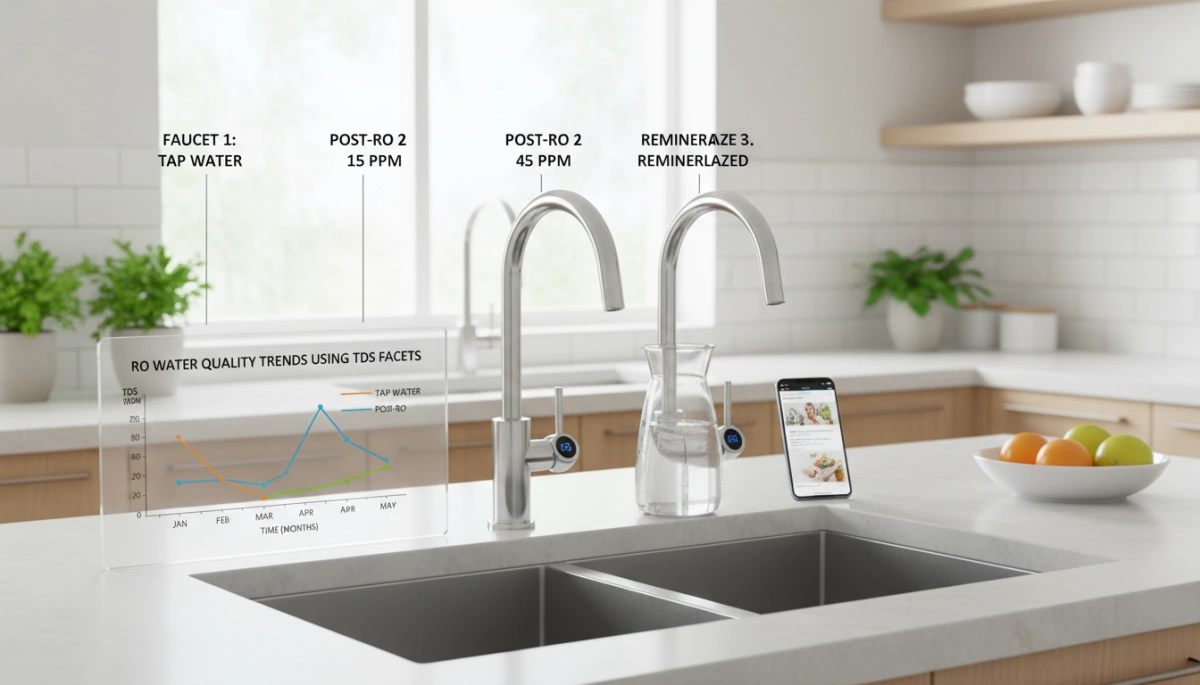
More important than the exact number is how much TDS the RO system removes. If your tap water is 400 ppm and your RO faucet shows 40–80 ppm, your system is doing its job with strong RO water quality transparency.
How often should you check your TDS display faucet?
You don’t need to obsess over the number, but you should build a simple routine:
- Quick glance daily – While filling a bottle or cooking
- More careful look weekly – Notice any steady climb in TDS
- Record it monthly – Snap a photo or note the value in your phone
This keeps real-time TDS monitoring useful without turning it into a chore.
Normal TDS fluctuations vs real problems
Some TDS changes are totally normal:
- First few seconds after turning on the RO faucet
- After the system hasn’t run for several hours
- Small shifts (±10–20 ppm) based on incoming city water changes
But watch for red flags:
- TDS slowly rising week after week
- TDS suddenly jumping to 2–3x your normal RO level
- RO water TDS getting close to your tap water TDS
That’s when your TDS display faucet is telling you something is wrong, not just “normal noise.”
When does rising TDS mean service time?
Use rising TDS as a practical maintenance trigger:
- Gradual climb over months
- Likely RO membrane wear or pre-filters getting clogged
- Time to schedule a check or replace filters
- Sharp spike in TDS
- Possible membrane failure, bypass, or service issue
- Shut off the system if it’s near tap-water levels and call support
Pairing live TDS readings with smart maintenance (and features like an auto-flush function that protects membrane life, as explained in this guide on why auto-flush functions extend RO membrane longevity) gives you data-backed confidence that your RO water is actually clean—not just “probably fine.”
FAQs on TDS Faucets and RO Transparency
What is a good TDS level after RO filtration?
For most homes in the U.S., a good TDS level after RO is usually in the 30–120 ppm range.
- Below 20 ppm: Very pure, but some people feel it tastes “flat.”
- 50–120 ppm: Sweet spot for safe, good-tasting RO water.
What matters most is stable, consistently low TDS compared to your incoming tap water, not chasing “0” at all costs.
How accurate are TDS display faucets in real use?
A quality TDS display faucet is usually accurate within ±2–5% when:
- The sensor is properly calibrated
- The probe is kept clean
- Water is flowing (TDS is measured best under flow, not in stagnant water)
Our approach is to use stable RO TDS sensor technology that’s tuned for real-time TDS monitoring, not lab work—good enough for daily RO water quality monitoring and spotting problems fast.
Do TDS faucets need extra maintenance or care?
Very little, but not zero. To keep RO system transparency reliable:
- Wipe the faucet and display gently to avoid moisture damage
- Don’t scratch or bend the sensor probe
- Ask your installer to check calibration during regular RO service
- Avoid harsh chemicals on the faucet body
If the display ever looks “stuck” or way off from a handheld TDS meter in your RO purifier system check, it’s time for a quick service or recalibration.
Can TDS readings change during the day, and why?
Yes, and that’s normal. TDS levels in drinking water can move slightly because of:
- Temperature changes (warmer water can read a bit higher)
- Start/stop usage (first few seconds may show a small TDS spike)
- Tank cycling (as the RO tank fills and empties, readings can drift a bit)
What you want to watch is trend, not every tiny fluctuation. A steady climb over days or weeks (TDS creep) is a stronger signal than minute‑to‑minute changes.
Do TDS displays show all contaminants in water?
No. This is a big point in transparent RO filtration education.
A digital TDS faucet display measures total dissolved solids, but it does not directly show:
- Specific heavy metals like lead or arsenic
- PFAS, pesticides, or most organic chemicals
- Bacteria or viruses
TDS is a powerful tool for visual water purity confirmation and RO membrane performance tracking, but it’s not a full lab test. It tells you how the RO is performing, not every single contaminant in the water.
Is a low TDS reading always better for health?
Not necessarily. RO water safety verification is about:
- Removing harmful contaminants
- Keeping TDS low enough
- Still allowing a comfortable taste and some minerals (if you prefer)
Ultra‑low TDS isn’t automatically “healthier.” Many U.S. families prefer low TDS RO water that’s also remineralized for taste and balance. The real win is predictable, visible proof that your filter is doing its job—something modern smart RO faucet designs and point‑of‑use TDS measurement finally give us.
If you’re also thinking about a compact setup that shows clear water quality visibility at the point of use, our countertop cold-water purifier line is built around the same transparency-led RO growth mindset and fits right into modern U.S. kitchens: countertop cold water purifier systems.