

















If you’re designing reverse osmosis (RO) systems today, you’re not just fighting scaling, fouling, and TDS anymore—you’re fighting regulations.
New water efficiency regulations are rewriting the rules of RO design.
Standards like EPA WaterSense, ASSE 1086, NSF/ANSI 58, and China’s GB 34914-2026 are pushing manufacturers to hit higher recovery rates, lower wastewater, and longer membrane life—without sacrificing contaminant rejection or driving costs through the roof.
In other words: the old 3–5:1 waste-to-permeate RO is dying.
High-recovery, water-efficient RO systems are becoming the new baseline.
In this post, you’ll see exactly how water efficiency regulations are influencing RO design in 2026—what’s changing in membrane selection, pretreatment, system configuration, and how manufacturers like Driplife are turning compliance into a competitive advantage.
Let’s get straight into how these rules are reshaping the next generation of high-efficiency RO systems.
Water Efficiency Regulations Influencing RO Design
Reverse osmosis can no longer be designed on “best effort” efficiency. Water efficiency regulations for RO systems now dictate how much water we can waste, how long membranes must last, and how performance is verified in the lab and in the field. When I design or specify RO, I start with regulation, not hardware.
Global Regulatory Drivers for RO Water Efficiency
Across markets, regulators push three core outcomes:
- Higher reverse osmosis water recovery rate (more permeate, less waste)
- Lower RO waste-to-permeate ratio (e.g., 1:1 instead of 4:1)
- Verified contaminant reduction under standard test conditions
Key drivers:
- Water scarcity and drought (US, Middle East, parts of China, EU)
- Utility and building codes demanding water-saving equipment
- Green certifications (LEED, corporate ESG goals)
- Consumer expectation for “water saving RO system design”
US EPA WaterSense Requirements for RO
The EPA WaterSense RO specification (for point-of-use systems) focuses on:
- Minimum recovery rate (typical target: ~30–40%+ depending on config)
- Maximum waste-to-permeate ratio (e.g., ~2:1 or better under test)
- Standardized inlet conditions (pressure, TDS, temperature)
- Clear labeling so users know the RO system wastewater reduction performance
In practice, if you want a WaterSense-aligned design, you must:
- Integrate permeate pumps or similar recovery enhancers
- Optimize flow restrictors and orifice sizing
- Control flush cycles to avoid unnecessary waste
ASSE 1086: Efficiency and Membrane Life
ASSE 1086 is a key RO efficiency standard for POU systems in North America. It sets:
- Benchmarks for recovery and waste ratio
- Membrane life testing under cycling and fouling conditions
- Limits on performance degradation over time
From a design standpoint, this forces us to:
- Use high efficiency RO membranes with stable flux
- Design pretreatment to protect membrane life
- Build in flow balance that holds recovery without over-stressing the membrane
NSF/ANSI 58: Efficiency and Contaminant Reduction
NSF/ANSI 58 certification for RO filters is still the baseline for credibility in the US:
- Contaminant reduction claims (e.g., lead, arsenic, TDS, cysts) must be tested and verified
- Efficiency rating: standardized recovery rate and product water efficiency metrics
- Structural integrity, materials safety, and pressure resistance
To pass NSF/ANSI 58 while still hitting efficiency targets, we:
- Balance high recovery reverse osmosis design with rejection performance
- Carefully pair TFC RO membrane technology with flow control hardware
- Use realistic design margins so field performance matches lab data
China GB 34914-2026 Water Efficiency Grades
China GB 34914-2026 water purifier efficiency grades define strict tiers (especially for RO):
- Grade 1 (highest efficiency)
- Grade 2
- Grade 3 (minimum acceptable)
Key RO-related metrics include:
- Water efficiency grade (based on recovery and wastewater volume)
- Wastewater ratio (e.g., around 1:1 for Grade 1 residential RO in many configurations)
- Rated total purified water volume (membrane durability)
This standard has pushed the global market toward:
- High-recovery reverse osmosis design as the norm, not the exception
- Concentrate recirculation and permeate pumps in compact POU systems
Industrial and Commercial Water Reuse Policy Impacts
For commercial and industrial RO, policy pressure is different but equally strong:
- Water reuse regulations and discharge limits drive higher recovery
- Many regions require water reuse plans for high-demand facilities
- Tight limits on concentrate discharge (TDS, salinity, metals, volume)
Design responses:
- Multi-stage RO with staged recovery
- Concentrate recirculation and blend loops
- Integration with cooling towers, boilers, or process reuse
Recovery Rate Requirements Across Major Standards
Below is a simplified comparison of how key standards look at RO water efficiency (approximate; actual limits depend on product type and test conditions):
| Standard / Program | Focus Area | Typical Efficiency Angle |
|---|---|---|
| EPA WaterSense (US) | Residential POU RO | Minimum recovery / max waste ratio; labeled efficiency |
| NSF/ANSI 58 (US) | Residential/Light Commercial RO | Tested efficiency rating + contaminant reduction |
| ASSE 1086 (US) | POU RO performance & life | Recovery benchmarks + membrane life / durability |
| GB 34914-2026 (China) | Residential RO purifiers | Water efficiency grades (Grade 1–3) based on recovery & waste |
| Local industrial reuse rules | Commercial / industrial RO | High recovery to reduce intake and concentrate discharge |
Across these, one theme is clear: regulatory compliance for RO filters now starts with water efficiency, not just contaminant removal. Any serious RO design for the US market—and for export—must be built around these standards from day one.
How Water Efficiency Regulations Reshape RO Design Principles
Water efficiency regulations for RO systems are forcing a full rethink of how we design and size every component. In the U.S. especially, rules and buyer expectations around reverse osmosis water recovery rate, waste-to-permeate ratio, and energy use are no longer “nice to have” – they’re the baseline.
Regulations Pushing Higher RO Recovery and Lower Waste
Today’s standards push RO systems toward much higher recovery and far less drain water. For point‑of‑use units under the sink, that means aiming for:
- 40–65%+ recovery rates (or better, depending on feed water)
- Tighter RO waste-to-permeate ratios like 1:1–2:1 instead of the old 4:1–5:1
For U.S. households dealing with rising water and sewer costs, this isn’t just about compliance – it directly cuts monthly bills and makes an RO unit easier to justify versus bottled water.
Designing for Tighter Waste-to-Permeate Ratios
To hit aggressive water saving RO system design targets, we build around:
- Correctly sized flow restrictors and capillaries
- More efficient drain and recirculation layouts
- Permeate pump integration to recover pressure energy and boost efficiency
On our high‑capacity 600–1200 GPD under-sink RO systems, for example, the hydraulic design is tuned first for recovery and waste ratio, then we size other parts around that.
Balancing Efficiency with Contaminant Rejection
Regulations don’t let you trade water savings for weak filtration. We have to balance:
- High recovery vs. high contaminant rejection (TDS, PFAS, heavy metals, etc.)
- Stable performance over the full membrane life, not just on day one
That’s why we pair high-efficiency RO membranes with smart pretreatment and flow control, so U.S. users get both strong contaminant reduction and real water savings.
Impact on Operating Pressure and Energy Use
Higher recovery often means higher operating pressure. To stay compliant and efficient, we:
- Use low-energy, high-permeability membranes that hit target rejection at lower pressure
- Optimize pump sizing so we’re not wasting power to chase efficiency
- Keep an eye on total kWh per gallon of purified water
The goal is simple: more drinking water, less drain, without turning your RO into a power hog.
Design Margins and Real-World Safety Factors
Tap water in the U.S. isn’t consistent from city to city, so we design with margin:
- Extra safety factors for hardness, TDS, and temperature swings
- Recovery and waste ratios that stay compliant even as membranes age
- Built-in monitoring options so OEMs and brands can prove regulatory compliance for RO filters over time
When we engineer a system, we don’t design for the lab – we design for the real kitchen, the real office, and the real water conditions users deal with every day.
RO Wastewater Reduction Strategies Under New Rules
New water efficiency regulations are forcing us to design RO systems that waste far less water while keeping performance stable. Here’s how we actually cut RO wastewater in real-world U.S. homes and light commercial setups.
Permeate Pump Integration to Boost RO Recovery
A permeate pump is one of the simplest, highest-ROI upgrades for better RO water recovery rate and a tighter waste-to-permeate ratio.
- Uses reject water energy to push permeate into the tank
- Reduces back-pressure on the membrane
- Typically improves recovery from ~20–25% up to 35–50%+
- Cuts drain flow, so you meet tougher RO waste-to-permeate ratio limits
For tankless RO units (similar to how we optimize flow paths in our tankless RO filter designs), pairing a permeate pump with smart control valves is often enough to hit new efficiency benchmarks.
Concentrate Recirculation and Loop Design
Concentrate recirculation is a core RO wastewater reduction strategy under new rules:
- Part of the brine (concentrate) is looped back to the feed side
- Increases overall system recovery without spiking inlet demand
- Cuts total wastewater flow while maintaining crossflow to protect the membrane
We design recirculation loops with strict limits on concentration factor to avoid scaling and to stay within high-recovery reverse osmosis design safety margins.
Low-Energy, High-Permeability Membranes
High-efficiency RO membranes are now a must, not a luxury:
- Low-energy TFC membranes produce more permeate at lower pressure
- High-permeability membranes allow higher recovery without over-sizing pumps
- Reduce energy use while helping meet WaterSense-style RO efficiency requirements
Pairing these with solid pretreatment (sediment + carbon, or even multi-layer filtration like in our multi-layer faucet filter designs) keeps fouling down and membrane life up.
Optimized Flow Paths and Hydraulics
Water saving RO system design lives or dies on hydraulics:
- Shorter, smoother flow paths = lower pressure drop
- Proper sized tubing and fittings = stable crossflow and better membrane flushing
- Balanced flow restrictors tuned for the specific membrane and local water quality
We treat flow path optimization like hardware-level efficiency tuning—this is how we hold tight RO waste-to-permeate ratio limits in the field, not just in lab testing.
Smart Flushing and Cleaning Strategies
Smart flushing is critical for maintaining recovery rates over time under stricter water efficiency regulations:
- Automatic fast flush at startup and shutdown to clear concentrate
- Periodic high-flow flush cycles to limit scaling at elevated RO recovery
- Intelligent cleaning reminders or auto-clean sequences to reduce fouling
This keeps the reverse osmosis water recovery rate closer to “day one” performance and helps systems stay compliant with water efficiency regulations for RO systems over their full membrane life.
Component-level innovations in RO systems driven by regulations
Water efficiency regulations are forcing real, component-level innovation in how we build reverse osmosis systems. To hit tighter waste-to-permeate ratios and higher recovery rates, we have to rethink everything from membranes and pretreatment to controls and monitoring.
Advanced high-recovery RO membranes
High-recovery operation starts at the membrane:
- High-permeability, low-pressure RO elements push more water through at lower pressure, cutting both waste and energy.
- Tighter manufacturing tolerances improve salt rejection so we can safely operate at higher recovery without sacrificing contaminant removal.
- In residential point-of-use units, we pair high-efficiency RO membranes with optimized flow restrictors and permeate pumps to reach 50–65% recovery under real U.S. tap conditions.
Low-fouling, high-flux TFC membranes
To stay compliant over the full life of the system, membranes must stay clean:
- Low-fouling thin-film composite (TFC) membranes reduce organic and colloidal buildup, keeping efficiency stable longer.
- High-flux TFC designs deliver strong flow even at lower pressures, which helps us meet efficiency standards without oversizing pumps.
- Surface modifications and smoother membrane skins help reduce the need for aggressive chemical cleaning, extending membrane life in line with ASSE 1086 expectations.
Pretreatment upgrades for high-efficiency RO
Stricter water efficiency regulations mean pretreatment can’t be an afterthought:
- We use sediment and carbon stages to protect RO membranes from particulates and chlorine.
- For tougher feed water or higher recovery targets, we add specialty media like KDF, or even integrate them into custom dispensers through our ODM customization programs for multi-function dispensers.
- Stable pretreatment keeps fouling down, so recovery rate and waste ratios stay within specification for NSF/ANSI 58 and other standards.
Using ultrafiltration and microfiltration before RO
For higher-end and light commercial systems, pressure from water reuse policies is pushing more advanced pretreatment:
- Ultrafiltration (UF) removes fine colloids and microorganisms before RO, allowing higher RO recovery with lower fouling.
- Microfiltration (MF) handles larger particles and suspended solids so RO elements see cleaner feed.
- UF/MF + RO trains are ideal for buildings or small businesses targeting water reuse and low discharge volumes.
Antiscalants and pH control in high-recovery operation
At higher recovery, scaling can quickly kill efficiency:
- Antiscalant dosing is essential to keep calcium carbonate and sulfate salts from crystallizing on the membrane.
- pH control helps keep hardness and silica manageable so we can safely push recovery without hitting scaling limits.
- Correct chemistry control lets us design RO systems that meet aggressive recovery targets while protecting membrane life and keeping operating costs predictable.
Multi-stage and staged recovery RO configurations
To meet regulatory expectations on waste while staying practical in the field, we rely on smarter hydraulics:
- Two-stage and multi-stage RO sends the concentrate from one stage into the next, squeezing more permeate out of the same feed water.
- Staged recovery designs allow us to tune recovery by stage, optimizing performance for different U.S. water qualities and local discharge rules.
- For commercial users, this often means reaching high global recovery without pushing any single stage into an extreme fouling or scaling regime.
Automated controls, sensors, and monitoring
Compliance isn’t just about the hardware – it’s about proving performance over time:
- Flow, pressure, and conductivity sensors track recovery rate, waste ratio, and rejection in real time.
- Smart controllers automatically adjust flushing, cleaning, and operating pressure to keep the system within target efficiency bands.
- For U.S. customers, this kind of monitoring gives clear proof that the system is meeting water efficiency expectations and helps brands document performance for marketing, labeling, and audits.
- When we help OEMs design systems for modern showrooms and integrated kitchens, we often tie this data into connected, smart dispensers so users can see water savings and filter status at a glance, similar to how we present premium kitchen water solutions in our professional showroom setups for water purifiers.
By upgrading membranes, pretreatment, system layout, and controls together, we build RO systems that don’t just pass today’s water efficiency regulations – they stay efficient in real-world U.S. homes and commercial sites over the long haul.
Technical challenges in meeting water efficiency regulations with RO
Designing RO systems around water efficiency regulation isn’t just “turn the recovery up and call it a day.” Once we start chasing higher recovery and tighter waste-to-permeate ratios, the technical challenges stack up fast.
Fouling and scaling risks at elevated RO recovery
When we push recovery higher, everything in the feed water gets concentrated harder. That means:
- More scaling risk (carbonate, sulfate, silica) on the membrane surface
- Faster fouling from organics, iron, and biofilm
- Higher differential pressure and more frequent downtime
For U.S. customers on hard or high‑TDS water, we typically solve this with:
- Stronger pretreatment (sediment, carbon, softening or antiscalant)
- Conservative recovery limits when TDS and hardness are high
- Clear service guidance so performance doesn’t crash six months in
Membrane lifespan and replacement cycles at high recovery
High recovery and tighter waste-to-permeate ratios stress the membrane:
- Higher osmotic pressure → higher operating pressure
- More scaling → shorter membrane life if pretreatment isn’t right
- More aggressive cleaning → potential membrane degradation
We plan membrane life assuming real‑world abuse, not lab conditions. For U.S. residential point‑of‑use RO, this usually means:
- Membrane life targets of 2–3 years under normal use
- Extra margin when dealing with high‑TDS or problem water (where we also recommend dual‑membrane solutions similar to our high‑TDS RO designs)
Cleaning, chemicals, and operating cost trade‑offs
To keep a high‑efficiency RO system in spec, you either clean more often, or accept lower recovery. Both cost money:
More cleaning:
- Higher chemical use
- More labor or service visits
- More downtime
Less cleaning:
- Faster membrane fouling
- Higher replacement frequency
We balance this by:
- Selecting low‑fouling TFC membranes
- Keeping cleaning protocols simple for residential and light commercial users
- Designing for reasonable, not extreme, recovery when water quality is poor
Passing NSF/ANSI 58, ASSE 1086, and GB 34914
Regulatory water efficiency standards are strict and test conditions are tough:
- NSF/ANSI 58 – efficiency rating, contaminant reduction, structural integrity
- ASSE 1086 – RO efficiency/waste ratios and membrane life benchmarks
- China GB 34914-2026 – graded water efficiency (Grade 1 is very aggressive)
Challenges include:
- Systems must hold spec at defined feed TDS, pressure, and temperature
- Efficiency claims must be repeatable, not “best case”
- We need built‑in design margin so aging membranes still pass
We engineer our RO layouts, flow restrictors, and permeate pumps around these requirements so we don’t just pass once in a lab, but stay compliant over time.
Balancing capex vs opex at high water efficiency
Pushing high recovery rates usually means:
- Higher capex (better membranes, pumps, controls, pretreatment)
- Lower opex (less water waste, potentially lower sewer and water bills)
Our design approach:
For U.S. homes:
- Use simple, robust components to keep entry cost reasonable
- Add permeate pumps and smart hydraulics where the water savings justify the price
For commercial/light industrial:
- Model payback on water and sewer savings
- Optimize membrane area vs pump size vs pretreatment capex
Concentrate disposal under stricter discharge limits
Higher recovery means more concentrated reject. Under stricter discharge rules, this becomes a design problem:
- Higher TDS and higher scaling potential in the concentrate
- Local rules may limit TDS, metals, or specific ions in sewer or drain
- In water‑tight buildings or campuses, concentrate may need pretreatment or blending
Our strategies:
- Use staged recovery instead of pushing one stage too hard
- Consider concentrate blending, equalization tanks, or partial reuse where regulations allow
- Size systems conservatively for locations with tight discharge permits
For OEM and brand customers, we engineer RO platforms that are “regulation‑ready” for the U.S., EU, and China, then fine‑tune components and settings to hit each market’s efficiency and discharge requirements without compromising real‑world reliability.
Design strategies to align RO systems with water efficiency regulations
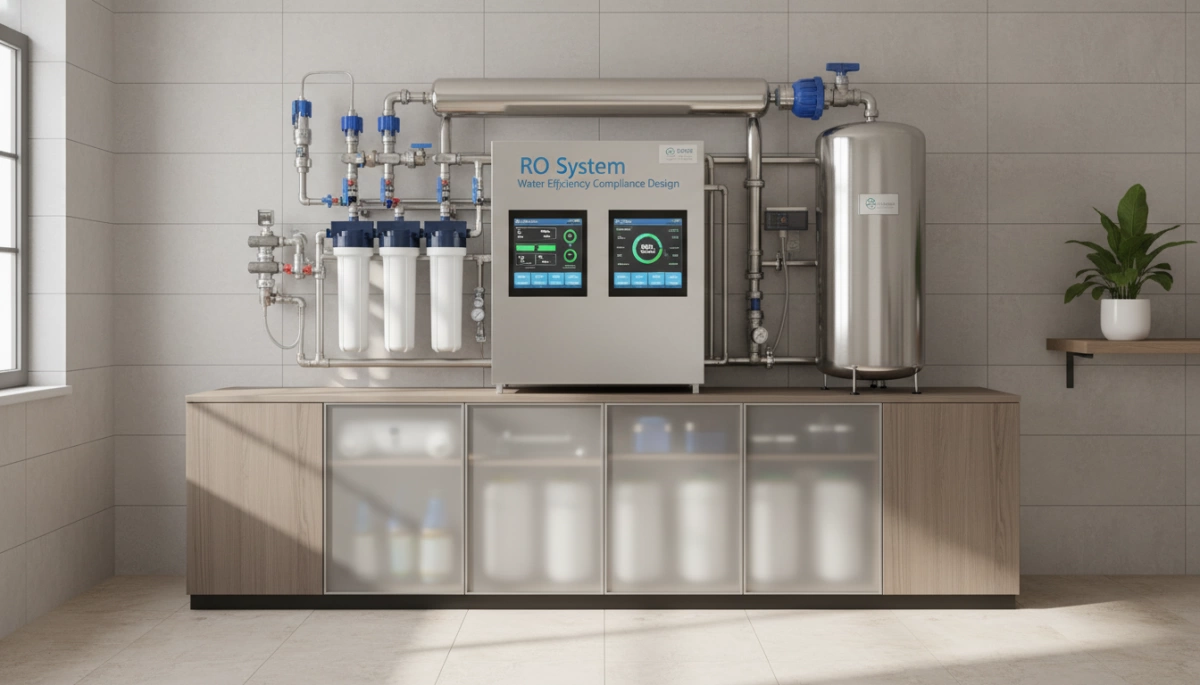
When I design reverse osmosis systems today, I start with water efficiency regulations first, then build everything else around them. If an RO unit can’t hit the required recovery rate, waste ratio, and certification marks, it doesn’t belong in the U.S. market.
Engineering RO units for different regional standards (US, EU, China)
To keep RO systems compliant and market-ready, I tailor designs by region:
- US – Design around NSF/ANSI 58, ASSE 1086, and the EPA WaterSense-style efficiency targets (where applicable). That means tested recovery, verified contaminant reduction, and realistic membrane life.
- EU – Focus on eco-design, low energy consumption, and support for water reuse policies. Documentation and test data are critical for regulators and facility managers.
- China – Build specifically for GB 34914-2026 water efficiency grades, especially Grade 1, with strict limits on the waste-to-permeate ratio and clear labeling of efficiency and membrane performance.
The same hardware doesn’t work everywhere. I adjust membrane selection, flow control, pressures, and control logic to match each region’s water efficiency regulations for RO systems.
Configuring residential point-of-use RO for 40–65%+ recovery
For residential point-of-use RO in the U.S., I design around 40–65%+ recovery without sacrificing taste or safety:
- Permeate pumps and better hydraulics to drive up the reverse osmosis water recovery rate.
- Precision flow restrictors to dial in the RO waste-to-permeate ratio and avoid over-flushing.
- High-rejection TFC membranes that still perform well at higher recovery.
- Simple, modular layouts that are easy to service and keep operating at the tested efficiency.
If the local water has high hardness or TDS, I’ll pair the RO with proper conditioning or pretreatment so the system can actually hold its certified efficiency in real homes. For example, homes dealing with very hard water benefit from upstream conditioning similar to what we discuss in our breakdown of water conditioner vs water softener solutions.
Designing commercial and light industrial RO for regulatory compliance
Commercial and light industrial RO design is all about hitting recovery and discharge limits while staying reliable:
- Size systems to meet local water reuse policies and concentrate discharge regulations.
- Use staged recovery (2-pass or multi-stage) to increase total recovery without over-stressing any one membrane stage.
- Design for continuous monitoring of flow, pressure, and conductivity so operators can prove they’re meeting internal and regulatory efficiency targets.
- Integrate pretreatment (softening, filtration, antiscalant) specifically tuned to support high efficiency RO water treatment.
I always design these units with clear, data-backed recovery assumptions, not theoretical “best case” numbers that disappear in the field.
Using modeling and pilot testing to validate RO efficiency
I don’t rely on guesswork. To validate water saving RO system design:
- I use RO modeling software with real feedwater data (TDS, hardness, silica, temperature).
- I run pilot tests to confirm the recovery rate, waste ratio, and scaling risk at full load.
- I simulate seasonal changes in feedwater quality so the unit stays compliant all year, not just on a good day.
This is essential before claiming any NSF/ANSI 58 certification-level efficiency or promising high recovery to customers.
Documentation and labeling for regulatory and customer transparency
Regulatory compliance for RO filters isn’t just about design; it’s also about clear documentation:
- Efficiency rating labels (recovery %, product-to-waste ratio) that match test reports.
- Certification marks (NSF/ANSI 58, ASSE 1086, GB 34914) clearly shown on spec sheets and packaging.
- Simple tables showing rated capacity, membrane life, and contaminant reduction performance under standard conditions.
- Operating manuals that spell out feedwater limits, maintenance needs, and what happens to performance if those limits are ignored.
This level of transparency builds trust with U.S. buyers who care about water usage, and it keeps OEMs and brands on the safe side of water efficiency regulation for RO systems.
How Driplife designs RO systems around water efficiency regulations
At Driplife, I design RO systems with water efficiency regulations as a starting point, not an afterthought. Every platform we build is mapped against US EPA-style WaterSense goals, NSF/ANSI 58, ASSE 1086, and China GB 34914-2026 so OEMs and brands don’t have to “retrofit” for compliance later. That means I lock in target recovery rates, waste-to-permeate ratios, and membrane life during the early engineering stage, then validate with modeling and lab testing.
Driplife’s approach to high-efficiency RO design for global markets
Because our OEM partners sell worldwide, I treat water efficiency regulation for RO as a global constraint. We design modular RO platforms that can be tuned for:
- Higher recovery and ultra-low waste for water-stressed US regions
- Stricter efficiency grades in China and Asia-Pacific
- Emerging EU and local utility rules on RO wastewater and concentrate discharge
By doing this, each customer can pick a compliance level (and price point) that fits their market without re-engineering from scratch.
Meeting and exceeding China GB 34914 Grade 1 efficiency targets
China’s GB 34914-2026 water purifier efficiency grades are some of the toughest in the world, especially Grade 1. We design our RO systems to meet and exceed Grade 1, focusing on:
- High recovery rate (often 55–65%+ in real homes)
- Stable performance across varying inlet TDS and temperature
- Long-term membrane life with controlled fouling and scaling
I validate contaminant reduction and efficiency with internal testing and third-party labs, using tools like a TDS tester to track real performance, just like in our guide on how to use a TDS tester accurately at home.
Design examples of residential RO with >60% recovery
For US residential point-of-use RO efficiency requirements, we routinely build systems that can hit >60% recovery under typical city water conditions. To get there, I combine:
- Permeate pumps to cut waste and boost pressure
- Optimized flow restrictors for better waste-to-permeate ratios
- Smart flushing cycles to maintain high recovery without trashing the membrane
The result: less water down the drain, stable TDS reduction, and a system that still feels “plug-and-play” for homeowners.
Optimized pretreatment packages in Driplife RO solutions
High-efficiency RO only works when pretreatment is dialed in. I bundle RO with optimized pretreatment packages like:
- High-capacity carbon water filter stages to protect the RO membrane from chlorine and organics (similar to the tech in our carbon water filter system solutions)
- Sediment filters sized for US municipal water quality
- Optional softening, pH control, or anti-scaling where needed
This pretreatment keeps the RO membrane clean, supports higher recovery, and extends service life to satisfy membrane life testing for RO certification.
Component selection and configuration philosophy at Driplife
My component and configuration philosophy is simple: design once, comply often. I focus on:
- Low-energy, high-permeability TFC RO membranes that hit target rejection at lower pressure
- Food-grade housings and tubing that meet US expectations
- Pumps, flow restrictors, and valves selected to hit strict RO waste-to-permeate ratio limits
Every part is chosen to help OEMs pass NSF/ANSI 58 certification for RO filters, ASSE 1086, and GB 34914 without repeated redesign.
Supporting OEMs and brands with compliant RO designs
I work with OEMs and private-label brands in the US to deliver regulatory-ready RO platforms. That support includes:
- Engineering systems to meet specific recovery rate and efficiency benchmarks
- Providing test data to support NSF/ANSI 58, ASSE 1086, and GB 34914 submissions
- Adjusting configurations (membranes, pumps, cartridges) to meet your local water and regulatory needs
You get a faster route to market with an RO line that already matches water saving RO system design expectations.
Future-focused R&D at Driplife for next-generation efficient RO
Looking ahead, my R&D focus is on next-generation high-efficiency RO membranes and smarter controls that make compliance easier and cheaper. That includes:
- Advanced high-recovery membrane materials with lower fouling
- Smarter sensing and monitoring to keep efficiency on target automatically
- Better integration of portable and under-sink reverse osmosis systems so they stay efficient over their full life, similar to our work on portable reverse osmosis systems and real-world use
For US brands, that means being ready for future compliance RO rules and staying ahead of competitors on water efficiency, not just keeping up.