














The Hidden Cost of “Roughly Right” Filtration
Are you guessing your flow rates? In commercial water treatment, “close enough” costs money. When you operate a high-capacity reverse osmosis system, relying on estimated flow data is a massive financial leak.
Defining High GPD in Commercial Applications
In the commercial sector, High GPD means systems pushing anywhere from 1,000 to over 10,000 Gallons Per Day. At this volume, a minor 5% sensor drift isn’t a simple rounding error. It translates to thousands of gallons of wasted water and hundreds of dollars in lost efficiency. You need precise water measurement RO to keep operations profitable and predictable.
The Financial Impact of Sensor Errors
Bad data drains your budget. Here is exactly what happens when your volumetric flow measurement is off:
- Wasted Water: Skewed data forces you to dump perfectly good water down the drain.
- Spiked Energy Bills: Pumps run longer and harder when flow feedback RO signals are inaccurate.
- Ruined Equipment: Misjudging your permeate to concentrate ratio destroys expensive membranes fast.
Membrane Health & Accurate Recovery Ratios
Flow sensor accuracy in high GPD RO systems directly dictates the lifespan of your membranes. If your sensors read artificially high, you will push the system past its safe limits. This triggers rapid scaling and irreversible damage.
Execute a precise RO recovery rate calculation to maintain system health. Accurate data is your primary tool for membrane fouling prevention.
Why We Prioritize Data Integrity at Driplife
Hardware is only as good as the data controlling it. At Driplife, we engineer our systems for intelligent monitoring RO because we know guesswork destroys margins. We build our equipment to deliver real-time water usage tracking and data driven RO control. You get absolute certainty, stable performance, and a system that protects your bottom line.
Why Flow Sensors Drift: The Physics of Inaccuracy
Maintaining flow sensor accuracy in high GPD RO systems isn’t just about buying expensive electronics. Even the best meters will drift over time because they are constantly fighting the laws of physics. Understanding these physical forces is the first step to securing reliable, data-driven RO control.
Here is exactly what causes your flow sensors to lose calibration in the field.
Hydrodynamic Turbulence in Pipes
When moving massive volumes of water, fluid dynamics get chaotic. High-pressure RO pumps create intense hydrodynamic turbulence in pipes. If the Reynolds number in pipe flow spikes before the water hits the sensor, the meter reads this erratic, swirling movement as false volume. Accurate volumetric flow measurement demands smooth, laminar flow. Without it, your data is compromised the second the water leaves the pump.
The “Low Flow” Blind Spot
Every time a commercial RO system fires up, there is a ramp-up period. Many mechanical meters have a distinct blind spot during this start-up phase.
- The Issue: The impeller or turbine simply doesn’t spin fast enough to register the initial low-pressure water push.
- The Impact: Over weeks of daily operation, these unrecorded start-up gallons compound. This hidden volume severely skews your precise water measurement RO data and throws off your true recovery calculations.
Scaling and Biofouling Effects
Hard water doesn’t just choke filters; it wrecks sensor reliability RO. Calcium, magnesium, and biofilm naturally build up on the internal components of a flow meter. This scaling physically reduces the internal pipe diameter and adds friction to moving parts, forcing the sensor to under-report the actual flow rate. While operators heavily prioritize membrane fouling prevention through advanced antiscaling technology, protecting the sensors from this exact same mineral buildup is mandatory for accurate flow feedback.
Temperature and Viscosity Shifts
Water changes behavior based on its environment. Cold winter water is significantly more viscous (thicker) than warm summer water.
- Mechanical Drag: Higher viscosity increases the drag on mechanical turbine blades and paddle wheels.
- Seasonal Drift: If your high GPD system operates in an uninsulated commercial facility, these seasonal temperature swings will naturally cause sensor drift, requiring routine recalibration to keep your usage tracking RO system accurate.
Sensor Technologies for High GPD Systems
Achieving reliable flow sensor accuracy in high GPD RO systems comes down to selecting the right measurement tools. We use specific sensor types based on the fluid dynamics, pressure requirements, and required precision of the facility. Because understanding the core mechanics of how a water filter works at an industrial scale relies entirely on accurate data, matching the sensor to the application is non-negotiable.
Here is a breakdown of the primary flow measurement technologies we deploy for real-time water usage tracking.
Variable Area Flow Meters (Rotameters)
Rotameters provide immediate visual verification of flow rates. They are simple, cost-effective, and operate without electricity. While they lack digital connectivity, they serve as excellent mechanical baselines to quickly verify digital readings right on the facility floor.
Turbine and Paddle Wheel Sensors
These mechanical sensors use a spinning rotor to calculate precise volumetric flow measurement.
- The Advantage: They are highly responsive to flow changes and easy to integrate with a digital flow switch for RO setups.
- The Catch: Moving parts are susceptible to physical wear. Strict turbine flow meter calibration schedules are required to prevent data drift over time.
Ultrasonic and Magnetic Flow Meters
When we need premium ultrasonic flow meter accuracy, we turn to non-intrusive technologies.
- Ultrasonic Sensors: These use sound waves to measure fluid velocity. With zero moving parts, there is no mechanical wear and tear, making them highly reliable for long-term data driven RO control.
- Magnetic Meters: Ideal for conductive fluids, these provide highly precise water measurement without obstructing the pipe, completely eliminating unwanted pressure drops.
Differential Pressure Flow Meters
These meters calculate flow by measuring the pressure drop across a stricture in the pipe. They are rugged, reliable, and perform exceptionally well in high-pressure RO piping designs where hydrodynamic turbulence might disrupt more sensitive digital equipment.
Flow Sensor Technology Comparison
| Sensor Type | Primary Application | Maintenance Level | Accuracy Rating |
|---|---|---|---|
| Rotameter | Quick visual flow verification | Low (Periodic cleaning) | Moderate |
| Turbine | Continuous digital tracking | High (Routine calibration) | High |
| Ultrasonic | High-purity, zero-contact monitoring | Very Low | Extremely High |
| Differential | High-pressure, turbulent environments | Moderate | High |
Critical Installation & Calibration Protocols
You can invest in the most expensive metering technology available, but if the installation is sloppy, your data is garbage. Achieving flow sensor accuracy in high GPD RO systems relies heavily on how the hardware is physically integrated into the plumbing and how strictly you adhere to maintenance schedules. We treat these protocols as the foundation of system reliability.
The “Straight Run” Rule for Stable Flow
Turbulence is the enemy of accurate measurement. When water rushes through an elbow, valve, or reducer, it swirls and creates a chaotic velocity profile. To fix this, we follow the “Straight Run” rule to minimize hydrodynamic turbulence in pipes.
- Upstream: Install the sensor with a straight pipe section at least 10 times the pipe diameter before the inlet.
- Downstream: Ensure a straight run of at least 5 times the pipe diameter after the outlet.
This spacing allows the fluid flow to stabilize (laminar flow) before it hits the sensing element, ensuring the reading reflects the actual volume passing through.
Vertical vs. Horizontal Positioning
Positioning dictates whether your sensor reads water or air. In high-pressure RO piping design, we strongly prefer installing flow sensors in a vertical pipe with flow moving upward. This orientation ensures the pipe remains completely full of liquid at all times and naturally pushes air bubbles out of the measuring chamber.
If a horizontal installation is unavoidable, never mount the sensor on the top side of the pipe where air pockets accumulate. Mount it at the 3 o’clock or 9 o’clock position to ensure the sensing element stays submerged.
Routine Calibration Schedules
Sensors drift over time due to mechanical wear or electronic aging. We don’t wait for a failure to check accuracy. For systems relying on mechanical measurement, turbine flow meter calibration should be performed annually or whenever the permeate-to-concentrate ratio seems off.
In modern setups, utilizing connected RO systems allows for easier tracking of drift by comparing sensor data against expected hydraulic performance. If the digital numbers don’t match the bucket test, it’s time to recalibrate.
Grounding Against Electrical Noise
Commercial RO environments are noisy. High-horsepower pumps and Variable Frequency Drives (VFDs) generate significant electromagnetic interference (EMI). This “noise” can induce false signals in magnetic or ultrasonic flow meters, causing erratic readings.
- Shielded Cables: Always use shielded twisted-pair cables for signal transmission.
- Dedicated Ground: Ensure the flow meter body is properly grounded, separate from the noisy power lines of the pumps.
- Signal Isolation: Use signal isolators if the sensor is connected to a PLC to prevent ground loops.
Prioritizing these electrical details ensures sensor reliability RO operators can trust, preventing phantom flow readings that mess up automation logic.
Optimizing Recovery Rates via Accurate Feedback Loops
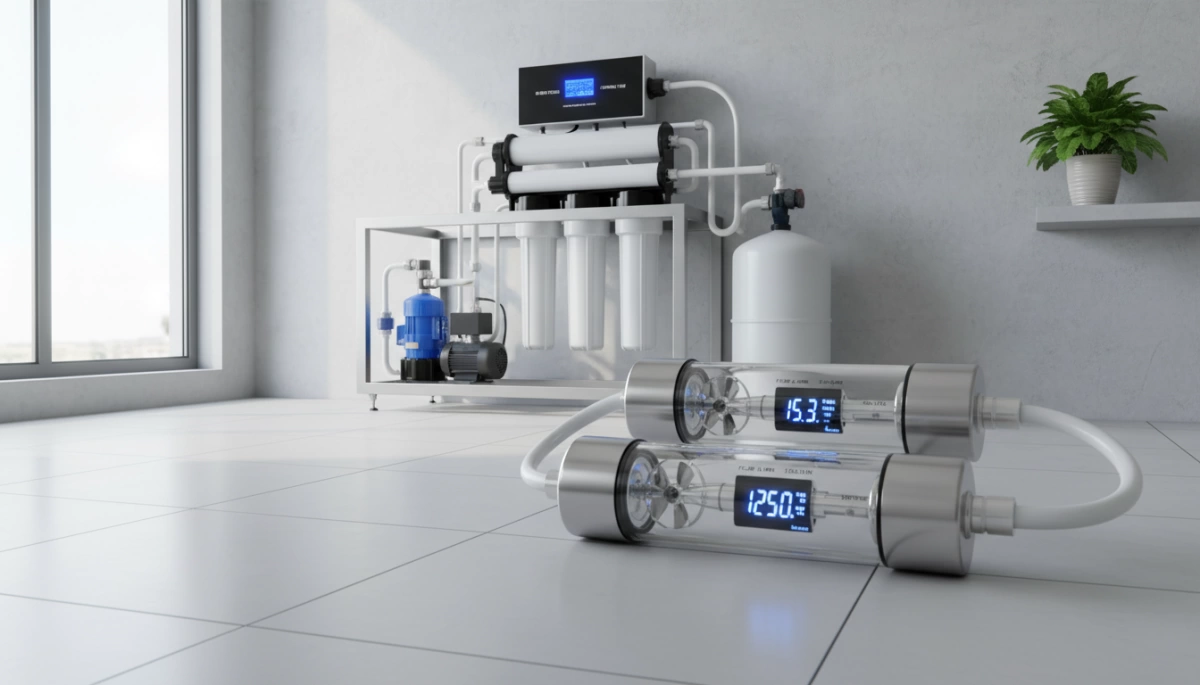
To maximize the efficiency of commercial water purification, relying on guesswork is not an option. Flow sensor accuracy in high GPD RO systems is the backbone of intelligent monitoring, allowing us to build highly responsive feedback loops that protect equipment and reduce operating costs.
Calculating True Recovery Ratios
Nailing down your exact RO recovery rate calculation requires continuous, precise data. It is not just about checking the permeate to concentrate ratio once a week; it is about tracking real-time performance. When your sensors deliver reliable volumetric flow measurement, you know exactly how much pure water is being produced versus what is being sent down the drain. This level of precise water measurement prevents you from pushing the membranes past their limits or unnecessarily wasting water. Monitoring this flow efficiency works hand-in-hand with tracking your output quality, much like relying on a high-quality TDS water filter setup to verify that the final product meets strict local standards.
Automated Adjustments with PLCs
Modern industrial water filtration monitoring thrives on automation. By feeding accurate data into the system’s brain, we enable data-driven RO control.
- Real-Time Compensation: PLC integration for water treatment allows the system to automatically adjust high-pressure pumps and motorized valves based on instant flow feedback.
- Dynamic Balancing: If feed water conditions change, the PLC instantly tweaks the system to maintain a perfectly stable recovery rate without requiring a technician to turn a single manual valve.
- Consistent Output: This automated loop ensures your daily production targets are met efficiently, regardless of minor fluctuations in feed pressure.
Leak Detection Using Flow Differentials
Accurate sensors do more than just track production; they act as a critical defense mechanism for your facility. By constantly comparing the incoming feed water volume against the combined output of permeate and concentrate, we can instantly spot hidden issues.
- Micro-Leak Identification: High-precision sensors catch tiny flow differentials that indicate early-stage leaks or internal seal failures.
- Real-Time Alerts: Sudden drops in expected flow trigger immediate system warnings.
- Automated Shutdowns: If a major differential is detected, the feedback loop can automatically halt the system, preventing catastrophic water damage and expensive downtime.
The Driplife Advantage: Engineering for Data Reliability
At Driplife, we understand that flow sensor accuracy ro isn’t just a specification on a sheet; it is the backbone of operational efficiency. We don’t just assemble components; we engineer systems where data integrity is prioritized from the ground up. When you are managing high GPD applications, you need precise water measurement ro to ensure your recovery rates are real and your costs are controlled.
Here is how we ensure sensor reliability ro in our commercial systems:
- Integrated Monitoring & Pre-Calibration: We don’t leave accuracy to chance during installation. Our sensors are integrated and pre-calibrated to strict standards before leaving the factory. This ensures calibration stable ro sensor performance from day one, eliminating the “start-up blind spots” common in generic assemblies.
- Corrosion-Resistant Durability: Commercial water streams can be chemically aggressive. We utilize high-grade, corrosion-resistant materials for all wetted sensor parts. This hardware resilience works in tandem to maximize system longevity with our antifouling water filter membrane technology, ensuring that neither sensor degradation nor membrane fouling skews your flow data.
- Smart Connectivity & IoT Alerts: We move beyond simple gauges. Our systems are designed for intelligent monitoring ro, capable of sending real-time data to your dashboard. This allows for usage tracking ro system capabilities that alert you instantly to flow anomalies, enabling data driven ro control rather than reactive maintenance.
FAQs on Flow Sensor Accuracy in High GPD RO Systems
How often should I calibrate my RO flow sensors?
For most commercial applications, I recommend a calibration check every 6 to 12 months. If your system handles high-turbidity feed water or operates 24/7, quarterly inspections are better. Maintaining flow sensor accuracy in high GPD RO systems ensures you aren’t flying blind when it comes to chemical dosing or membrane replacement cycles.
Can air bubbles cause false flow readings?
Yes, air is a major enemy of precision. Air bubbles change the fluid density and disrupt the internal mechanisms of turbine and ultrasonic sensors. This often leads to “phantom” flow readings or erratic spikes. Ensuring your piping has proper high-point vents and stable pressure helps maintain precise water measurement.
What is the most accurate flow meter for high GPD systems?
It depends on your budget, but Electromagnetic (Mag) meters and Ultrasonic flow meters are the gold standard for accuracy because they lack moving parts that wear out. For standard commercial builds where cost-efficiency matters, a high-quality digital flow switch for RO paired with a calibrated turbine sensor provides excellent data for the price.
Why does my permeate flow rate fluctuate?
If your sensors are calibrated, fluctuations are usually caused by:
- Water Temperature: Cold water is more viscous and harder to push through membranes.
- Pressure Changes: Fluctuations in feed pressure or a failing booster pump.
- Membrane Fouling: Gradual scaling reduces output, which is why real-time water usage tracking is vital for preventative maintenance.
When scaling your water business with larger commercial units, these technical details become the difference between a system that lasts a decade and one that fails in two years.
| Issue | Impact on Accuracy | Solution |
|---|---|---|
| Scaling/Fouling | Under-reporting flow | Regular acid cleaning of sensors |
| Turbulence | Erratic readings | Install 5-10x pipe diameter of straight run |
| Electrical Noise | Signal “jitter” | Use shielded cables and proper grounding |
| Air Entrainment | Over-reporting flow | Install air release valves upstream |