Why Retrofit Instead of Replace?
When facility teams ask me whether to rip out old drinking fountains or retrofit them with a bottle filler, cooling, and UV, my answer is blunt: in most commercial buildings, a well‑engineered retrofit delivers more value with far less pain.
Retrofit vs Replacement Cost (40–70% Savings)
A properly designed drinking fountain retrofit kit or bottle filler conversion kit usually costs a fraction of a full replacement:
- 40–70% project savings are typical once you include demolition, wall repair, and new rough‑in work.
- You reuse the existing cabinet, plumbing, and often the refrigeration base instead of paying for an entirely new refrigerated drinking fountain.
- For multi‑site portfolios (schools, offices, transit), this compounding retrofit project cost savings is what makes a campus‑wide hydration upgrade realistic within a single budget cycle.
Less Disruption, Faster Upgrades
Full fountain replacement means cutting walls, moving plumbing, and shutting down corridors. A retrofit engineering approach is far lighter:
- Shorter downtime: most retrofit bottle filler installations are same‑day tasks per unit.
- Minimal plumbing and electrical changes when the existing water fountain upgrade uses compatible supply, drain, and power.
- Reduced noise, dust, and access issues in sensitive areas like hospitals, labs, and classrooms.
This is why many facility managers choose a wall‑mounted fountain retrofit solution first, instead of a full demolition project.
Sustainability and Asset Life
If you care about sustainability metrics and total cost of ownership, retrofit wins again:
- You avoid sending a heavy steel drinking fountain body to the landfill.
- You extend the life of legacy drinking fountain assets by layering in a chilled water bottle filler upgrade and modern controls.
- Retrofit supports green building hydration strategy goals by cutting bottled water use and helping with LEED and similar green building credits.
A sustainable hydration retrofit lets you modernize quickly without overspending on embodied carbon and new materials.
Hygiene, Touchless Use, and UV
Post‑pandemic, users expect a touchless hydration station with clear hygiene benefits:
- Hands‑free, sensor‑activated bottle fillers reduce contact points and perceived risk.
- Adding a UV disinfection retrofit module at the point of dispense helps control pathogens without chemicals.
- Pairing UV with filtration improves taste and odor, making the bottle filling station the preferred option over traditional bubblers.
In practice, this means an office hydration station retrofit or school drinking fountain modernization can materially boost user satisfaction with modest spend.
When Full Replacement Still Makes Sense
Retrofit engineering is not a silver bullet. I still recommend full replacement in specific cases:
- The existing unit is non‑ADA compliant and cannot be brought into compliance with an ADA compliant retrofit drinking fountain solution (height, clearances, controls).
- The base unit has failed refrigeration, severe rust, or structural damage, making a refrigerated drinking fountain upgrade uneconomical.
- Plumbing, voltage, or wall conditions are fundamentally incompatible with modern commercial bottle filling station upgrades.
- You’re redesigning a space and need a new layout, such as converting to a bi‑level drinking fountain conversion with integrated bottle fillers.
In every other case, a well‑specified retrofit bottle filler on an existing fountain is the smarter engineering and economic decision—especially when you use OEM‑compatible modules like the Driplife retrofit solutions I design for facility-wide modernization.
Core Components of a Modern Drinking Fountain Retrofit Upgrade
A smart retrofit starts with the right hardware. When I design a retrofit engineering package, I focus on a few core components that turn a basic wall fountain into a modern, touchless hydration station.
Retrofit bottle filler integration for existing fountains
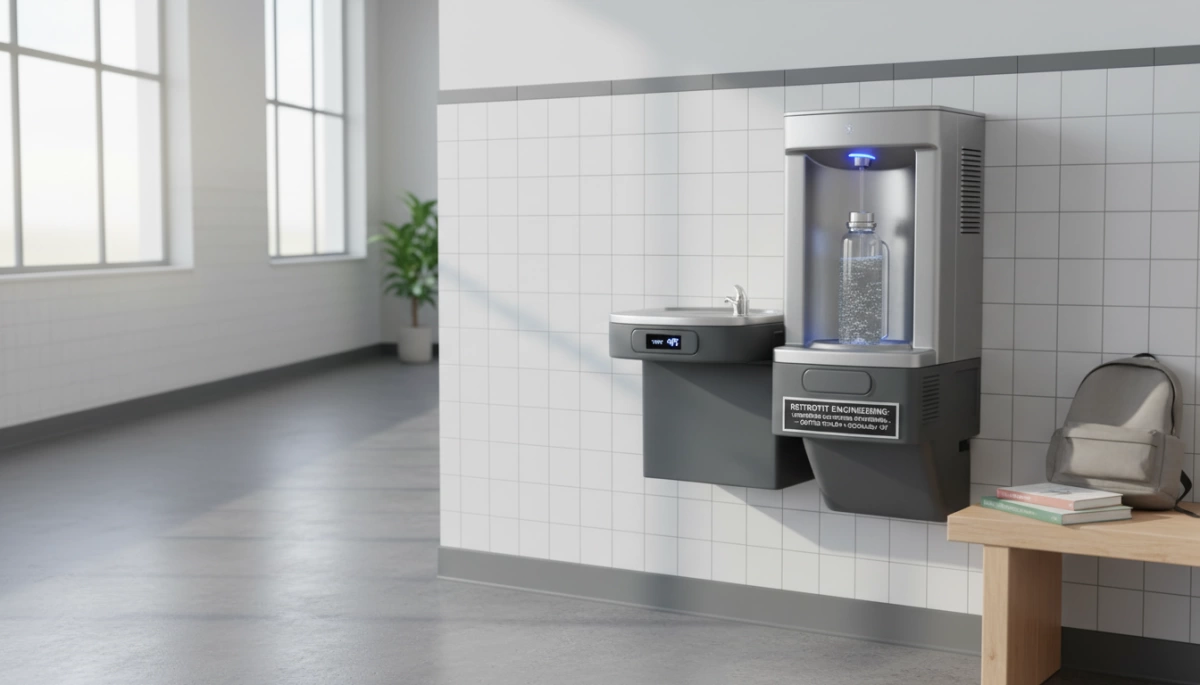
A drinking fountain retrofit kit or bottle filler conversion kit lets you mount a new bottle filling station above an existing unit without tearing out walls. I look for:
- Direct compatibility with common US legacy fountains (Elkay, Halsey Taylor, Oasis, etc.)
- Wall-mounted, bi-level, and high/low options for flexible layouts
- Clean routing for water lines and power so the upgrade looks OEM, not “bolted on”
Sensor-activated, hands-free bottle filler design
Today, most facility managers want a hands-free bottle filling station. A good touchless bottle filler retrofit should offer:
- Infrared sensor activation with reliable detection and auto shutoff
- Bottle filler flow rate optimization (fast fill, but within WaterSense-style efficiency limits)
- Clear bottle placement area and easy reach for kids, seniors, and ADA users
Chilled water cooling system add-ons
If the existing water fountain upgrade doesn’t have enough cooling—or none at all—I spec a chilled bottle filler retrofit with:
- An energy efficient fountain cooling system sized to your peak demand
- Refrigerated drinking fountain upgrade modules that fit within existing cabinets
- Proper airflow paths and grilles so the condenser doesn’t overheat
UV disinfection retrofit modules for pathogen control
For post-pandemic hygiene upgrades, I often add an in-line UV-C LED water treatment stage:
- Compact UV disinfection retrofit modules installed right before the bottle filler outlet
- Chemical-free pathogen control with verified UV dosage and NSF-certified retrofit components
- Low-power designs that integrate cleanly with fountain electrical capacity
Filtration and UV synergy for taste and safety
The best commercial drinking fountain upgrades combine filtration and UV, not one or the other. A multi-stage drinking water filtration system can:
- Cut chlorine, odors, and bad taste for a better user experience
- Reduce particulate, lead, and other contaminants when paired with lead-free drinking water system components
- Work in tandem with UV so users get both great taste and strong pathogen protection
If you want a deeper dive into why filtration matters so much, I recommend looking at our breakdown of why water filtration is crucial for safe, good-tasting drinking water.
Choosing the right retrofit kit
To lock in retrofit project cost savings, I always match the retrofit bottle filler installation kit to the existing unit:
- Confirm plumbing compatibility for retrofits (line size, pressure, drain)
- Check electrical needs for UV, sensors, and cooling add-ons
- Use OEM compatible retrofit modules from proven vendors like Driplife so the retrofit looks clean, performs reliably, and passes inspections
Engineering Assessment And Site Evaluation For Retrofit Projects
A solid engineering assessment is what makes a retrofit bottle filler on an existing fountain work long-term. Before anyone orders a drinking fountain retrofit kit, I always walk the site and document the basics.
Identifying Retrofit-Ready Fountains
Not every legacy drinking fountain is worth a retrofit. I focus on:
- Recognizable, OEM-compatible brands that have proven retrofit bottle filler installation options
- Units with decent structural condition (no cracked basins, rusted frames, or unstable wall mounts)
- Bi-level and wall-mounted fountain retrofit solutions with enough space for a bottle filler conversion kit above the basin
If the cabinet is rotted, badly vandalized, or non-compliant with ADA clearances, I usually recommend replacement instead of a legacy drinking fountain retrofit.
Plumbing, Voltage, And Cooling Checks
Next, I verify that the existing water fountain upgrade can support new loads:
- Plumbing compatibility for retrofits: line size, pressure, and shutoff valve location
- Electrical: correct voltage, dedicated circuit where needed, and grounding for UV disinfection retrofit modules and electronics
- Cooling capacity: existing refrigerated drinking fountain upgrade potential—can the current chiller support a chilled water bottle filler upgrade, or do we need a new energy efficient fountain cooling system?
Without this step, you risk underpowered cooling and nuisance trips once the touchless bottle filler retrofit goes live.
Space, Mounting, And Airflow Constraints
Physical constraints often make or break a commercial drinking fountain upgrade:
- Wall space above and around the unit for a hands-free bottle filling station
- Structural backing strong enough to carry the retrofit kit engineering load
- Clear airflow paths for any cooling system add-on for fountains so the compressor doesn’t overheat
I also look at adjacent finishes to avoid cutting into fire-rated walls or tile that will blow the budget.
Electrical And Plumbing For UV And Electronics
When adding in-line UV-C LED water treatment or a commercial UV water disinfection module, I confirm:
- Dedicated power for UV, controls, and sensors (no overloading lighting circuits)
- Safe routing for low-voltage signal cables for sensor-activated bottle fillers
- Plumbing layout that allows a logical sequence: multi-stage drinking water filtration system first, then UV, then the dispenser
If the facility already uses RO or advanced filtration elsewhere, I’ll sometimes align our retrofit with existing RO water filtration standards to keep maintenance consistent.
Pre-Retrofit Checklist
For any retrofit hydration station engineering project, my standard checklist includes:
- Clear photos of each unit and surrounding wall
- Model and serial numbers for OEM compatible retrofit modules
- Fountain dimensions, mounting height, and basin depth
- Water quality testing for retrofits (chlorine, hardness, sediment, and any known local contaminants)
These details feed directly into retrofit project cost savings estimates and make procurement and installation smoother.
Red Flags That Limit Bottle Filler + Cooling + UV
Some conditions push me away from retrofit and toward full replacement:
- Severe corrosion, leaks inside the cabinet, or non-repairable damage
- No practical way to add proper electrical service for UV and a refrigerated drinking fountain upgrade
- Insufficient wall structure or space for ADA compliant retrofit drinking fountain clearances
- Known water quality issues that require more advanced solutions than a standard filtration and UV for drinking fountains can reasonably handle at that location
Catching these red flags early keeps the facility manager retrofit guide honest, avoids surprise change orders, and protects the total cost of ownership for the hydration upgrade.
Step-by-Step Retrofit Engineering Process: From Planning to Commissioning
Plan the Retrofit Scope (Bottle Filler, Cooling, UV, Filtration)
For a successful retrofit bottle filler installation, I always start by locking in the scope:
- Decide if you’re adding a bottle filler only, or a full chilled bottle filler retrofit with UV and multi-stage filtration.
- Set clear targets: chilled water output (GPH), bottle filler flow rate optimization, UV dosage, and filter life.
- Confirm goals for hygiene (UV pathogen control), taste and odor (filtration), and energy efficiency (modern cooling system add-on for fountains).
This upfront planning keeps the retrofit project cost savings predictable and avoids mid-project surprises.
Phase 1: On-Site Survey & Technical Specs
In Phase 1, we treat each legacy drinking fountain retrofit like an engineering site visit:
- Document existing units: photos, serial numbers, model, and mounting type.
- Check plumbing compatibility for retrofits: pipe size, pressure, and shutoff access.
- Verify electrical: voltage, available circuits, and space for UV disinfection retrofit modules and electronic sensors.
- Confirm wall space, clearance, and airflow for a refrigerated drinking fountain upgrade.
- Run basic water quality testing for retrofits to decide on the right filtration and UV combination; this also supports ongoing programs that follow structured filter replacement workflows and documentation.
The result is a clear technical spec for each drinking fountain modernization project.
Phase 2: Selecting Retrofit Kits & Modules
Next, we match the site conditions with the right drinking fountain retrofit kit:
- Choose an OEM compatible bottle filler conversion kit designed for your brand/model.
- Select chilled water bottle filler upgrade modules sized to your expected traffic (schools, office hydration station retrofit, airports, etc.).
- Add UV disinfection retrofit modules or in-line UV-C LED water treatment where hygiene is a priority.
- Specify NSF certified retrofit components and lead-free materials to meet US health codes and procurement rules.
This phase ensures the commercial drinking fountain upgrade is technically sound and code-ready.
Phase 3: Clean Installation Sequence
A tight installation sequence keeps downtime low and the retrofit looking factory-built:
- Shut off water and power, protect floors, and safely open the existing water fountain.
- Rough-in plumbing for the retrofit bottle filler, filtration, and UV, keeping tubing runs short and accessible.
- Mount the hands-free bottle filling station, sensors, and cooling system add-on for fountains in line with ADA heights.
- Route wiring cleanly to power supplies and controls, following retrofit installation best practices for service access.
The aim is a wall-mounted fountain retrofit solution that looks like it shipped that way from day one.
Phase 4: Testing, Calibration & Commissioning
Before we hand over any retrofit hydration station engineering project, we fully commission it:
- Flush filters and verify no leaks at all connections.
- Check flow rate, bottle filler activation, and shutoff timing; fine-tune sensors for reliable touchless bottle filler retrofit performance.
- Measure chilled water temperature, recovery time, and noise from the energy efficient fountain cooling system.
- Confirm UV status indicators, alarm functions, and that UV modules deliver the required pathogen control for drinking fountains.
We document all readings so facility teams can reference them during future audits.
Phase 5: Maintenance Planning for Filters, UV & Cooling
Finally, we lock in a practical retrofit maintenance schedule planning process:
- Set filter change intervals based on usage, water quality, and filter capacity.
- Define UV lamp or LED replacement cycles and cleaning checks.
- Plan coil cleaning and basic service for refrigerated units to protect efficiency and lifespan.
- Capture all steps in a simple facility manager retrofit guide so staff can keep every ADA compliant retrofit drinking fountain running like new.
When this process is followed, total cost of ownership for hydration upgrades stays low, and your retrofit vs replacement cost analysis continues to favor retrofits year after year.
Compliance And Standards For Retrofit Drinking Fountain Upgrades
When we engineer a retrofit drinking fountain upgrade with bottle filler, cooling, and UV, we always start with compliance. In the U.S. market, you won’t get sign-off from facilities, inspectors, or risk teams unless the retrofit bottle filler installation clearly meets ADA, safety, and water quality standards.
ADA-Compliant Retrofit Drinking Fountain Checks
For an ADA compliant retrofit drinking fountain, I focus on:
- Clear floor space and reach: Bottle filler activation sensors, buttons, or displays must sit within ADA reach ranges for both wheelchair and standing users.
- Spout height and knee clearance: When we add a drinking fountain retrofit kit or bottle filler conversion kit, we verify the new spout height and underside clearance still meet ADA rules.
- Controls and ease of use: Touchless bottle filler retrofit sensors must be easy to activate, with no tight pinching or twisting.
Lead-Free, NSF/ANSI, And Health Code Requirements
Every commercial drinking fountain upgrade we ship uses:
- Lead-free components: Valves, fittings, and faucets must meet U.S. lead-free limits for potable water.
- NSF/ANSI certifications: Filtration and UV modules should be NSF/ANSI certified for materials, performance, and structural integrity. Our approach is similar to how we design our NSF-compliant faucet water filters for residential use.
- Local health codes: We align retrofit hydration station engineering with city and state plumbing and health codes, especially in schools, healthcare, and food-service areas.
Water Efficiency And Flow Rate Limits
Modern water fountain modernization must hit water efficiency targets:
- Bottle filler flow rate optimization: We typically design touchless bottle filler retrofit units to stay within WaterSense-style flow limits while still filling a 16–20 oz bottle quickly.
- No excessive spray or waste: Correct nozzles and internal regulators keep the stream tight, clean, and efficient.
Electrical And Safety Standards For UV And Cooling
When we add a UV disinfection retrofit module or a cooling system add-on for fountains, we treat it like any other electrical appliance:
- UL/ETL safety listings: Power supplies, UV drivers, and refrigerated drinking fountain upgrade components must meet recognized electrical safety standards.
- Proper grounding and GFCI: Any outlet serving UV or cooling equipment should be grounded and GFCI-protected where required.
- Enclosures and wiring: All wiring must be protected from moisture, vandalism, and accidental contact.
Vandal Resistance And Durability
In schools, transit hubs, and public buildings, a legacy drinking fountain retrofit only works long term if it’s tough:
- Vandal-resistant housings: Tamper-resistant screws, steel covers, and protected sensors are standard for a wall-mounted fountain retrofit solution.
- Protected nozzles and bottle areas: We design touchless hydration station components so exposed points are minimized and hard to break.
Documenting Compliance For Inspectors And Procurement
For facility managers and procurement teams, proof matters as much as performance:
- Submittal packages: We provide cut sheets, certifications (NSF, lead-free, electrical), ADA diagrams, and installation manuals for each drinking fountain retrofit kit.
- Commissioning and test records: Flow rates, UV performance checks, and electrical tests are logged so inspectors and auditors can quickly verify compliance.
- Clear spec alignment: Our documentation is written to plug straight into RFPs and internal standards, making it easy to justify a sustainable hydration retrofit that meets all regulatory expectations.
Cost Estimation and ROI for Drinking Fountain Retrofit Engineering
When I look at a drinking fountain retrofit engineering project, I break cost and ROI down into a few simple buckets so facility teams can compare retrofit vs replacement in a straight line.
Typical Cost Breakdown: Bottle Filler, Cooling, UV
For a standard commercial drinking fountain retrofit kit with bottle filler, cooling, and UV disinfection retrofit module, here’s the usual material spread per unit:
- Bottle filler conversion kit (hands-free, ADA compliant): about 35–50% of material cost
- Chilled water bottle filler upgrade (refrigerated cooling system add-on): about 25–35%
- In-line UV-C LED water treatment / UV module: about 15–25%
- Filtration (multi-stage drinking water filtration system) and small parts (fittings, brackets, trim): about 10–20%
In most US projects, a full retrofit hydration station engineering package comes in at roughly 30–60% of the price of a full unit replacement, depending on brand compatibility and performance specs.
Labor, Tools, and Contingency
On an existing water fountain upgrade, labor is the other big driver:
- Labor: typically 4–8 hours per unit for an experienced installer, more if walls are opened or power needs extending.
- Tools and consumables: modest—basic plumbing/electrical tools, anchors, sealants, and test gear usually add 5–10% to project cost.
- Contingency: I always advise 10–15% for unexpected issues (old shutoff valves, corroded piping, hidden framing, etc.).
Compared with full replacement, you usually avoid major wall work, floor patching, and large plumbing reroutes, which is where retrofit project cost savings really show up.
Key Variables That Drive Retrofit Cost Savings
Your retrofit vs replacement cost analysis should focus on a few key variables:
- Number of existing fountains suitable for retrofit (legacy drinking fountain retrofit vs condemned units)
- Plumbing compatibility for retrofits (line size, pressure, drain condition)
- Electrical availability for refrigerated drinking fountain upgrade and UV power
- ADA compliance retrofit check (height, clear floor space, reach ranges)
- Facility access (schools and airports often require off-hours work, impacting labor rates)
With good OEM compatible retrofit modules, we routinely see 40–70% retrofit project cost savings versus tearing out and replacing units.
Calculating ROI: Bottled Water, Maintenance, Energy
To build a clean business case, I typically model ROI on three fronts:
- Reduced bottled water use:
- Estimate bottles displaced per filler per day (often 100–300 bottles/day in busy schools and offices).
- Multiply by cost per bottled water case and disposal fees.
- Lower maintenance and service calls:
- Modern touchless bottle filler retrofit kits have fewer mechanical push buttons and valves to fail.
- Predict fewer leak calls, fewer filter emergencies, and longer component life.
- Energy efficiency gains:
- New energy efficient fountain cooling system designs and UV modules usually draw less power than legacy compressors and ballasts.
- Tracking typical kWh usage and comparing to new systems is similar to how we approach low-maintenance RO system efficiency in other categories.
In many commercial drinking fountain upgrade projects, payback from reduced bottled water spend alone can land in the 2–4 year range, with total cost of ownership improving further over the full life of the retrofit.
Building a Retrofit Business Case
For stakeholders and budget owners, I keep the retrofit business case tight and visual:
- One-page cost : material, labor, contingency, and total retrofit project cost vs replacement.
- 5-year TCO comparison: energy use, maintenance, filter and UV replacement schedule, and any rental/lease costs.
- Sustainability and post-pandemic hygiene upgrades: bottles avoided, waste reduced, and pathogen control for drinking fountains.
- Risk and disruption: shorter downtime, less wall demolition, fewer change orders.
When we position Driplife retrofit solutions in a proposal, we highlight retrofit vs replacement cost analysis, clear performance specs, and a defined retrofit maintenance schedule planning so decision-makers can sign off quickly with confidence.
Procurement Specs & RFP Tips for Retrofit Bottle Filler Projects
How to Write RFP Specs for Drinking Fountain Retrofit Kits
When I write an RFP for a drinking fountain retrofit kit or bottle filler conversion kit, I keep it clear and measurable:
- Define scope: retrofit bottle filler + cooling system add-on + UV disinfection retrofit module + filtration
- List compatible brands/models of existing drinking fountains
- Require OEM-compatible retrofit modules and wall-mounted fountain retrofit solutions
- Call out installation type: surface-mount, in-wall, bi-level drinking fountain conversion, etc.
- Specify hands-free, touchless bottle filler retrofit with ADA compliant activation
Key Performance Metrics to Include
Spell out performance numbers so vendors can’t hide behind vague claims:
| Metric | What To Specify |
|---|---|
| Chilled water output | gph at target °F (e.g., 8 gph at 50°F) |
| Cooling efficiency | compressor type, energy use (kWh/year) |
| UV dosage | mJ/cm² at rated flow |
| UV type | in-line UV-C LED water treatment |
| Filter rating | micron size, NSF/ANSI standard |
| Filter life | gallons or months, with change indicator |
| Flow rate | bottle filler flow rate optimization (gpm) |
| Noise level | max dBA at 1 meter |
Link metrics like UV dose and flow rate to the quality of the multi-stage filtration system; for example, you can pair UV with a carbon water filter system for better taste and odor.
ADA, Safety, and Certification Requirements
I always hard-code compliance in the RFP:
- ADA compliant retrofit drinking fountain: clear knee space, reach ranges, controls
- Lead-free components: NSF/ANSI 372, “lead-free” per U.S. law
- Drinking water safety: NSF/ANSI 42/53/58/401 as relevant
- Water efficiency: WaterSense compliant bottle filler or equivalent flow limits
- Electrical safety: UL/ETL listing for UV and cooling systems
- Materials in contact with water: food-grade, corrosion resistant
Evaluating Retrofit Vendors and OEM Partners
When I shortlist vendors for a commercial drinking fountain upgrade, I compare:
- Proven legacy drinking fountain retrofit references (schools, airports, offices)
- Retrofit reliability data: failure rates, warranty terms, spare parts access
- Technical support: design help, plumbing compatibility for retrofits, installation guidance
- Lead times: stock vs custom, average ship time for retrofit projects
- Documentation: wiring diagrams, plumbing schematics, retrofit commissioning guides
Positioning Driplife Retrofit Engineering Solutions
If you want Driplife solutions in the spec without locking to a single brand:
- Use phrasing like: “Driplife or approved equal” for retrofit bottle filler installation kits
- Reference “OEM compatible retrofit modules from Driplife” for UV, cooling, and filters
- Call out “energy efficient fountain cooling system and commercial UV water disinfection by Driplife”
- Require vendors to match or exceed Driplife’s multi-stage drinking water filtration performance
Avoid Vague Language in Retrofit RFPs
Loose wording leads to cheap, non-compliant offers. I avoid:
- “High quality,” “good filtration,” “adequate cooling” with no numbers
- Missing standards (NSF, ADA, UL) and missing UV dosage or filter ratings
- Open-ended “bottle filler” without specifying hands-free, vandal-resistant, and refrigerated drinking fountain upgrade requirements
Instead, I lock in:
- Exact performance metrics
- Named standards and test methods
- Clear retrofit project cost savings goals and total cost of ownership expectations
Case Studies: Retrofit Engineering In The Real World
School drinking fountain retrofit projects with bottle fillers and UV
In K–12 schools, we see the fastest adoption of drinking fountain retrofit kits with bottle filler conversion kits and UV disinfection retrofit modules. Districts upgrade aging hallway fountains into touchless bottle filling stations with chilled water and in-line UV-C LED water treatment to cut germs, boost student hydration, and reduce plastic bottles. A typical school drinking fountain modernization project can convert dozens of legacy units during a single break window, giving facility managers a practical, low-disruption path to a sustainable hydration retrofit.
Office and corporate campus chilled bottle filler upgrades
On corporate campuses, a commercial drinking fountain upgrade usually focuses on experience and image: cold, great-tasting water in high-traffic break areas. We retrofit existing water fountains with chilled water bottle filler upgrades, multi-stage drinking water filtration systems, and touchless bottle filler retrofits to support wellness programs. With the right retrofit bottle filler installation plan, offices transform outdated coolers into modern, ADA compliant retrofit drinking fountain solutions that fit open-plan layouts and flexible work schedules.
Hospitals, airports, and public facilities going touchless
Hospitals, airports, and government buildings are prioritizing post-pandemic hygiene upgrades and pathogen control for drinking fountains. Here, we engineer wall-mounted fountain retrofit solutions with hands-free bottle filling stations, UV disinfection retrofit modules, and vandal-resistant drinking fountain retrofits designed for 24/7 use. For many of these projects, our clients pair filtration and UV for drinking fountains with existing green building hydration strategies and broader water quality initiatives informed by tools like detailed ambient water quality and usage analysis.
Common retrofit challenges and on-site solutions
Across schools, offices, and public spaces, the same retrofit challenges come up:
- Limited wall cavity depth or blocked airflow for a refrigerated drinking fountain upgrade
- Old plumbing lines that complicate cooling system add-ons for fountains
- Inconsistent power supply for UV modules and electronic sensors
We address these on-site with OEM compatible retrofit modules, custom bracket kits, and clear installation constraints retrofit checks before work starts. Our engineering team designs retrofit hydration station engineering plans that match plumbing compatibility for retrofits and local codes, avoiding surprises during install.
Measured outcomes: satisfaction, hygiene, and savings
After commissioning, facilities typically report:
- Higher user satisfaction and refill counts at touchless hydration stations
- Better perceived taste and odor thanks to multi-stage filtration and UV
- Retrofit project cost savings of 40–70% compared to full replacement
- Lower total cost of ownership for hydration upgrades via energy efficient fountain cooling systems
Many customers also track plastic reduction, using refill metrics to support ESG reporting and internal sustainability goals.
How Driplife supports retrofit projects from design to delivery
At Driplife, we treat every legacy drinking fountain retrofit like an engineering project, not just a product sale. For facility managers and engineers, we provide:
- Front-end feasibility checks and retrofit vs replacement cost analysis
- Help selecting the right drinking fountain retrofit kit, bottle filler conversion kit, and commercial UV water disinfection modules
- Retrofit installation best practices, commissioning and validation guidance, and long-term retrofit maintenance schedule planning
Because we manufacture and supply Driplife retrofit solutions at scale, we can support school districts, corporate portfolios, and public building hydration upgrades globally with consistent quality, NSF certified retrofit components, and dependable lead times.