

















Dealing with rusty water every time you turn on the tap?
Reddish-brown stains on your sinks, toilets, or laundry… and that harsh metallic taste in your drinking water… are more than just annoying. They’re signs that iron particles in your water are creeping into your pipes, fixtures, and appliances.
And here’s the thing most people don’t realize:
A basic pitcher or small under-sink filter won’t fix this.
To actually remove rust from water and stop stains for good, you need the right water filter for rusty water—one designed to handle heavy sediment, rust flakes, and sometimes even dissolved iron without clogging every few weeks.
In this guide, you’ll quickly see:
- What’s really causing that reddish brown water
- Why many standard filters fail with rusty water
- The best whole house rust filter and sediment filter for rust options that actually work in real homes
If you’re ready to protect your plumbing, keep your laundry stain-free, and finally get clear water out of every faucet, keep reading.
Understanding Rusty Water: Often a Plumbing Problem, Not the Water Source
If you’re seeing rusty water, reddish brown water in the tub, or rust stains on fixtures, it’s natural to blame the city or your well. In reality, rust in tap water is usually a plumbing problem, not a treatment-plant failure.
Here’s what’s typically going on:
Corroded galvanized pipes in older homes
- Many US homes still have old galvanized steel lines.
- As these pipes corrode from the inside, they shed iron particles in water, which show up as rust colored water from the faucet, especially after the water sits.
Rust from well water and iron-rich aquifers
- If you’re on a well, your source may pull from iron-rich aquifers.
- Pumping can bring up sediment and iron, which then oxidizes into visible rust sediment in pipes and fixtures.
Oxidation turns iron into visible rust
- Clear, dissolved iron in water reacts with oxygen.
- This oxidized iron becomes reddish-brown rust particles you can see, making water look cloudy, orange, or streaky.
Common triggers that suddenly make water look worse
- Water main work or hydrant flushing stirring up rust.
- Pressure changes from pump cycling or valve operation.
- Long periods of stagnation (vacations, unused bathrooms) letting rust build up in the lines.
How to tell if it’s your plumbing or the source
- Only hot water rusty? Likely your water heater or hot water piping.
- Only certain faucets or one bathroom? Often localized galvanized pipe corrosion.
- All fixtures, hot and cold, suddenly rusty? Could be a municipal disturbance or well water rust issue.
- Run the tap for 1–2 minutes:
- If the rusty tap water clears, the problem is usually inside your plumbing.
- If it stays rusty, the issue is likely at the water source and needs a whole house rust filter or well treatment.
Understanding where your rusty water comes from is the first step to choosing the right water filter for rusty water that actually works, instead of swapping out cartridges that keep clogging.
Particulate Rust vs. Dissolved Iron – Why It Changes Your Water Filter Choice
If you’re shopping for a water filter for rusty water, you first need to know what kind of iron you’re actually dealing with. Rusty water and dissolved iron look similar in the long run (both cause stains), but they need very different filter setups.
How Particulate Rust Looks in Tap Water
Particulate rust = visible, solid particles. You’ll usually notice:
- Water looks cloudy or hazy right from the tap
- Orange / reddish-brown tint in a clear glass
- Tiny flakes or specks that settle at the bottom after a few minutes
- Short bursts of rusty water from the faucet, then it clears up
This is oxidized iron that has already turned into solid rust particles in your plumbing. To remove it, you need a mechanical sediment filter for rust, not just a taste-and-odor filter.
How Dissolved (Clear) Iron Shows Up
Dissolved iron = clear in water, visible as stains later. Signs include:
- Water looks clear at the tap, but
- Orange or brown stains on sinks, tubs, toilets, and dishwashers
- Rust stains on fixtures that keep coming back even after cleaning
- Yellow/orange laundry stains, especially on whites
- Slight metallic taste in tap water
Here, the iron is still dissolved (invisible) when it leaves the faucet. It only turns into “rust” when it hits air, heat, or cleaning products. A basic sediment filter for rust won’t fix this alone.
Why Filter Type Depends on the Iron Type
Particulate rust (visible):
- Needs micron-rated filters (usually 5–50 microns)
- Best handled with sediment filters, spin-down filters, and Big Blue housings
- The goal is to physically strain out iron particles in water
Dissolved iron (clear):
- Often needs oxidation first (air injection, chemical feed, or special media)
- Then passes through iron media filters designed to grab oxidized iron
- Typical carbon cartridges are not enough for serious iron in well water
If you plan to polish drinking water after treatment (for taste, chlorine, or extra clarity), a point-of-use purifier, like a countertop ice and water purifier with advanced filtration, can be a great add-on for the kitchen tap and fridge area, once the heavy rust is handled at the main line.
Simple At‑Home Checks to Tell Which You Have
You don’t need a lab to get a first read. Start with these:
Clear glass test
- Fill a clear glass with cold water
- Look right away:
- Cloudy / tinted with visible bits = particulate rust
- Clear at first but turns yellow/orange after sitting = likely dissolved iron
Paper towel test
- Run water through a white paper towel or coffee filter
- Orange/brown residue left behind = rust particles
Hot vs. cold test
- Rusty hot water only often points to water heater or internal plumbing issues
- Rusty hot and cold suggests source or main line issues
Basic water test kit
- Use a home iron test kit from a hardware store
- If the iron level is high but the water still looks clear, you’re mainly dealing with dissolved iron
Once you know if your issue is particulate rust, dissolved iron, or both, you can choose the right water filter for rusty water and avoid wasting money on filters that clog fast or don’t touch the real problem.
Why Standard Household Filters Fail with Rusty Water
Most “standard” water filters were never built as a true water filter for rusty water—they’re built to fix taste, not rust.
Carbon filters aren’t rust filters
Typical under-sink and fridge filters use carbon blocks made for:
- Chlorine, taste, and odor reduction
- Light organic chemicals
They’re not designed to remove rust from water or handle iron particles in water. Once rust and sediment hit that dense carbon block, it plugs up fast.
Fine rust clogs small cartridges fast
With rusty tap water, especially from wells or old galvanized pipes, you get:
- Fine particulate iron and grit that load up small filters in days or weeks
- Cartridges that look orange or brown long before their “rated” lifespan
You’ll notice:
- Drop in water pressure at faucets and showers
- Slow flow from fridge and under-sink filters
- Filters needing replacement way more often than the box claims
If you’ve ever wondered why your carbon filter seems to die early, it’s usually because sediment and rust hit it before anything else. A carbon filter like the ones explained in this breakdown of what a carbon filter actually does for water simply isn’t a rust workhorse.
Why pitchers and basic faucet filters aren’t enough
Pitcher filters, small faucet filters, and compact countertop units:
- Have tiny media beds and low sediment capacity
- Are focused on chlorine and taste, not high sediment water
- Plug up quickly or let fine rust slip through
For rust colored water from the faucet or heavy rust stains on fixtures, these are “cosmetic” solutions at best—not a real rusty water filter.
Signs your current setup can’t handle rust
You probably need a dedicated sediment filter for rust or whole house rust filter if:
- Your filters turn orange or brown long before the recommended change time
- Flow rate drops sharply after a few weeks of use
- You still see reddish brown water at startup or after the filter
- You get rust stains on fixtures and laundry even “after filtration”
- You’re constantly buying new cartridges just to keep basic pressure
When you see these signs, it means your system wasn’t built for rust and iron water treatment—you need something designed for real-world rust sediment in pipes, not just better-tasting water.
Key Features of an Effective Water Filter for Rusty Water
If you want a water filter for rusty water that actually works, you have to look past the “basic pitcher” stuff and focus on specs. Here’s what I always dial in first.
1. The Right Micron Rating for Rust
Rust = particles. Your filter has to be sized to catch them without choking your water flow.
Good micron ranges for rusty water:
| Rust Situation | Recommended Micron Rating | Notes |
|---|---|---|
| Big flakes / sand from well | 30–50 micron | First stage or spin-down pre-filter |
| Typical rusty tap water | 10–25 micron | Good balance of clarity and flow |
| Fine rust, orange haze | 5–10 micron | Clears water but clogs faster if heavy |
Tip: Don’t jump straight to 1 micron for rust. It’s overkill and will clog constantly in high-sediment water.
2. High Sediment-Handling Capacity
Rusty water can dump a LOT of iron particles into your lines. Your rusty water filter should be built for abuse, not just “polishing.”
Look for:
- High dirt holding capacity (often listed in grams or lbs of sediment)
- Pleated or depth filters that trap more rust before plugging
- Pre-filters if your water has visible reddish brown water or sand
3. Large Housing Size for Strong Water Pressure
Small cartridges + heavy rust = weak showers and slow sinks.
For a whole house rust filter, I always recommend:
- Big Blue–style housings (4.5″ diameter, 10″ or 20″ long)
- 1″ or larger ports to avoid choking flow
- Straight-through flow paths to limit pressure drop
This matters a lot if you’re running multiple showers, laundry, and a dishwasher at the same time.
4. Washable or Reusable Filter Elements
In high-sediment or iron-heavy water, disposable cartridges get expensive fast. A washable sediment filter for rust can save real money.
Good options:
- Stainless mesh cartridges you can hose off
- Pleated washable filters you can rinse and re-use
- Spin-down sediment filters with a flush valve
You’ll still replace them eventually, but you’re not throwing one away every time rust hits your lines.
5. Durable Housings for Whole-House Rust Filtration
Rusty water is tough on hardware. I always spec:
- Thick-walled housings rated for whole-house pressure
- Brass or high-quality polymer heads
- Solid threaded connections that won’t crack or leak
- Temperature and pressure ratings that match U.S. home systems
For U.S. homes with well pumps or city pressure spikes, durability isn’t optional—it’s protection against burst housings and leaks.
6. NSF/ANSI Standards and Performance Specs
If you want something trustworthy, don’t skip the label details. For a rusty water filter or whole house rust filter, I look for:
- NSF/ANSI 42 – structural integrity, basic material safety
- NSF/ANSI 61 – safe contact with drinking water
- Published data on:
- Micron rating (absolute or nominal)
- Flow rate at a given pressure drop
- Maximum operating pressure and temp
If you’re pairing sediment filtration with drinking water treatment, a high-capacity reverse osmosis system like this under-sink RO filtration system can polish the water for taste once the rust load is handled up front.
Dialing in these features is how you move from “my filters are always clogged” to a stable, low-maintenance rusty tap water solution that actually fits a U.S. household’s daily use.
Top Filtration Solutions for Rusty Water
When you’re dealing with rusty water, the first decision is where you want to filter: right where water enters the house, or only where you drink/use it.
Point-of-Entry vs. Point-of-Use Rust Filters
Point-of-entry (POE) / whole house rust filter
Installed on the main line where water comes into your home. This is what I recommend when:- You see rusty water from multiple faucets (showers, laundry, sinks).
- You’re getting rust stains on fixtures, toilets, or in the tub.
- You want to protect water heaters, washers, and dishwashers from iron particles in water.
Point-of-use (POU) / under-sink & dedicated tap filters
Installed at a single faucet (usually the kitchen sink). This makes sense when:- You mainly care about drinking and cooking water.
- The rest of the house has milder rust issues, or you’re on a budget.
- You want to combine a sediment filter for rust with a taste-and-odor unit, like an under-sink filter or even a system feeding a filtered water faucet at the sink.
In most U.S. homes with obvious rust colored water from faucets, a POE system solves more problems with one install.
When a Simple Pre-Filter Is Enough vs. a Full Treatment Train
You can think of solutions in two buckets:
Simple pre-filter only (basic line defense):
- Great if your main problem is visible rust flakes or sand.
- Works best on city water with occasional bursts of reddish brown water after hydrant flushing or main breaks.
- A spin-down sediment filter or Big Blue washable sediment filter is usually enough.
Full treatment train (pre-filter + media + polishing):
- Needed for consistent rust sediment, especially on well water.
- Ideal when you have both particulate iron and metallic taste or light dissolved iron.
- Typical setup:
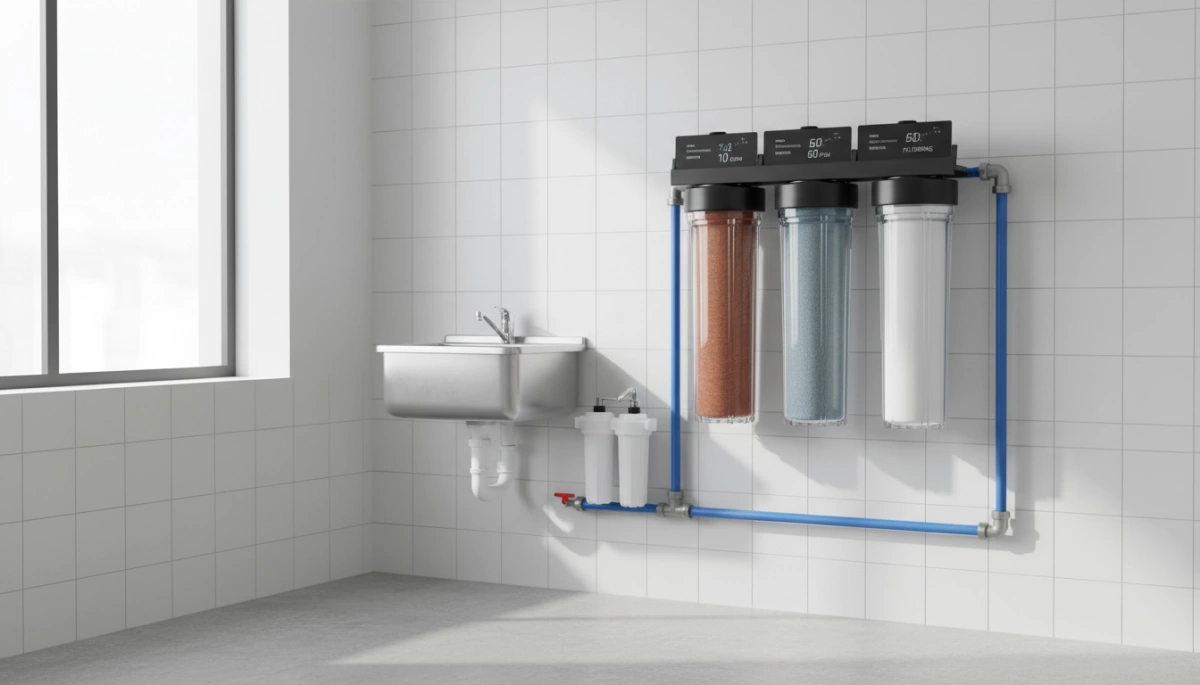
- Stage 1: High-capacity sediment pre-filter for rust (e.g., 50–20 micron)
- Stage 2: Iron/rust media for finer particulate iron filtration
- Stage 3: Carbon “polishing” stage for taste, odor, and clearer-looking water
If you’re constantly clogging small filters or seeing rust clogging water filters every few weeks, you’re in “treatment train” territory, not “simple pre-filter” territory.
City Water vs. Well Water Rust Problems
City / municipal water:
- Rust usually comes from:
- Old neighborhood mains
- Galvanized pipe corrosion inside the home
- You’ll see:
- Short bursts of rust colored water from the faucet
- Rust stains on fixtures, but iron levels often aren’t extreme
- Best fit:
- Whole house rust filter with a solid sediment stage
- Optional polishing at key taps with under-sink filters or even water pitcher filters (but pitchers alone rarely fix heavy rust, as discussed in depth in our breakdown of how effective water pitcher filters really are).
Well water:
- Rust usually comes from:
- Iron-rich aquifers
- Sediment and iron particles in water pumped from the well
- You may have:
- Both visible rust sediment and dissolved (clear) iron that shows up as stains later
- Higher overall sediment load
- Best fit:
- High sediment water filter as a first line (like a spin-down)
- Followed by multi-stage rust water system with iron media
- Sometimes air injection or oxidation ahead of the main filter if dissolved iron is high
Why Combining Systems Works Best (Pre-Filter + Media + Polishing)
A strong water filter for rusty water usually isn’t just one cartridge; it’s a small “team” of filters, each doing what it’s best at:
Pre-filter
- Captures big rust chunks and sediment.
- Keeps the downstream filters from plugging up too fast.
- Extends the life of more expensive media.
Media filter (iron/rust focused)
- Targets particulate iron filtration and light dissolved iron.
- Reduces rust stains on fixtures and helps prevent rust stains in laundry.
Polishing stage
- Usually carbon or a fine sediment filter.
- Improves taste, odor, and clarity so water looks and tastes clean.
- Great near drinking points or sensitive fixtures.
Done right, this layered approach delivers:
- Clearer water at every tap
- Less wear on appliances
- Filters that last longer instead of clogging immediately
If you’re choosing a whole house water filtration for rust, think of it as building a small, efficient system: catch the big stuff, target the rust, then polish the water where you drink it.
Sediment Pre-Filters and Spin-Down Systems
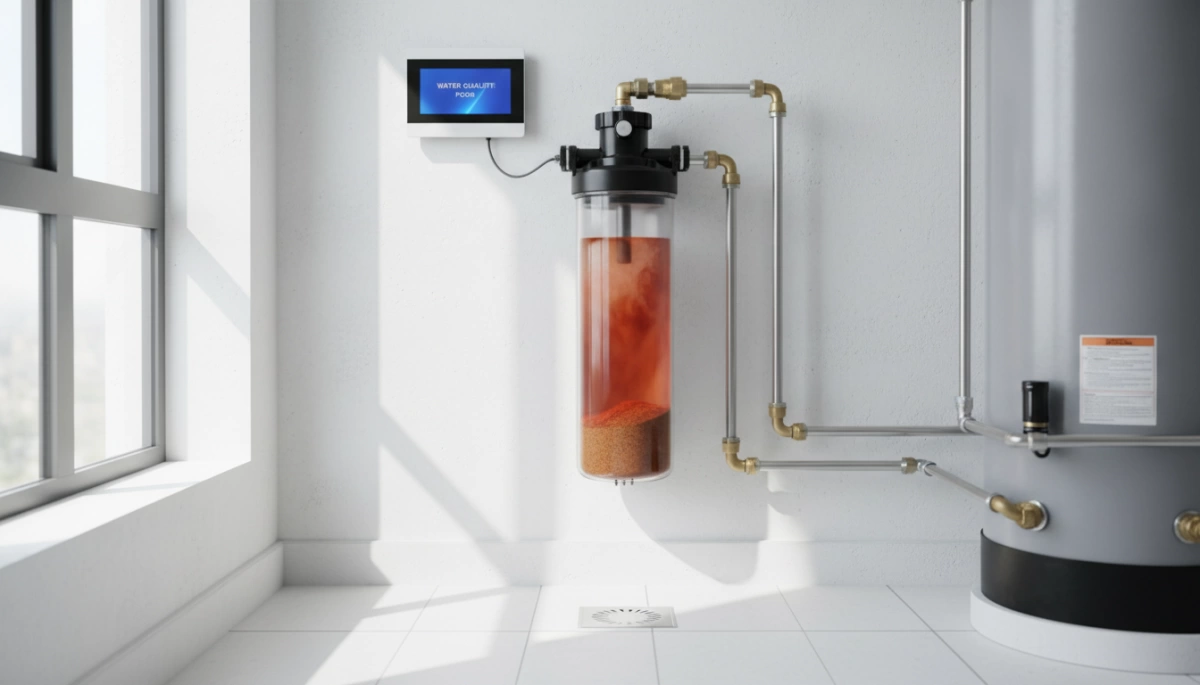
If you’re dealing with rusty water, a good sediment pre-filter for rust is usually the first thing I install in any system. It protects everything downstream—softeners, heaters, and fine cartridges—so they don’t clog and die early.
How Spin-Down Filters Catch Rust and Sand
A spin-down sediment filter for rust sits right after the main shutoff and uses water pressure and gravity:
- Water enters the top, spins in a clear housing
- Heavy rust flakes, sand, and grit drop to the bottom
- Cleaner water continues through your plumbing
They’re perfect as a whole house rust filter pre-stage when you’ve got visible iron particles in water or reddish-brown sand coming from a well.
Best Use Cases for Spin-Down Rust Filters
I lean on spin-downs when:
- You’re on well water with rust removal needs and sand
- You have older galvanized pipe corrosion sending flakes downstream
- Your street line is known for high sediment or frequent main breaks
- You see rust colored water from the faucet after pressure changes or hydrant flushing
If your water looks fine but you get rust stains on fixtures over time, you usually pair this with finer stages, not use it alone.
Benefits of Clear Housings
For rusty tap water solutions, clear housings are a must:
- You can see rust sediment in pipes being captured
- Easy to tell when to flush—no guessing
- Great for renters or busy households that don’t want to track dates
A lot of homeowners who already use an under-sink purifier like those discussed in this guide to under-sink water purifier systems add a clear spin-down at the entry to protect the whole line.
How to Flush and Clean Spin-Down / Mesh Filters
Most spin-down rusty water filters can be cleaned without tools:
- Open the bottom valve into a bucket or floor drain
- Let water blast out the rust and sand for 5–20 seconds
- Close the valve and you’re done
For mesh inserts:
- Shut off water and relieve pressure
- Unscrew housing if needed
- Rinse mesh screen under tap; scrub lightly if packed with rust sediment
In heavy-rust homes, I tell people to flush weekly at first, then adjust based on how fast it loads up.
Where to Install a Rust Pre-Filter
Placement is critical if you want to remove rust from water effectively and protect everything:
- Install right after the main shutoff (point of entry)
- Always before:
- Water softeners
- Tank or tankless water heaters
- Multi-stage whole-house filters
- Any fine micron filter for rust or carbon stage
This setup keeps big rust chunks from wrecking expensive gear and stops rust clogging water filters downstream.
Quick Reference Table – Spin-Down Rust Filter Basics
| Feature | Why It Matters for Rusty Water Filter Setups |
|---|---|
| Type | Spin-down or mesh sediment pre-filter for rust |
| Best For | Wells, galvanized plumbing, high-sediment municipal lines |
| Particle Size | Large rust flakes, sand, grit (not fine dissolved iron) |
| Housing | Clear plastic for easy visual rust monitoring |
| Maintenance | Tool-free flushing via bottom valve |
| Location | Point-of-entry, before softeners, heaters, and main filtration |
| Main Benefit | Extends life of all other whole house water filtration for rust |
Pleated or High-Capacity Cartridge Filters for Rusty Water
When rusty water is more than an occasional burst, pleated or other high-capacity cartridge filters are usually the first real upgrade that actually works.
How pleated filters hold more rust before clogging
Pleated sediment filters have a folded surface, which gives them a lot more area than smooth “string wound” or basic foam cartridges. That extra surface means they can:
- Trap a lot more rust and sediment before pressure drops
- Hold fine iron particles and sand without choking off flow right away
- Stretch out replacement intervals in high-rust homes
For most U.S. households dealing with chronic rust, a pleated sediment filter is the minimum I’d install ahead of any downstream filtration.
Why Big Blue housings improve flow and lifespan
“Big Blue” style housings (typically 4.5″ x 10″ or 4.5″ x 20″) are built for high sediment loads and whole-house flow:
- Larger diameter = lower pressure drop at normal home flow rates
- Bigger cartridges = more media, more rust capacity, fewer changeouts
- Better match for 3/4″–1″ plumbing in U.S. homes
If you’ve had small inline or fridge-style filters clog with rust, upgrading to a Big Blue rust filter style housing is usually the turning point.
Disposable vs. washable pleated cartridges
For rusty water, you can go either way:
Disposable pleated cartridges
- Best for: busy homeowners who want simple swap-and-go
- Pros: consistent performance, no mess, predictable lifespan
- Cons: higher long-term replacement cost under heavy rust
Washable / reusable pleated cartridges
- Best for: well owners, high-sediment lines, DIY-friendly users
- Pros: hose-cleanable, lower long-term cost in dirty water
- Cons: need regular cleaning, performance slowly degrades over time
If you already use a compact water filter at the tap (like a compact under-sink system), pairing it with a washable whole-house pleated pre-filter can dramatically cut cartridge costs.
Micron options for different rust problems
Micron rating = how small a particle the filter can catch. For rust:
- 50 micron – Large flakes, sand, visible debris; great as a first stage
- 20 micron – Typical for general rusty water from older pipes
- 5 micron – For fine rust, “cloudy” water, and protection for softeners/RO
Smaller micron = cleaner water, but faster clogging. In high-rust areas, don’t jump straight to 5 micron without staging.
Building a staged sediment setup (50 → 20 → 5 micron)
For serious rust and sediment, a simple staged system works best:
- Stage 1: 50-micron pleated – Catches big rust flakes, sand, pipe scale
- Stage 2: 20-micron pleated – Grabs medium rust and finer grit
- Stage 3: 5-micron pleated or depth filter – Polishes out fine rust and protects any downstream carbon, softener, or RO
This approach:
- Spreads the work across multiple filters
- Prevents your fine 5-micron filter from plugging in days
- Keeps flow and pressure stable for showers, laundry, and appliances
If you also care about drinking taste at the tap, combining this kind of high-capacity pre-filtration with a dedicated glass water filter pitcher or alkaline water filter pitcher gives you both rust control and improved taste where you actually drink the water.
Multi-stage whole-house water filter systems for rusty water
A multi-stage whole-house rust filter is the most reliable way to protect your entire home when you’re dealing with rusty water, iron particles, and sediment.
Typical stages in a whole-house rusty water filter:
- Stage 1 – Sediment filter for rust (5–50 microns):
Catches sand, rust flakes, and iron particles in water before they reach the rest of your plumbing. - Stage 2 – Carbon filter:
Improves taste and odor, reduces chlorine and organics, and helps with metallic taste in tap water. - Stage 3 – Specialty iron/rust media:
Targets fine particulate iron and light dissolved iron, helping prevent rust stains on fixtures and laundry.
How multi-stage systems protect your home:
- Keeps rust sediment out of water heaters, washing machines, dishwashers, and faucets
- Reduces orange or reddish brown water and rust stains in showers, toilets, and sinks
- Helps maintain water pressure by stopping rust sediment from clogging fixtures and small lines
When to add an extra iron filter or softener:
- Add a dedicated iron filter if you have high dissolved iron in well water (clear water that later leaves rust stains).
- Add a water softener if you also have hard water (white scale plus rust issues) and want better protection for appliances or an RO drinking system like a reverse osmosis setup.
Multi-stage vs. single-stage sediment filter:
- Multi-stage pros:
- Better overall water quality (sediment + rust + taste + odor)
- Longer life for each stage because the load is shared
- Stronger protection for plumbing and fixtures
- Multi-stage cons:
- Higher upfront cost
- More components to maintain
- Takes more space than a single Big Blue rust filter
Typical maintenance and filter changes:
- Sediment pre-filter: every 1–3 months in high-sediment or rusty well water
- Carbon stage: about every 6–12 months, depending on usage and chlorine levels
- Specialty iron/rust media: often 3–5+ years before media replacement (varies by water quality and system size)
If you’re supplying or installing systems, a well-designed multi-stage whole-house rust and sediment filter is what actually solves rusty tap water long term, instead of just masking symptoms at a single faucet.
Whole-House Rust Filter Systems with Targeted Media
When you want a real fix for rusty water across the entire home, you need a whole-house rust filter with media designed specifically for iron and rust—not a basic taste filter.
Media Types That Actually Work
Different media target different iron problems:
| Media Type | Best For |
|---|---|
| Multi-grade sediment media | Visible rust particles, sand, fine grit |
| KDF / catalytic media | Light dissolved iron, metallic taste, some odor |
| Birm / catalytic carbon | Light–moderate dissolved iron (with oxidation) |
| Mixed-bed iron media | Combo of particulate iron + light dissolved iron |
For most homes dealing with rusty tap water (reddish brown water, flakes, rust stains on fixtures), I lean on high-capacity sediment + catalytic media to remove rust from water before it reaches showers, laundry, and appliances.
When You Need Air Injection or Oxidation
If your water has dissolved (clear) iron that turns orange after standing, simple particulate filtration isn’t enough. You usually need:
- Air injection / venturi systems – add air to oxidize dissolved iron into rust particles
- Oxidation tanks – contact time to fully convert iron before filtration
- pH adjustment – in some wells, low pH makes iron treatment harder
Use oxidation before the rust media when:
- Iron is >2–3 ppm in tests
- You see orange staining but the water looks clear at the tap
- Your existing sediment filter stays clean but fixtures still stain
Sizing the Right Whole-House Rust Filter
A whole-house rust filter has to match your plumbing and lifestyle:
- Pipe size: Most U.S. homes are 3/4″ or 1″, so I size housings and valves to match or oversize for better flow.
- Flow rate: Target at least 8–12 GPM for a typical 2–3 bath home so showers and laundry can run together.
- Media volume: Bigger tanks = more iron/rust capacity and fewer service cycles.
Basic sizing rule:
- 1–2 baths: small–medium system
- 3–4 baths: medium–large system
- 5+ baths or high-use homes: large system or dual-tank setup
How These Systems Help with Taste and Staining
Done right, a whole-house water filtration for rust will:
- Cut orange stains on fixtures, tubs, and toilets
- Reduce rust stains in laundry, especially whites
- Help with metallic taste in tap water (when combined with carbon or catalytic media)
- Protect water heaters, dishwashers, and washers from iron particles in water
If you care about drinking taste too, you can still polish at the tap with something like a glass water filter pitcher that focuses on taste and chlorine control along with your whole-house system: glass water filter pitcher DL-P36.
Limitations: When You Need Advanced Iron Treatment
There are times when a standard rusty water filter isn’t enough:
- Very high dissolved iron (often >5–7 ppm)
- Iron + manganese + sulfur odor combo
- Severely low pH or problem well chemistry
In those cases, you’re usually looking at:
- Dedicated air-injection iron filters
- Chemical injection (chlorine or peroxide) plus contact tank
- Followed by a sediment filter for rust and possibly carbon polishing
Bottom line:
- Visible rust only? Go with high-capacity sediment + rust media.
- Heavy dissolved iron? Plan on oxidation + specialized iron media as a full iron and rust water treatment system.
How to Choose the Right Water Filter for Rusty Water
Choosing a water filter for rusty water isn’t guesswork. I look at six things every time: source, pipes, flow, location, maintenance, and cost.
1. Diagnose Your Rust Source
Well water vs municipal water:
| Source Type | Common Rust Cause | Typical Fix |
|---|---|---|
| Private well | Iron in aquifer + sediment | Spin-down + high-capacity sediment + iron media |
| City / municipal | Old mains, hydrant flushing, scale | Whole-house sediment filter for rust |
Quick checks:
- Only one faucet rusty? Likely local plumbing.
- All taps rusty, cold + hot? Likely supply or main line.
2. Check for Old Galvanized Pipe Corrosion
If your home is older (pre-1980), I always assume galvanized might be in play.
Signs it’s your pipes, not the water source:
- Rusty water is worst after sitting overnight.
- You see flakes or gritty particles in a clear cup.
- Some lines are fine, others are always rusty.
In this case:
- A sediment filter for rust will protect fixtures and appliances.
- Long term, you’ll still want to replace old galvanized lines.
3. Size the System for Flow and Peak Demand
Undersized filters cause pressure drops and frustration.
| Home Type | Typical Flow Need | Filter Size Guide |
|---|---|---|
| Small apartment / condo | 3–7 GPM | Under-sink / single “Big Blue” housing |
| Typical single-family home | 8–12 GPM | 1–2 “Big Blue” housings, 1″ ports |
| Large home / 3+ baths | 12–20+ GPM | Multiple housings or larger media tank |
Look for:
- 1″ or larger ports for whole-house rust filters.
- Clear GPM rating on the product, not just “whole house.”
4. POE vs POU: Whole House or Under-Sink?
Point-of-entry (POE) / whole-house rust filter:
- Best when:
- You see rust stains on fixtures and laundry.
- Multiple bathrooms show rusty tap water.
- You want to protect water heaters, washers, and dishwashers.
- Install on the main line after the shutoff and before branches.
Point-of-use (POU) / under-sink:
- Best when:
- You mostly care about drinking and cooking water.
- Budget is tight and you can’t do whole-house yet.
- Good add-on after POE if you still want polished drinking water.
If your shower is the main pain point (hair, skin, staining), a shower filter for problem water can help; if hardness is also an issue, a shower filter for hard water and sediments is often the better pick.
5. Maintenance Style: Set-and-Forget vs Hands-On
Be honest about how much effort you’ll put in.
Low-maintenance / set-and-forget:
- Larger “Big Blue” housings.
- High-capacity pleated cartridges.
- Automatic backwashing systems for iron and rust.
Hands-on / budget-friendly:
- Spin-down filters you manually flush.
- Washable sediment filters you hose off.
- More frequent cartridge changes but cheaper up front.
6. Upfront Cost vs Long-Term Filter Costs
Rusty water can chew through small filters fast. I always run the math.
| Option | Upfront Cost | Ongoing Cost | Best For |
|---|---|---|---|
| Small cartridge / pitcher | Low | Very high in rust | Light discoloration, not heavy rust |
| Single Big Blue sediment filter | Medium | Moderate | Most city homes with rust issues |
| Multi-stage whole-house rust system | Higher | Lower per gallon | Wells, heavy rust, family homes |
Focus on:
- Filter life in gallons, not just “months.”
- Availability and price of replacement cartridges.
- Whether a high-capacity rust water filter lowers your yearly spend vs cheap filters that clog weekly.
When I design or choose a water filter for rusty water, I always match:
- Rust type (flakes vs clear water iron),
- Source (well vs city),
- Flow needs,
- Maintenance style.
Get those four right and you’ll actually fix the problem instead of just swapping out clogged filters every weekend.
Installation and Maintenance Tips for a Water Filter for Rusty Water
Where to Put a Rusty Water Filter
For most homes, the best spot for a whole house rust filter is on the main line right after it comes into the house, before it branches off to:
- Water heater
- Laundry
- Kitchen and bathrooms
That way, the sediment filter for rust protects your entire plumbing system and cuts down on rust stains on fixtures and in laundry.
Key placement tips:
- Install before a water softener, RO system, or any other treatment
- Leave enough straight pipe (usually 8–12″) before and after the housing
- Make sure you can easily reach it to change cartridges or flush a spin-down
DIY vs. Calling a Pro
DIY install makes sense if:
- You’re comfortable cutting pipe (PEX, copper, or PVC)
- You already have a shutoff on the main line
- You’re installing a simple Big Blue rust filter or spin-down unit
Call a plumber if:
- You have old galvanized pipe corrosion and brittle lines
- You’re adding a multi-stage rust water system with bypass and drains
- Your main line is in a tight space or you’re unsure about code requirements
For under-sink or faucet setups, most homeowners can handle installing a point-of-use rusty tap water solution, especially when pairing it with a dedicated sink faucet water filter system.
Use Bypass and Shutoff Valves
A good whole house rust filter setup should include:
- Main shutoff before the filter
- Bypass valve or bypass loop so you can still get water while you service the filter
- Unions or quick-connects on each side of the housing for easy removal
These small plumbing choices make cartridge swaps, high sediment water filter upgrades, and troubleshooting way faster and cleaner.
How Often to Flush and Check Filters
For spin-down sediment filters and mesh pre-filters:
- Start by flushing weekly in heavy rust or well water
- If the flush water runs clear quickly, you can stretch it to every 2–4 weeks
- In extreme well water rust removal situations, you may need to flush daily at first
For cartridge sediment filters:
- Check visually every 30–60 days
- Replace when:
- Water pressure drops noticeably
- Cartridges show heavy orange/brown loading
- Manufacturer’s max time is reached (even if it still “looks OK”)
Signs Your Rust Filter Needs Attention
Watch for:
- Drop in water pressure at showers and faucets
- Reddish brown water returning after being clear for weeks
- New rust stains on fixtures or in toilets
- Filter housing filling with visible iron particles in water
Any of these mean it’s time to flush, clean, or replace your rusty water filter components.
Protecting Heaters and Appliances During Install
When you’re installing or upgrading a filter for rusty shower water or a full point of entry rust filter:
- Shut off power and gas to water heaters if you’re working near them
- Close supply valves to water heaters, washers, and dishwashers if possible
- After install, run cold water first to flush rust and air from the line
- Only then open hot water and reconnect appliances
Done right, a properly installed iron and sediment pre filter will protect water heaters, washers, and dishwashers from rust buildup, reduce maintenance, and help prevent rust stains in laundry long term.
driplife Solutions – Reliable Filtration Built for Real-World Rust Problems
When someone asks me for a water filter for rusty water, I don’t point them to a generic carbon pitcher. At driplife, we build systems specifically to remove rust from water, handle heavy sediment, and stay reliable in real U.S. homes.
Systems Designed for Rusty Water
For rusty tap water, I focus on two main directions:
Whole-house rust filter systems (point-of-entry)
- High-capacity sediment filter for rust with large “Big Blue” housings
- Staged cartridges that catch iron particles in water from coarse to fine
- Optional media stages that improve color, odor, and metallic taste
- Configured to protect the full plumbing loop: showers, laundry, dishwasher, and water heater
Point-of-use filters for metallic taste (under-sink / shower)
- Compact units that polish water at the tap for drinking and cooking
- Target rust-related metallic taste in tap water plus lingering odor
- Ideal as a final stage after a whole-house sediment or rust system
- For shower comfort and skin/hair, we pair well with our shower water filter options designed for chlorine and sediment control: driplife shower water filter solutions
Key Build Features That Matter in Rusty Water
Every rusty water filter we design is built around real-world problems we see over and over in U.S. homes:
High-capacity housings
- Oversized body and flow paths to handle high sediment water without choking flow
- Supports heavier rust loads so you’re not swapping filters every few weeks
Durable materials and strong connections
- Thick-wall housings and robust threads to handle municipal and well pressure
- Built to work as a whole house rust filter in basements, garages, or crawl spaces
Strong, stable water flow
- Low pressure drop designs so showers, washers, and dishwashers run normally
- Smart micron choices to balance rust capture and real-world flow
How driplife Protects Your Home Long-Term
The whole point of a rust and iron water treatment system is to stop the mess and the damage:
Prevent rust stains on fixtures and laundry
- Reduces orange rings in toilets, tubs, and sinks
- Cuts down on rust spots on clothes and towels, helping you prevent rust stains in laundry
Protect plumbing and appliances
- Keeps rust sediment out of water heaters, washing machines, and dishwashers
- Helps reduce clogging of aerators, valves, and small internal passages
Clearer, cleaner-looking water
- Less reddish brown water from faucets and showers
- Smoother experience when paired with point-of-use filtration for drinking and cooking
I design driplife systems to be practical: high capacity, easy to maintain, and sized for how U.S. families actually use water—heavy laundry days, back-to-back showers, and real rust problems from older plumbing and well water.
Frequently Asked Questions About Rusty Water Filters
Can a water filter permanently fix rusty water, or do I still need plumbing work?
A rusty water filter can remove rust from water coming into your home, but it can’t fix galvanized pipe corrosion that’s already inside your walls.
- If rust is coming from the city main or your well, a whole house rust filter can be a long-term fix.
- If rust is mainly from old pipes inside your home, you’ll usually need plumbing upgrades plus filtration to fully solve the problem.
What’s the difference between rust stains and hard water or mineral stains?
- Rust stains: orange/brown, often streaky, show up in toilets, tubs, sinks, and on laundry. They come from iron particles in water.
- Hard water/mineral stains: white or gray, chalky buildup around faucets and showerheads, from calcium and magnesium.
You can have both at the same time, so many homes run a sediment filter for rust plus a softener.
Will a rusty water filter also remove metallic taste and odor?
In most cases, yes—if you choose the right setup.
- A sediment or spin-down sediment filter removes rust sediment in pipes that causes muddy or metallic taste.
- Adding a carbon or RO stage at the tap can polish the water and greatly reduce metallic taste and odor for drinking. A compact system like a table-top RO water purifier pairs well with a whole-house rust setup for clean-tasting drinking water (you can see an example of this type of system in our table-top RO purifier).
Is rusty water filtration safe and effective for well water systems?
Yes, as long as it’s sized and configured correctly.
- For iron in well water treatment, we use spin-down or Big Blue rust filters as a first step.
- For heavy dissolved iron, we add iron-specific media or oxidation ahead of the filter.
All of this is safe for household use when installed to code and maintained on schedule.
How often should I replace filters in high-rust conditions?
It depends on how bad your reddish brown water is and your water usage:
- Spin-down / mesh filters: flushed weekly to monthly, sometimes more in extreme cases.
- Pleated or cartridge filters: typically every 1–3 months in high sediment, or sooner if you see a big pressure drop.
I always tell customers: watch your water pressure and the cartridge color—those two signs tell you when to change.
Are rusty water filters safe to use with water heaters and washing machines?
Yes—and they’re actually a big protection for them.
- Installing a whole house water filtration for rust before your water heater helps prevent rust clogging water filters, heater elements, and valves.
- Clean water going into washers and dishwashers helps prevent rust stains in laundry and on dishes.
Just make sure the filter housing is rated for your home’s temperature and pressure.
Can I use a rusty water filter with a water softener or reverse osmosis system?
You should. That’s the ideal setup:
- Put the rusty water filter (sediment/iron filter) first to catch iron particles in water and protect downstream equipment.
- Then run water to a water softener if you have hard water.
- For drinking water, send softened, filtered water to a reverse osmosis system for the cleanest result.
This kind of multi-stage rust water system extends the life of your softener and RO, keeps maintenance lower, and gives you clean water at every tap.