
















Why Countertop RO Filters Need Intelligent Cartridge Recognition
Engineers and product teams building countertop RO filters all hit the same wall: you can design a great membrane, a clean hydraulic path, and a quiet pump, but the whole system still depends on one messy variable—how and when the user replaces the cartridges. That’s exactly where cartridge recognition smart chip engineering changes the game.
Limitations of Traditional Countertop RO Filter Tracking
Most no-installation countertop RO filters today still rely on blunt tools:
- Simple timers that count days, not real usage, water quality, or flow volume
- Basic flow meters in the base that have no idea which cartridge is actually installed
- Manual resets or app logging that assume the user remembers to tap a button after changing filters
These approaches are cheap, but they’re blind. The system doesn’t know:
- Whether the cartridge is authentic or a low-grade clone
- Whether it’s new, partially used, or already expired
- Whether the cartridge belongs to this specific RO purifier or was moved from another device
For modern smart countertop RO purifier manufacturers, this is a hard limit on performance, safety, and brand control.
Pain Points: Premature and Overdue Cartridge Replacements
Without an intelligent cartridge recognition system, you get three recurring pain points:
- Premature replacements – Timers nag early, or customers replace “just to be safe,” wasting filter capacity and driving up total cost of ownership.
- Overdue replacements – Busy users ignore vague alerts, leading to overused RO cartridges running far past their designed lifespan.
- Wrong or mismatched cartridges – Third-party filters or wrong SKUs get installed, with no way for the purifier to detect or block them.
From a filter usage tracking perspective, this is a black box. You can’t reliably map real RO cartridge lifespan monitoring to how the filter is actually being used.
Impact on Water Safety, Taste, and Trust
Inaccurate filter changes have direct technical and business impact:
- Water safety risk – Overdue pre-filters and post-filters can let contaminants or microbial growth break through, especially in warm countertop environments.
- Taste degradation – Spent carbon causes off tastes and odors that users blame on “the RO brand,” not on skipped maintenance.
- Inconsistent TDS performance – Membranes used past their design window drift in rejection rate, undermining any reverse osmosis filter life indicator chip or performance claims.
- Erosion of trust – If alerts feel arbitrary or wrong, users stop believing the device, ignore notifications, and lose confidence in the brand.
For any premium portable countertop RO purifier targeting the US market, that’s a strategic problem, not just a service issue.
How Smart Chip Cartridge Recognition Solves These Issues
This is why I build around embedded chips in water filter cartridges rather than relying on timers alone. A smart chip filter authentication module lets the purifier base know exactly what’s installed and how it’s been used.
A well-designed filter chip recognition engineering stack enables:
- Authentic cartridge detection – The base reads an encrypted cartridge ID from an EEPROM, RFID, NFC tag, or microcontroller-based smart filter module and verifies it as genuine.
- Usage-aware lifespan tracking – The filter usage tracking chip stores cumulative flow, time in service, and other usage data directly on the cartridge, not just in the base.
- Cartridge history and status – The purifier can see if a cartridge is new, partially used, or already expired the moment it’s inserted.
- Tamper resistance – With encrypted cartridge ID technology and cryptographic signatures, cloned or reset chips are much harder to pass off as valid.
Instead of guessing, the countertop RO filter now makes decisions based on actual, authenticated cartridge data.
Business Value for Brands, OEMs, and Distributors
For brands, OEMs, and distributors, countertop RO anti-counterfeit technology isn’t just a tech feature—it’s a business lever:
- Counterfeit prevention in RO filters – A smart chip and cryptographic signature anti-counterfeit scheme block low-cost clones that hurt performance and reputation.
- Protected consumable revenue – Genuine smart water purifier consumables become the default choice, because the system can warn or disable when non-authentic parts are used.
- Lower service and warranty cost – With better RO purifier consumable management, you see fewer failures caused by overused or wrong cartridges. Support teams can trace cartridge IDs and usage.
- Stronger distributor relationships – Authorized partners can sell assured genuine smart RO cartridge inventory with traceability built in.
- Foundation for subscriptions – Reliable RO filter usage and flow tracking makes subscription and auto-replenishment models realistic and profitable.
In short, cartridge recognition smart chip engineering turns a countertop RO filter from a “best effort” system into a controlled, data-driven platform for safe water, predictable performance, and secure consumable business.
Core Components Of Cartridge Recognition Smart Chip Engineering
When I design cartridge recognition smart chip engineering for countertop RO filters, I focus on a few core building blocks: the chip type, the data model, how the chip is embedded, power strategy, and how it talks to the purifier base.
Types Of Smart Chips Used In RO Cartridges
In real countertop RO filters, we usually choose from four main smart chip technologies:
- EEPROM-based cartridge authentication – A simple memory chip that stores an encrypted cartridge ID, batch data, and usage counters. It’s low-cost and reliable for basic smart filter tracking.
- RFID water filter cartridge recognition – Uses short-range radio for contactless reading. Ideal when you want wireless communication between the cartridge and purifier base with no exposed metal contacts.
- NFC-enabled RO filter chips – Similar to RFID but designed to work with smartphones and service tools. Great for field diagnostics, quick warranty checks, and distributor support.
- Microcontroller-based smart filter module (MCU) – Adds processing power for advanced RO cartridge lifespan monitoring, on-chip encryption, and more complex cartridge usage monitoring logic.
I pick the chip type based on the brand’s goals: aggressive anti-counterfeit protection, pure cost optimization, or premium smart countertop RO purifier experiences.
What Data Lives On A Smart Filter Chip
A smart chip in a water filter cartridge is basically its digital passport. Typical data fields include:
- Unique cartridge ID and encrypted serial number
- Production data – factory code, production date, and lot number for RO filter traceability
- Capacity and rating – rated gallons or liters, time limit, and RO cartridge lifespan algorithm parameters
- Usage history – volume processed, days in service, error flags, water quality/flow snapshots
- Authentication keys – encrypted cartridge ID technology, cryptographic signature for anti-counterfeit chip filter RO system
This cartridge data communication engineering lets the purifier base instantly know what’s installed, what it can handle, and how much life is left.
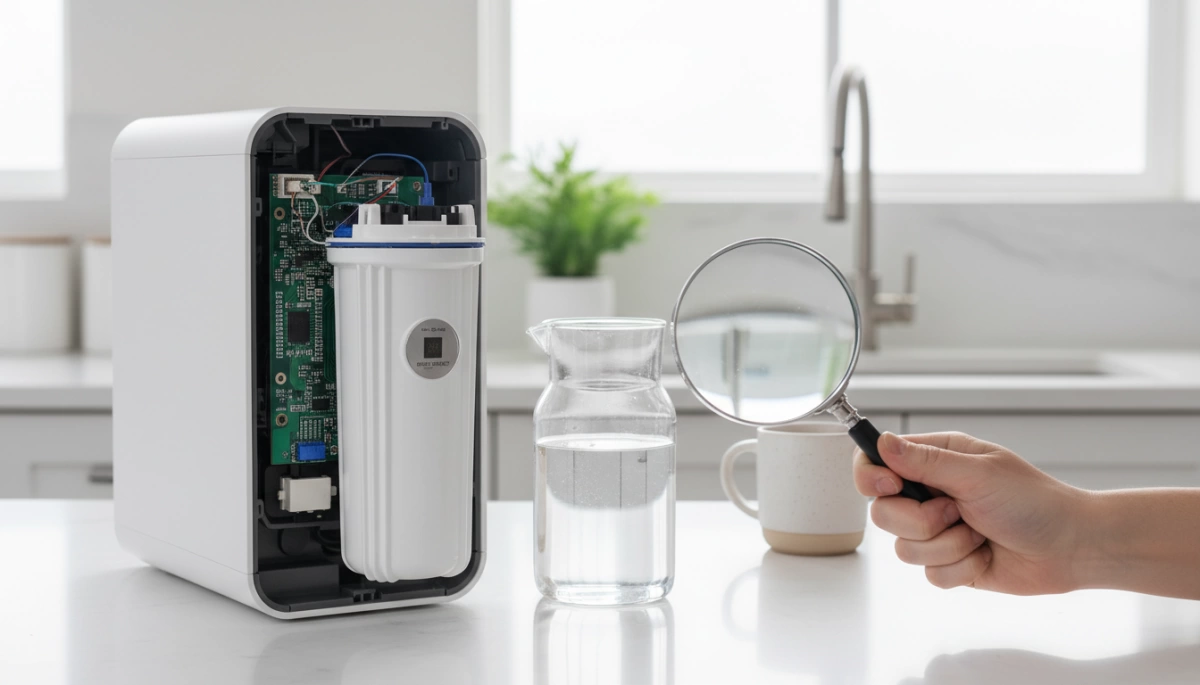
How The Chip Is Embedded In The Cartridge Housing
To make this work in real-world kitchens, I embed the smart chip where it’s:
- Protected from water – sealed in a dry pocket or potted with resin so it survives a wet, high-pressure reverse osmosis environment.
- Easy to align – placed near the cartridge head so the docking motion naturally lines up contacts or the RFID/NFC antenna.
- Tamper-resistant – integrated into the plastic so it’s hard to remove or swap without visible damage, supporting counterfeit prevention in RO filters.
This kind of durable chip encapsulation in wet environments is key to a long service life in portable countertop RO purifier products.
Power Supply And Low-Power Design
In countertop RO filters, power strategy is critical:
- Contact-based EEPROM or MCU chips – powered from the main RO controller only when the unit wakes up to read/write data. Firmware sleeps the interface aggressively to keep system power low.
- Passive RFID/NFC smart chips – draw energy from the reader’s field, so there’s no battery inside the cartridge. This is ideal for low-power smart chip design for filters with long shelf life.
- Optimized polling – the intelligent cartridge recognition system reads and updates chip data only when needed (on insertion, startup, and after filter runs) instead of constantly.
Low-power design ensures the smart sensor technology RO system runs efficiently even in no-installation countertop RO systems that sit on a kitchen counter all day.
Contact-Based vs Wireless Communication
For communication between the cartridge and purifier base, I usually pick one of two paths:
Contact-based communication
- Uses gold-plated spring pins and pads.
- Supports EEPROM-based cartridge authentication and high-speed data transfer with low BOM cost.
- Requires careful design to avoid corrosion or loss of contact in humid environments.
Wireless (RFID / NFC) communication
- Uses coils or antennas embedded in the cartridge and base.
- No exposed metal, which is great for long-term reliability and tamper-resistant RO cartridge design.
- Enables app tools and service tools to read smart RO cartridge data in the field.
Both options integrate cleanly with a smart consumable management platform, helping brands manage RO purifier consumable management at scale while still giving end users simple, automatic filter replacement alert behavior.
For brands that want to tie this into a broader home water strategy, I often pair this smart chip layer with broader hygiene and quality guidance, similar to how we approach managing water quality in public bottle filling stations with UV and hygiene protocols.
How Cartridge Recognition Smart Chip Engineering Works
Step-by-step cartridge recognition in countertop RO filters
When someone in the U.S. drops a new cartridge into a no‑installation countertop RO filter, the cartridge recognition smart chip engineering kicks in immediately:
- As soon as the cartridge locks into place, the purifier base detects it through contact pins or a wireless reader (RFID/NFC).
- The controller pings the embedded chip in the water filter cartridge and requests its basic identity data.
- The chip responds with a unique cartridge ID, type (sediment, carbon, RO membrane, etc.), and production information.
- The RO controller quickly checks if this cartridge type matches the slot, the model, and the allowed cartridge generation.
- If everything lines up, the system “binds” the cartridge to that device and starts RO cartridge lifespan monitoring from real usage.
This intelligent cartridge recognition system gives us precise control over which cartridge is used, instead of relying on the user to track everything manually.
Data handshake between chip and RO controller
Behind the scenes, there’s a tight data handshake between the filter usage tracking chip and the countertop RO controller:
- The controller sends a wake‑up and read command to the smart chip.
- The chip returns structured data: encrypted ID, model, batch, production date, rated capacity, and sometimes last usage stats.
- The controller confirms the data format, validates checksums, and logs the cartridge as “active.”
- During use, the controller periodically updates usage metrics (gallons, days, fault flags) back to the chip, turning it into a reverse osmosis filter life indicator chip that travels with the cartridge.
This kind of cartridge data communication engineering is what makes smart RO purifier consumable management reliable over years of daily use.
Smart chip filter authentication and genuine cartridge checks
To stop low‑quality or unsafe knockoffs, we build smart chip filter authentication directly into the firmware:
- The purifier only accepts cartridges that present a valid, vendor‑issued encrypted cartridge ID technology.
- Firmware checks the chip’s authentication keys against secure data stored in the RO system.
- If the key pair and expected signatures match, the cartridge is flagged as authentic and fully enabled.
- If anything looks off, the flow is limited or blocked, and the user gets a clear error on the display or app.
This authentic cartridge detection in RO systems reduces risks that come from unknown filters built with poor media, weak housings, or untested materials. When we design full RO systems, we tie this to how each filter element in a reverse osmosis water purifier works, so performance and safety are aligned.
Encrypted IDs and cryptographic anti‑counterfeit protection
Modern countertop RO anti‑counterfeit technology is built on secure, hardware‑level protection, not just printed labels:
- Each chip stores a unique, non‑cloneable ID plus cryptographic keys that never leave the chip.
- The purifier sends random challenges; the chip must produce a correct cryptographic signature to prove it’s genuine.
- We use EEPROM‑based cartridge authentication or secure microcontroller‑based smart filter modules with tamper‑resistant design.
- Keys are managed with strict access control and rotated at the OEM/ODM level to stay ahead of counterfeiters.
This cryptographic signature anti‑counterfeit strategy makes cloning far more expensive and impractical, especially for gray‑market sellers online.
Fail states and system response to counterfeit or unknown cartridges
If a counterfeit, modified, or unknown cartridge is inserted, the intelligent cartridge recognition system does not silently ignore it:
- If authentication fails, the RO firmware blocks operation or forces bypass mode so no untreated water is dispensed as “filtered.”
- The user sees a clear alert like “Invalid Cartridge” or “Non‑Genuine Filter Detected,” often paired with an automatic filter replacement alert.
- If the cartridge is genuine but expired (usage or time exceeded), the system can:
- Hard‑stop dispensing for safety, or
- Run in a limited mode with constant warnings, depending on brand policy.
- All fail states are logged for traceability, which helps OEMs and distributors control RO purifier consumable management and reduce support disputes.
For U.S. customers, this behavior matters: it lowers the risk of unknowingly drinking through an expired or counterfeit cartridge, while keeping the user experience simple in portable countertop RO purifiers used in apartments, rentals, and small offices.
Engineering Challenges in Smart Chip Implementation
Smart cartridge recognition sounds simple, but the engineering under the hood is serious work. When we design cartridge recognition smart chip engineering for countertop RO filters, we have to solve a set of tough, real‑world problems that show up in U.S. kitchens every day.
Surviving Wet, High‑Pressure RO Environments
A smart chip in a countertop RO filter lives right next to cold water, pressure spikes, and constant temperature swings.
To keep the embedded chip in the water filter cartridge safe, we focus on:
- Fully encapsulated chips in epoxy or overmolded plastic so moisture never reaches the electronics.
- Strategic placement in dry zones, away from RO concentrate paths and high‑pressure seals.
- Pressure‑tolerant housings that prevent stress on solder joints and chip pads over years of use.
Without this level of protection, the intelligent cartridge recognition system quickly becomes unreliable.
Stable Electrical Contact Or Wireless Coupling
Because U.S. customers remove and reinstall cartridges often, maintaining stable data communication is a major challenge.
We typically choose between:
- Contact‑based designs with gold‑plated spring pins or pads, shaped to self‑clean with each insertion and resist oxidation.
- RFID or NFC wireless coupling, tuned carefully so the signal remains strong even with plastic walls, misalignment, or vibration in portable countertop RO purifiers.
Both approaches need strict mechanical tolerances so the filter chip recognition engineering stays solid over thousands of cycles.
Mapping Usage To Real Cartridge Lifespan
Another big challenge is turning real‑world usage into accurate RO cartridge lifespan monitoring.
We engineer the system to:
- Track flow volume and runtime, not just days on a calendar.
- Factor in incoming TDS and local water quality so heavy usage or harder water shortens the allowed capacity.
- Store key usage history directly on the filter usage tracking chip to keep data consistent, even if the base unit is unplugged.
Done right, the smart filter tracking engineering in a countertop RO purifier gives an honest filter life indicator chip reading, not just a guess.
Compatibility Across Generations And SKUs
As brands update models and add new cartridges, smart chip filter authentication must stay compatible.
We design for:
- Flexible ID schemes that distinguish cartridge type, capacity, and region while still working across multiple device generations.
- Clear rules in firmware so older machines can recognize newer cartridges and either accept, adapt, or safely reject them.
- Smart RO cartridge compatibility management that lets OEMs launch new SKUs without breaking existing fleets in the field.
This is critical for OEM smart chip integration in countertop purifiers that ship through big box retailers and online in the U.S.
Balancing Cost, Reliability, And Scale
Finally, we have to balance BOM cost with reliability and performance in mass production.
Our approach:
- Choose between EEPROM‑based cartridge authentication or a microcontroller‑based smart filter module based on brand positioning and price point.
- Standardize key components so distributors and OEMs get predictable lead times and consistent anti‑counterfeit chip filter RO system performance.
- Validate designs in real‑world conditions similar to modern cooling water trend countertop RO deployments—frequent use, variable water quality, and on‑off power cycles.
When we solve these challenges well, the result is a tamper‑resistant RO cartridge design that delivers dependable smart chip filter authentication without driving up the total cost of ownership for U.S. households.
Engineering Solutions and Best Practices for Cartridge Recognition Smart Chip Engineering
When I design cartridge recognition smart chip engineering for countertop RO filters, I treat the chip like a critical safety part, not just an add‑on. The goal is simple: the chip must read accurately every time, survive a wet life, and be extremely hard to cheat.
Mechanical Design Tricks for Robust Chip Placement and Sealing
For countertop RO filters, the embedded chip in the water filter cartridge has to survive years of handling, vibration, and occasional splashes.
I focus on:
- Recessed pockets and ribs around the chip area so the housing takes the mechanical load, not the PCB or smart module.
- Double sealing (O‑ring + ultrasonic welding or epoxy potting) around contact pads or antennas, so moisture never reaches the electronics.
- Keyed alignment features that force the cartridge to insert in one direction, keeping the cartridge recognition contacts or RFID/NFC antenna perfectly aligned.
- Drop and twist testing on assembled cartridges to make sure the smart chip filter authentication module doesn’t shift, crack, or lose contact over time.
Signal Integrity and EMC Inside Compact Countertop RO Units
Countertop RO filters pack pumps, valves, and power supplies into a tight space, which can create noise around the filter chip recognition engineering.
To keep communication solid:
- I isolate the smart chip communication traces from motor and pump lines, and I use ground shielding where space allows.
- I set clean debounce and retry logic on contact‑based interfaces so small glitches don’t cause “cartridge missing” errors.
- I follow EMC best practices: RC filters on lines, proper grounding, and controlled rise times on the RO system firmware for cartridge recognition signals.
- On wireless (RFID/NFC) designs, I tune antenna shape and placement specifically for plastic thickness, cartridge geometry, and nearby metal parts in the purifier base.
Calibration for Usage, Flow, and TDS‑Based Lifespan Algorithms
A smart RO cartridge lifespan algorithm has to match real life, not just lab specs. US households use very different amounts of water, and municipal water quality can vary a lot from city to city.
My approach mixes:
- Flow‑based tracking: pulse flow meters count every ounce of filtered water and log it against the cartridge’s rated capacity.
- Time‑based aging: I factor in max calendar life (for example, 12 months) even for low‑usage homes, so stagnant cartridges are never “approved” just because flow is low.
- TDS and water quality inputs when available: higher incoming TDS or hardness can shorten expected RO cartridge lifespan, and I adjust remaining life estimates accordingly.
- Factory calibration curves stored in the chip (EEPROM, NFC, or microcontroller‑based smart filter module) so each cartridge type can be tuned to its own capacity and media design.
Firmware Strategies for Error Handling and Safe Fallback Modes
In a smart cartridge authentication RO system, firmware is what turns raw chip data into a safe user experience.
I always build in:
- Multi‑step retries on read/write failures, with short delays, before flagging a cartridge as unreadable.
- Grace modes (for example, limited‑time bypass) when a genuine cartridge suddenly can’t be read, so a family isn’t stuck without drinking water while still clearly seeing a warning.
- Clear error codes and logs stored in the controller for service tools, so distributors and OEMs can see if issues came from bad contact, counterfeit cartridges, or user error.
- Safe lockout behavior when the system is certain a cartridge is expired or untrusted, blocking filtered water dispensing while still allowing basic diagnostics.
Security Design Patterns for Key Storage, Encryption, and Anti‑Cloning
For countertop RO anti‑counterfeit technology, security has to be built in from day one. A simple serial number alone is not enough anymore.
My security stack includes:
- Encrypted cartridge ID technology using symmetric or asymmetric keys stored in secure memory or crypto‑MCUs.
- Challenge‑response authentication so the purifier sends a random challenge, and only a genuine cartridge chip with the right secret can respond.
- Per‑cartridge keys or signed data blocks, so cloning one chip doesn’t unlock the whole product line.
- Secure key management at the factory and in the RO purifier consumable management backend, so keys never leak into the open supply chain.
- Anti‑tamper checks: if the smart chip detects abnormal access or malformed requests, it can limit responses, block further attempts, or flag the cartridge as suspicious.
With these engineering best practices in place, cartridge recognition smart chip engineering turns into a reliable core platform for smart countertop RO purifier manufacturers, not a fragile add‑on that causes support headaches.
Benefits for End Users of Smart Chip RO Cartridges
Real-time filter health and lifespan
With cartridge recognition smart chip engineering built into our countertop RO filters, you always know where you stand. The system tracks actual use, not just time on a calendar, so the reverse osmosis filter life indicator chip shows:
- Current filter health status
- Estimated days or gallons remaining
- Clear “good / warning / replace” states on the display
This kind of intelligent cartridge recognition system takes the guesswork out of RO cartridge lifespan monitoring.
Automatic filter replacement alerts
Smart chip filter authentication also powers automatic filter replacement alerts, so you don’t have to remember dates or log anything in an app manually. Depending on the model, you can get:
- On-unit screen alerts and color status bars
- Audible beeps when a change is overdue
- Optional app notifications if you pair with a smart RO system
For busy U.S. households, these automatic filter replacement alerts make it far easier to keep water quality consistent day to day.
Protection from expired or counterfeit cartridges
Because each embedded chip in the water filter cartridge carries an encrypted cartridge ID technology, the purifier can quickly tell authentic cartridges from fakes or reused ones. That means:
- Lower risk of drinking through expired filters
- Reduced chance of low-grade or counterfeit cartridges slipping in
- More stable taste and TDS performance over the full lifespan
This kind of countertop RO anti-counterfeit technology is especially important if you buy replacement filters online or through multiple distributors.
Easier filter changes and less hassle
Smart sensor technology in the RO system also simplifies the user journey. Once you twist in a new smart chip RO cartridge, the purifier:
- Automatically recognizes the cartridge type and capacity
- Resets usage counters without manual steps
- Confirms installation success on the display
You don’t need to track serial numbers or do app-based pairing. The cartridge usage tracking chip and RO system firmware handle that in the background.
Premium experience and long-term trust
Smart chip RO cartridges make the whole system feel more premium and trustworthy. U.S. customers looking for clean, good-tasting water and low effort maintenance get:
- A more “set it and forget it” experience
- Confidence that the system is watching filter health for them
- A level of tech and protection usually found only in higher-end appliances
Paired with good core filtration design and proper care routines like the ones we use in our reusable housings and cleaning and maintenance practices, cartridge recognition smart chip engineering turns a basic water purifier into a smart, dependable part of your kitchen.
| Benefit | What It Means For You |
|---|---|
| Real-time filter health | Always know when your filter is still safe to use |
| Automatic replacement alerts | No tracking dates or guessing when to change |
| Anti-counterfeit protection | Lower risk of bad or fake filters in your RO system |
| Simple installation & reset | Drop-in, twist, and the chip does the setup for you |
| Premium, trusted experience | Smarter, safer, and easier countertop RO purifier use |
Benefits for Distributors, OEMs, and Brands
Cartridge recognition smart chip engineering in countertop RO filters isn’t just a tech upgrade—it’s a profit and protection tool for every partner in the chain.
Lower Warranty Risk and Support Load
Smart chip filter authentication locks in the right cartridge, in the right system, at the right time.
- Block wrong or unsafe filters to reduce “no water,” leaks, and poor taste complaints
- Usage and event logs on the chip help your support team see exactly what happened
- Fewer truck rolls, fewer RMAs, and leaner call center time
| Benefit | How Smart Chip Helps |
|---|---|
| Fewer warranty claims | Prevents misuse, wrong SKUs, and overdue RO cartridges |
| Faster troubleshooting | Clear cartridge history and error codes |
| Better customer satisfaction | Stable performance and fewer “mystery” issues |
Easy Warranty Validation and Traceability
Every embedded chip in the water filter cartridge carries a unique, tamper‑resistant ID.
- Match cartridge serial + device serial + install date in seconds
- Confirm if a unit used genuine, approved filters before approving a claim
- Build full RO filter traceability for audits and channel control
This same traceability can link to color-based sales tactics, similar to how strategic water filter color coding drives consistent replacements.
Stronger Anti‑Counterfeit Protection
Countertop RO anti-counterfeit technology protects your brand across Amazon, retail, and service networks.
- Encrypted cartridge ID technology and cryptographic signature anti-counterfeit checks
- System blocks non‑authentic cartridges and logs attempts
- Clear on-screen messages guide users to approved channels instead
Data for Inventory and Demand Planning
RO purifier consumable management becomes data-driven instead of guesswork.
- Aggregate RO cartridge lifespan monitoring and usage by region
- Plan production and stocking based on real replacement cycles
- Spot abnormal usage patterns that signal new market opportunities or service issues
| Data Point | Use Case |
|---|---|
| Average days to replacement | Subscription and promo planning |
| Filter usage by SKU | Smarter purchasing and inventory levels |
| Regional consumption trends | Targeted marketing and distributor allocation |
Enabling Subscription and Auto‑Replenishment
With a filter usage tracking chip and accurate cartridge life data, recurring revenue becomes predictable.
- Offer subscription model for RO filter cartridges with just‑in‑time deliveries
- Trigger auto‑replenishment when remaining capacity hits a threshold
- Tie into apps, e‑commerce, and CRM for seamless, hands‑off reordering
For OEM and ODM partners in the U.S., we design smart consumable programs around your brand and channel strategy from day one. To talk custom B2B water purifier smart chip integration, reach out through our Driplife contact page.
Smart Chip vs Traditional Filter Monitoring Methods
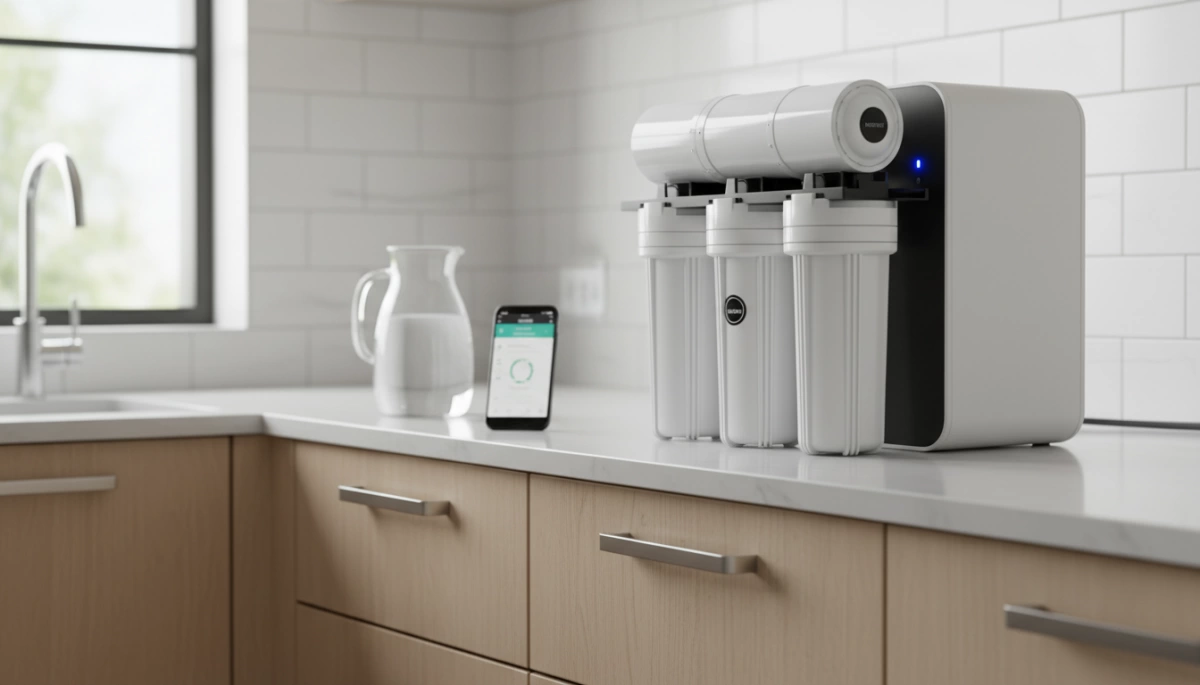
When I compare cartridge recognition smart chip engineering to traditional countertop RO filter monitoring, the gap is obvious in real homes across the United States.
Timer and Flow‑Meter vs Smart Chip
Traditional methods:
- Timer‑based reminders: Simple countdown from install date. They ignore how much water your family actually drinks and what your local water quality looks like.
- Flow‑meter only systems: Better than a timer, but all the usage data lives in the purifier, not in the cartridge. If the power is cut, the board is replaced, or someone resets the unit, accuracy drops fast.
With an intelligent cartridge recognition system:
- Each embedded chip in the water filter cartridge stores its own usage history and RO cartridge lifespan monitoring data.
- The purifier reads real‑time usage from the chip instead of guessing, giving a much more accurate reverse osmosis filter life indicator.
App‑Only Tracking vs Embedded Smart Chips
App‑only tracking depends on you:
- You have to log changes manually or trust that Bluetooth/Wi‑Fi never glitches.
- If the phone changes, app is deleted, or accounts get mixed, your tracking is gone.
With embedded cartridge recognition in the purifier:
- The RO controller talks directly to the filter usage tracking chip—no phone needed.
- Apps become a bonus for alerts, not a single point of failure.
Accuracy, Reliability, and Tamper Resistance
Across the methods:
- Timer‑based: Lowest accuracy, easy to ignore or reset.
- Flow‑meter only: Moderate accuracy, but no strong cartridge authentication.
- App‑only: Depends on user behavior, not the system.
- Smart chip filter authentication with encrypted cartridge ID technology and cryptographic signatures: High accuracy, high reliability, and strong counterfeit prevention in RO filters.
Pairing smart chips with smart TDS monitoring and calibration like we do in our systems, similar to the approach in this guide on smart TDS monitoring sensor calibration in countertop RO, tightens that accuracy even more.
Total Cost of Ownership and Long‑Term Benefits
From a total cost of ownership view:
- Traditional methods look cheaper upfront but often cause premature cartridge swaps, expired filters in use, and more support calls.
- Smart chip RO purifier consumable management cuts waste, protects against counterfeit cartridges, and keeps the system running inside spec for longer.
For U.S. families who expect low hassle, clear automatic filter replacement alerts, and safe water without babysitting their purifier, smart chip cartridge recognition simply delivers better long‑term value than old‑school monitoring.
Driplife’s Cartridge Recognition Smart Chip Engineering in Countertop RO Filters
At Driplife, I design our cartridge recognition smart chip architecture from the ground up for countertop RO filters. Each RO cartridge carries an embedded chip with a unique encrypted ID, production data, and capacity profile. Our countertop RO controller reads this data at insertion, verifies authenticity, and syncs it with the system’s filter usage tracking logic. This lets us deliver precise, tamper‑resistant cartridge recognition smart chip engineering that U.S. brands can trust.
Smart Chip Architecture and Anti‑Counterfeit Workflows
Our smart chip filter authentication uses a mix of EEPROM‑based cartridge IDs and secure cryptographic signatures. When a user inserts a cartridge, the RO purifier runs a challenge‑response handshake, validates the encrypted cartridge ID, and checks against allowed SKUs. If the chip fails authentication or looks cloned, the system enters a safe mode: reduced flow or full lockout, clear on‑screen error, and stored event logs for service teams. This anti‑counterfeit workflow protects both water safety and brand reputation, especially in online and marketplace sales channels.
Real Usage Lifespan Algorithms
We don’t depend on simple timers. Our cartridge recognition logic combines:
- Total flow volume through each RO cartridge
- Time in service and pause periods
- Local TDS and water quality conditions where sensors are used
The smart chip stores usage counters and status flags so RO cartridge lifespan monitoring stays accurate even if the countertop RO purifier is unplugged or moved. The result is a smart RO cartridge lifespan algorithm that reflects real U.S. home use patterns instead of generic lab assumptions.
Integration with UI, Apps, and Service Tools
Driplife’s smart chip data ties directly into user interfaces and connected tools. On the device, users see a clear reverse osmosis filter life indicator chip status and remaining percentage. For connected countertop RO systems, we push automatic filter replacement alerts to mobile apps and service dashboards, supporting subscription models and proactive maintenance. Our experience in smart control board integration in RO systems helps us keep cartridge data communication engineering stable, responsive, and low‑power.
OEM and ODM Smart Chip Customization
As a China smart RO filter OEM supplier, I offer OEM and ODM smart RO filter solutions tailored for U.S. brands. We can customize:
- Chip type (EEPROM, NFC, RFID, or microcontroller‑based smart filter module)
- Security level and cryptographic key scheme
- Cartridge usage thresholds, SKUs, and compatibility rules
- App integration, cloud APIs, and service tool access
This lets smart countertop RO purifier manufacturers launch differentiated, tamper‑resistant RO cartridge designs while keeping BOM cost, reliability, and long‑term service flexibility in balance.
Future Trends in Cartridge Recognition Smart Chip Engineering
Smart cartridge technology is moving fast, and I’m designing countertop RO filters so they’re ready for what’s coming next in the U.S. market.
IoT-Connected Countertop RO Filters
IoT-connected countertop RO filters are the next logical step. A smart chip in the cartridge pairs with Wi‑Fi or Bluetooth to push usage, TDS, and flow data to the cloud in real time. That means:
- Remote monitoring of filter health and RO cartridge lifespan
- Automatic alerts when a family is close to end‑of‑life capacity
- Service teams seeing issues before the customer even calls
For homes already upgrading to smarter kitchens with devices like premium water sink purifiers for different budgets, IoT‑enabled countertop RO systems fit right in.
AI-Driven Predictive Cartridge Replacement
AI and machine learning will make RO cartridge lifespan monitoring far more accurate than fixed timers:
- Algorithms learn how each household actually uses water
- Models adjust for local water hardness, TDS, and seasonal changes
- The system predicts the best replacement window, not just “every 6 months”
This AI‑driven approach reduces waste from premature changes and cuts risk from pushing filters too far.
Blockchain and Secure Ledger Tracking
For brands and OEMs, counterfeit prevention in RO filters is a real problem. Future cartridge recognition smart chip engineering will lean on:
- Blockchain or secure ledgers to register each encrypted cartridge ID
- End‑to‑end traceability from factory to distributor to end user
- Easy authenticity checks during service or warranty claims
This makes it much harder to clone RO cartridges or inject fake products into online marketplaces.
Deeper Water Quality Analytics
Smart sensor technology in RO systems will move beyond simple TDS checks. We’ll see:
- Multi‑parameter monitoring (TDS, temperature trends, possible chlorine breakthrough)
- Per‑cartridge performance profiles stored on the embedded chip in the water filter cartridge
- Personalized recommendations, like flushing guidance or earlier replacement for tough water
For health‑focused U.S. households, this turns a countertop RO purifier into a real-time water quality dashboard.
Evolving Smart Consumable Standards
As more manufacturers adopt intelligent cartridge recognition systems, industry standards will tighten around:
- Common data formats for cartridge usage tracking chips
- Security baselines for encrypted cartridge ID technology and anti‑cloning
- Interoperability rules so OEM smart chip integration in countertop purifiers is smoother
I’m building our smart consumable management platform and cartridge data communication engineering with these future standards in mind, so our partners can plug into the next generation of smart, no‑installation countertop RO filters without starting from scratch.
FAQs on Cartridge Recognition Smart Chip Engineering
How do smart chips in RO cartridges detect and block counterfeits?
Our cartridge recognition smart chip engineering uses encrypted IDs and authentication protocols to confirm that each cartridge is genuine. When you insert a filter, the countertop RO filter controller reads the chip’s unique ID, checks its cryptographic signature, and validates it against approved cartridge profiles stored in the system. If the smart chip filter authentication fails or the ID doesn’t match an authorized SKU, the unit can block operation, limit flow, or show a clear “invalid cartridge” alert. This tamper‑resistant RO cartridge design protects you from unsafe knockoffs and keeps your reverse osmosis filter running at its rated performance.
What happens when a non‑authentic or expired cartridge is inserted?
If a non‑authentic or expired cartridge is detected, the intelligent cartridge recognition system follows a strict safety flow. In most cases, the smart countertop RO purifier will:
- Show a visible “Replace Cartridge” or “Invalid Cartridge” warning
- Disable dispensing or switch to a safe bypass mode
- Log an error code to help service teams diagnose the issue
For expired filters, the RO cartridge lifespan monitoring logic can allow a short grace period with reduced capacity or flow before lockout, so you’re not suddenly without water but you’re clearly pushed to replace the filter. This approach reduces health risk and warranty issues for US households and distributors.
How long do smart chip‑enabled RO cartridges last in real use?
Smart chip cartridges usually last 6–12 months in typical American homes, depending on:
- Local water quality (TDS, hardness, chlorine)
- Actual daily usage (gallons per day)
- Cartridge type (sediment, carbon, RO membrane, polishing filter)
The embedded chip in the water filter cartridge tracks usage, time, and sometimes water quality inputs to give a more accurate reverse osmosis filter life indicator chip reading than simple timers. For example, heavy users on hard water may see earlier replacement prompts than light users on softer water. If you want more background on how pre‑filters impact RO life, it helps to understand what a carbon filter does for water.
Can smart chip cartridges be reset, reused, or hacked?
By design, smart RO cartridges are not meant to be reset or reused. EEPROM‑based cartridge authentication, encrypted cartridge ID technology, and anti‑cloning logic make it very hard to spoof a “new” filter after it reaches its rated lifespan. Any attempt to physically tamper with the chip, reflash it, or transplant it into another housing usually breaks the seal or triggers authentication errors. This protects end users from unsafe DIY resets and protects OEMs from counterfeit prevention issues in RO filters across online marketplaces and discount channels.
Are there privacy or data concerns with usage tracking in smart RO filters?
Smart sensor technology in RO systems focuses on consumable management, not personal data. In most designs:
- The chip stores technical data: serial number, production batch, usage counters, error flags
- No personal identity, address, or payment data lives on the cartridge
If the system is IoT‑enabled, usage metrics sent to the cloud are typically anonymized and used for service optimization, predictive RO cartridge replacement, and better inventory planning. As a platform owner, I treat privacy as a design requirement: we minimize data, encrypt communication, and let users opt in to connected features.
How can OEMs integrate cartridge recognition into new countertop RO designs?
For OEM and ODM partners, integrating cartridge recognition smart chip engineering into a no‑installation countertop RO purifier is straightforward when planned early. We typically:
- Select the right chip type (EEPROM, NFC, or microcontroller‑based) for your cost and feature targets
- Define cartridge data structures for ID, capacity, and usage history
- Design mechanical interfaces for robust, sealed chip placement
- Implement RO system firmware for cartridge recognition, error handling, and anti‑counterfeit logic
- Expose configuration tools so you can manage multiple SKUs and generations over time
This B2B water purifier smart chip integration approach gives brands a scalable, secure smart consumable management platform that supports warranty control, subscription models, and premium positioning in the U.S. countertop RO filters market.