















Understanding Shower Filter Pressure Resistance
When people ask me about shower filters, they usually worry about two things: “Will it leak?” and “Can it handle my high water pressure without cracking?” That’s exactly where shower filter pressure resistance comes in.
What Pressure Resistance Really Means
When I say a shower filter has good pressure resistance, I’m talking about how well the entire filter system holds up under water pressure over time, not just in a lab test. It includes:
- Shower filter pressure rating – the maximum water pressure (PSI) the filter is designed to handle safely in normal use.
- Structural integrity – how strong the housing, threads, and seals are when the system is pressurized.
- Leak-tight sealing – how well O-rings, gaskets, and connections resist seepage under constant pressure and on/off cycles.
Put simply: a pressure resistant shower filter is engineered not to leak, deform, or burst when exposed to real-world water pressure.
How Pressure Resistance Affects Safety and Durability
Pressure resistance isn’t a “nice to have.” It directly affects:
- Safety – Weak housings can crack or fail under pressure spikes, sending hot water and plastic fragments into the shower area.
- Leaks and water damage – Poor sealing or low maximum working pressure leads to slow drips, sudden sprays, or hidden leaks in walls and ceilings.
- Long-term durability – A pressure tested shower filter keeps its shape, thread engagement, and seal compression after thousands of on/off cycles and high PSI runs.
In my designs, we treat structural burst resistance and shower filter durability engineering as core safety features, not optional upgrades.
Why Pressure Resistance Matters More in High-Pressure or Unstable Systems
Not every home runs at the same pressure. In many U.S. homes, especially in high-rise buildings or city systems, pressure can be very high or unstable. In those setups, a high PSI shower filter isn’t just marketing—it’s essential.
Pressure resistance becomes critical if:
- Your building runs close to or above 80 PSI.
- You experience pressure spikes when neighbors turn water on/off or pumps cycle.
- You use pressure boosting pumps or live in areas with aggressive municipal pressure.
A high pressure compatible shower filter with a clearly stated maximum working pressure and tested burst pressure gives you a safety margin when pressure jumps suddenly. That’s why I focus heavily on pressure resistant shower filter housing, robust sealing, and verified pressure rating shower water filtration on every unit we build.
Water Pressure Basics in Shower Systems
Most homes in the U.S. run between 40–80 PSI of water pressure. That’s the sweet spot where a pressure resistant shower filter housing can give you good flow without stressing the parts. But it’s normal to see short pressure spikes over 100 PSI, especially in buildings with older plumbing, well systems, or areas with big demand swings (like mornings and evenings).
A quality high pressure compatible shower filter is engineered and pressure tested to handle these real-world swings. When the PSI goes up, the filter sees more force on the housing, threads, and seals. When the PSI drops, you’ll feel lower flow and weaker spray. As cartridges clog with sediment or scale, you see extra pressure drop through the shower filtration system, which can turn a strong shower into a trickle if the design isn’t right.
Most pressure-related issues show up as:
- Low flow or weak spray – often from high pressure drop, undersized flow paths, or a clogged cartridge.
- Noisy pipes or “water hammer” – quick on/off and high PSI create shocks that stress the shower filter structural integrity.
- Drips and leaks at the housing or threads – seals and O-rings start to give way under repeated pressure spikes.
- Cracked or burst housings – the worst case, where the filter exceeds its maximum working pressure and approaches burst pressure.
If you already use under-sink filtration or a faucet tap water filter like this compact tap water filter system, the same pressure behavior applies in your bathroom: consistent PSI plus a pressure safe filter housing equals stable performance, fewer leaks, and better long-term durability.
Core Engineering Standards for Shower Filter Pressure Resistance
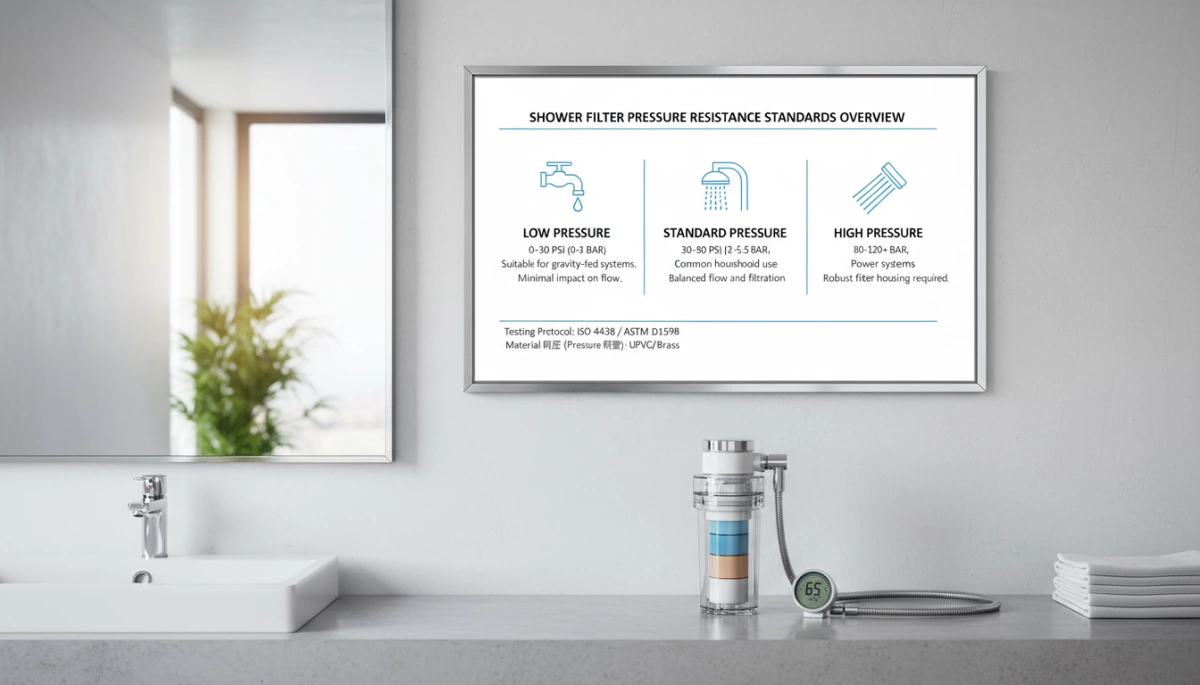
When I design a pressure resistant shower filter, I build it around recognized plumbing and filtration standards, not guesswork. The goal is simple: a certified pressure safe shower filter that won’t crack, leak, or burst under normal U.S. residential water pressure.
Key Plumbing And Filtration Standards
For a serious, pressure rated shower water filtration device, I look for:
- NSF/ANSI 177 – dedicated to shower filter performance and structural safety
- ANSI/IAPMO listings – confirm plumbing code compliant shower filters in the U.S.
- Local plumbing code approvals – required by many states and cities before installation
- For export: WRAS (UK), CE (Europe), and regional marks across Asia
These marks tell you the filter housing, seals, and connectors have gone through pressure tested shower filter evaluations, not just basic flow checks.
NSF/ANSI 177 Standard And Structural Integrity
NSF/ANSI 177 is the core shower filter engineering standard I target. It covers:
- Structural integrity testing – hydrostatic pressure test for filters at elevated PSI
- Maximum working pressure – verifies the stated pressure rating shower water filtration devices can safely handle
- Burst resistance – checks that the filter housing burst test PSI is far above normal line pressure
- Thermal/pressure combo – confirms safety with hot water pressure testing on shower filters
In plain terms, if a filter is certified to NSF/ANSI 177, an independent lab has already pushed the housing and sealing technology past typical real-world loads to make sure it holds.
Other Certifications And Global Pressure Differences
Beyond NSF, I rely on:
- IAPMO/UPC/cUPC marks for high pressure compatible shower filters in North America
- WRAS and CE for European systems that often run lower steady PSI but strict on materials and backflow
- Asian markets, where some regions have more unstable water pressure spikes, often require extra proof of structural burst resistance showerhead filter design
U.S. homes commonly see 40–80 PSI with spikes higher, so I design high PSI shower filtration with a higher maximum working pressure and strong shower filter structural integrity. In lower-pressure European setups, the focus shifts slightly more toward long-term durability, materials safety, and compatibility with existing bathroom plumbing pressure systems.
If you’re also filtering your sink or kitchen, the same mindset applies: look for certified systems like a good faucet water filter with solid engineering and testing so every fixture in your home is built for safe, reliable pressure performance.
Pressure Ratings and What They Really Mean
When we talk about shower filter pressure rating, we’re really talking about two numbers that decide whether a filter is just “okay” or truly pressure safe in real-world U.S. homes.
Maximum Working Pressure vs. Burst Pressure
- Maximum working pressure is the highest PSI (pounds per square inch) your shower filter is designed to handle all day, every day, without leaking or deforming. For a high pressure compatible shower filter, this is typically 100–125 PSI in U.S. residential systems.
- Burst pressure is the extreme limit where the shower filter housing will physically fail in a lab test. Quality designs target 300–500+ PSI burst pressure shower filtration ratings to give a serious safety margin above normal house pressure and short spikes.
If a brand only shows burst pressure and hides the maximum working pressure, I treat that as a red flag.
Typical Engineering Targets in PSI
A well-engineered, pressure resistant shower filter housing is usually designed around:
- 100–125 PSI: maximum working pressure shower filter rating
- 300–500+ PSI: filter housing burst test PSI under controlled conditions
- Built-in safety margin of 3x–4x between normal use and catastrophic failure to support shower filter durability engineering and long-term reliability.
This gap is what keeps you safe when your city line spikes overnight or your pressure regulator drifts out of calibration.
How to Read a Shower Filter Pressure Rating Label
When you look at a label or spec sheet, focus on:
- A clearly stated “Max working pressure: XX PSI” (not just “tested to…”).
- Separate line for “Burst pressure: XX PSI” or “proof tested to…”.
- A temperature range listed next to the pressure rating, since hot water and pressure always work together.
- Any mention of NSF/ANSI 177 standard, IAPMO, or similar compliance, which usually means the unit has gone through defined structural and pressure-related checks.
If the label only lists a vague “suitable for most homes” with no real numbers, the filter is not designed for people actually paying attention to residential water pressure shower filter safety.
Safety Margins Built Into Pressure Resistant Designs
From an engineering and manufacturing side, our goal is simple: build pressure tested shower filters that stay safe even when your plumbing behaves badly. That means:
- Designing the filter housing geometry, wall thickness, and thread design to survive way above the maximum working pressure shower filter rating.
- Using reinforced materials and shower filter sealing technology to stay leak-free across thousands of on/off cycles.
- Proof-testing batches with hydrostatic pressure test for filters and burst testing to validate the shower filter safety margin PSI we claim.
The same mindset we use for faucet filtration and pressure safe filter housing certification in OEM water filters is what we apply to our high PSI shower filtration designs: clear numbers, honest ratings, and enough margin that you don’t have to think about it every time you turn on the water.
Pressure Testing Methods for Shower Filter Pressure Resistance
Hydrostatic Proof Testing Shower Filters
To guarantee real pressure resistance, we run hydrostatic proof tests on every new shower filter housing design. In this test, we fill the pressure rated shower filter with water and slowly raise the PSI to well above its maximum working pressure (often 1.5–2x higher).
- This confirms basic shower filter structural integrity under steady high load.
- Any hairline cracks, weak joints, or poor sealing technology show up fast.
- A properly engineered high PSI shower filter should hold this proof pressure with zero leaks or deformation.
Burst Pressure Testing Shower Filtration Housings
Burst pressure testing tells us the true limit of the filter housing. We increase water pressure until the shower filter housing fails, then record the burst pressure PSI.
- Quality pressure resistant shower filter housing designs regularly reach 300–500+ PSI burst ratings.
- Engineers use this burst pressure shower filtration data to set safe maximum working pressure ratings and safety margins.
- This is how we confidently label a maximum working pressure shower filter spec that can handle US residential systems, including spikes.
Cyclic Pressure Testing Filtration Systems
Real homes don’t run one constant PSI; they cycle on and off all day. That’s why we use cyclic pressure testing for shower water filtration devices.
- Filters are repeatedly pressurized and depressurized to simulate years of daily use.
- This exposes fatigue issues in threads, O-rings, and other pressure rated shower filter components.
- A certified pressure safe shower filter should survive tens of thousands of cycles without leaks or structural damage.
Thermal and High PSI Testing (Hot Water + Pressure)
High PSI is only half the story; hot water makes materials expand, soften, and age faster. We test shower filters under both temperature and pressure.
- Hot water pressure testing shower filters often runs at 120–140°F combined with elevated PSI.
- This checks for warping, seal creep, and stress cracking in engineered plastics and gaskets.
- A high pressure compatible shower filter must stay stable under hot shower conditions, not just cold lab water.
Lab Tests vs Real-World Use
Lab tests give us hard numbers, but we design around how people actually shower. Residential water pressure shower filter performance has to stay safe in older US homes, homes with well pumps, and systems with pressure spikes.
- We build in safety margins so that occasional pressure spikes don’t put you at risk.
- We validate flow, comfort, and durability in both controlled tests and real plumbing setups.
- The same engineering mindset is what we use in more demanding products like our under-sink water filters, where pressure durability filtration engineering is even more critical over long runtimes.
Design Engineering For Pressure Resistant Shower Filters
When I design a pressure resistant shower filter, I’m thinking about one thing first: how it behaves at 100+ PSI on a bad day, not just 60 PSI on a normal day. A truly pressure safe, high PSI shower filter has to combine the right housing material, geometry, sealing technology, and flow path so it can pass serious pressure testing and still feel great in daily use.
Pressure Resistant Filter Housing Materials
For the housing, we typically use three material directions, each tuned for shower filter structural integrity and high pressure compatibility:
- Brass housings – Excellent burst pressure resistance and long-term durability; ideal for high pressure compatible shower filters and older U.S. homes with known pressure spikes.
- Stainless steel housings – Strong, corrosion resistant, and stable at hot water temperatures; a good choice when you want both style and a high shower filter pressure rating.
- Reinforced engineered plastics – Glass-filled or fiber-reinforced plastics can deliver high burst pressure shower filtration performance at a lighter weight and lower cost, as long as they’re properly tested and certified.
Behind each material, we look at how hot water, chlorine, and stress over time will affect the shower filter housing materials, so the device stays structurally sound throughout its service life.
Wall Thickness, Ribbing, And Geometry
To get a pressure rated shower filter that won’t deform or crack, we tune the body geometry, not just the raw material:
- Wall thickness – Load-bearing sections around threads and joints are thickened to handle maximum working pressure and extra safety margin.
- Internal ribbing – Strategic ribs and gussets help distribute hoop stress evenly, increasing filter housing burst test PSI without adding unnecessary bulk.
- Curved shapes over sharp corners – Smooth transitions and rounded corners reduce stress concentration and are key to structural burst resistance in showerhead filter designs.
This is what allows us to engineer housings that routinely target 100–125 PSI maximum working pressure with 3x–4x burst pressure capacity in lab tests.
Sealing And Leak Prevention Technology
High pressure shower filter engineering lives or dies at the seals. We use a layered sealing strategy to keep everything tight under pressure:
- O-rings and gaskets – We spec high-grade elastomers rated for hot water and chlorine exposure to prevent hardening and cracking.
- Precision thread design – Tapered or gasketed threads with proper engagement length reduce the risk of thread blowout at high PSI.
- Redundant sealing zones – Critical joints often use two barriers (e.g., an O-ring plus a flat gasket) for extra insurance against leaks when pressure spikes.
This pressure resistant sealing technology is tested during hydrostatic pressure tests for filters to make sure the failure point, if any, is gradual leakage rather than sudden structural rupture.
Flow Path Design, Pressure Drop, And Comfort
Pressure resistance is useless if the shower feels weak. We engineer the internal flow path to balance shower filtration pressure drop with real-world comfort:
- Streamlined flow channels minimize turbulence and unnecessary pressure loss through the filter.
- Optimized media layout keeps filtration effective without choking flow; for example, combining granular media with high-surface-area structures, similar to how we design carbon water filter systems for full-house use.
- Calibrated outlet nozzles maintain a strong spray pattern even as the filter cartridge slowly loads with sediment.
The goal is a pressure tested shower filter that delivers strong, consistent flow at common residential water pressure while still offering fine filtration.
Designing For High PSI And Pressure Spikes
In many U.S. homes, actual residential water pressure shower filter loads can be harsher than the spec sheet suggests due to thermal expansion and sudden valve closures. To handle that, we:
- Design around known pressure spike profiles, not just static PSI numbers.
- Add extra safety margin into maximum working pressure shower filter ratings so brief spikes don’t cause cracks or leaks.
- Validate designs with cyclic pressure testing filtration programs, where we repeatedly ramp pressure up and down to simulate daily on/off use over years.
- Test with hot water plus pressure to reflect real shower conditions, not just cold-water bench tests.
This is how we deliver high pressure shower filter engineering that stays stable under stress, resists sudden failure, and keeps your shower comfortable and safe even in demanding plumbing conditions.
Materials and Components That Handle High PSI
Metal vs. Engineered Plastic in High-Pressure Shower Filters
For a truly pressure resistant shower filter housing, the material choice matters more than the marketing.
- Metal housings (brass or stainless steel) handle high PSI shower systems extremely well. They offer excellent structural burst resistance, better heat tolerance, and long-term shower filter durability under pressure spikes.
- Engineered plastics (like reinforced ABS or polycarbonate) can also be safe at high PSI when they’re glass-filled or fiber-reinforced and tested to a clear shower filter pressure rating (maximum working pressure and burst PSI).
- I always look for filters that clearly list both a maximum working pressure shower filter rating and a burst pressure shower filtration rating, not just “heavy-duty” claims.
Temperature, Chlorine, and Stress on Filter Housing
High pressure compatible shower filters also have to survive heat, chemicals, and daily stress.
- Hot water plus high PSI accelerates stress cracking in cheap plastics. Chlorine in U.S. municipal water can slowly weaken lower-grade polymers.
- Quality housings use UV- and chlorine-resistant materials, with added stabilizers to maintain shower filter structural integrity over years of use.
- If a brand doesn’t talk about hot water pressure testing for shower filters or publish a temperature rating, I assume the safety margin is thin.
Connectors, Adapters, and High-Pressure Fittings
Even a strong housing can fail at the threads if the connectors aren’t built for high pressure.
- I prefer solid brass or stainless steel 1/2″ NPT connectors with precise machining and robust thread depth for pressure rated shower filter components.
- Strong O-rings and gaskets (EPDM or silicone) plus clean thread design give you better leak resistance than thread tape alone.
- If you’ve already invested in premium water gear like a water bottle filling station with solid metal fittings, you’ll recognize the same high pressure plumbing compatibility details in better shower filters: clean threads, solid weight, and no flimsy plastic adapters.
- Avoid thin plastic adapters or mystery metal; they’re usually the first point of failure when water pressure spikes.
Internal Cartridges and Media Under Pressure Load
Inside the housing, the cartridge also has to be engineered for pressure resistance.
- A pressure tested shower filter uses cartridges with rigid shells, internal supports, and evenly packed media so they don’t deform or crack under high PSI.
- Poorly packed media can shift, collapse flow paths, and create localized pressure points, which leads to leaks, channeling, or sudden flow loss.
- I look for designs that mention pressure safe filter housing certification, cyclic pressure testing filtration, and clear details on how the cartridge is retained and sealed—not just what media is inside.
How Pressure Affects Shower Filter Performance
Shower filtration pressure drop and user experience
Every shower filter creates some pressure drop. That’s normal. The problem starts when the pressure drop is too high and your “high pressure compatible shower filter” suddenly feels weak. If your city pressure is already on the low side (under 45–50 PSI), a restrictive or clogged filter can turn your shower into a trickle. A properly engineered, pressure resistant shower filter housing keeps flow smooth by managing internal flow paths so you still get a strong spray while the water passes through the media.
Clogging, scaling, and changing pressure over time
Even a certified pressure tested shower filter will behave differently after months of use. Hard water scaling, sediment, and rust particles slowly clog the filter media and narrow flow channels. That increases pressure drop, which you feel as falling flow rate, uneven spray, or sudden temperature swings when you mix hot and cold. In hard water areas, I always plan for more frequent cartridge changes than the marketing claims suggest, similar to the guidance in this breakdown on how often shower filter cartridges should be replaced.
High PSI, filter lifespan, cracks, and leaks
High residential water pressure (70–100+ PSI) puts real stress on shower filter structural integrity. Over time, constant high PSI plus temperature changes can fatigue plastic housings, stretch threads, and flatten O-rings. The result: hairline cracks, slow drips at the connections, or sudden leaks when you turn the valve on and off. A true high PSI shower filter is built with a generous shower filter safety margin PSI, meaning maximum working pressure and burst pressure are well above what your plumbing ever sees in normal use.
Balancing fine filtration with flow and pressure
There’s always a trade-off between ultra-fine filtration and comfortable flow. Tighter media and very fine pore sizes trap more contaminants but raise pressure drop, especially as the cartridge loads up. When I design or choose a pressure safe shower filter, I look for:
- A clearly stated maximum working pressure shower filter rating
- Realistic flow rate (usually 1.5–2.5 GPM) at typical residential water pressure
- Media design that spreads flow evenly so it doesn’t create high-stress points inside the housing
Done right, you get strong, consistent shower filtration pressure, long-term durability engineering, and water that actually feels better on your skin and hair.
How to Choose a Pressure Safe Shower Filter
Key Specs: Pressure Rating and Temperature
When I pick a pressure safe shower filter for U.S. homes, I always start with the hard numbers:
| Spec (What to Look For) | Recommended Target for U.S. Homes | Why It Matters for Pressure Safety |
|---|---|---|
| Maximum working pressure (PSI) | 100–125 PSI minimum | Handles normal 40–80 PSI plus daily spikes safely |
| Burst pressure (PSI) | 300–500+ PSI | Shows true structural integrity and safety margin |
| Temperature rating (°F) | At least 140°F, ideally 160°F+ | Hot showers + high PSI = much higher stress on the housing |
| Certifications | NSF/ANSI 177, IAPMO, code-compliant listings | Independent verification of claims and structural performance |
If a brand doesn’t clearly list maximum working pressure, burst PSI, and temperature rating, I treat that as a red flag.
Why NSF/ANSI 177 Matters for Pressure Safety
NSF/ANSI 177 isn’t just about chlorine reduction; it includes requirements tied to structural integrity, pressure resistance, and safe operation under normal plumbing conditions. A shower filter tested and certified to NSF/ANSI 177 (often through IAPMO or NSF) gives you:
- Verified maximum working pressure for shower use
- Structural and sealing performance checked under hot water
- A higher chance the housing, threads, and O-rings won’t fail when your municipal line spikes
When you see NSF/ANSI 177 or IAPMO listings on a high PSI shower filter, you’re not just buying better filtration—you’re buying engineering standards and liability behind the product.
How to Read Spec Sheets Without Being Misled
Marketing language around “high pressure shower filter” or “pressure tested shower filter” can be vague. Here’s how I cut through the noise:
- Ignore generic phrases like “pressure resistant” unless they show actual PSI numbers
- Confirm both maximum working pressure and burst pressure are listed in PSI
- Check if the test conditions are realistic (e.g., hot water plus pressure, not just ambient cold water)
- Look for explicit mention of NSF/ANSI 177 standard, IAPMO, or similar, not just “tested to NSF guidelines”
For example, on our own aluminum alloy shower filter engineered for hard water and dechlorination, I make sure we publish clear pressure and temperature ratings instead of vague “heavy-duty” claims.
Matching Filter Pressure Ratings to Your Home
Most U.S. homes run 40–80 PSI, but spikes to 100+ PSI are common, especially in city systems or buildings with pumps. Before buying:
- Measure your water pressure with a cheap PSI gauge on an outdoor spigot or laundry tap
- If you’re consistently above ~80 PSI, plan on a pressure regulator plus a high pressure compatible shower filter
- Choose a filter where your measured PSI is at least 30–40% below the maximum working pressure rating
If your home sees frequent water hammer or sudden pressure jumps, it’s worth looking at both a regulator and a shower filter housing that’s specifically described as “pressure tested” with published burst PSI.
Red Flags: When a Shower Filter Isn’t Engineered for High Pressure
I avoid a shower filter for high pressure setups when I see:
- No published maximum working pressure or burst PSI at all
- Only vague terms like “durable,” “heavy-duty,” or “industrial strength” with no numbers
- Very thin, cheap plastic housings with no visible reinforcement or metal body
- No mention of NSF/ANSI 177, IAPMO, WRAS, or similar testing for structural integrity
- Spec sheet only tested at low ambient pressure and temperature, not hot water and real residential conditions
If you want to understand why burst pressure and water hammer matter so much, the same principles we use in our burst pressure and water hammer testing guide for filtration systems apply directly to shower filter structural integrity as well.
Installation and Setup for Pressure Resistant Shower Filter Performance
Check Your Home Water Pressure First
Before you install any pressure resistant shower filter, you need to know what you’re working with.
- Use a simple water pressure gauge on a hose bib or laundry tap (they’re cheap at any hardware store).
- Ideal residential shower pressure: 40–60 PSI
- Many US homes sit around 70–80 PSI, and some spike over 100 PSI—that’s where high PSI shower filter performance really matters.
- If your static pressure is over 80 PSI, your shower filter, plumbing, and warranty are all at higher risk.
When to Use a Pressure Regulator or Expansion Tank
If your pressure is high or unstable, you should not rely on the shower filter pressure rating alone.
You should strongly consider:
- Pressure regulator on the main line or at the shower if:
- Your pressure is consistently above 80 PSI
- You notice big jumps when fixtures turn on/off (pressure spikes)
- Thermal expansion tank on water heaters if:
- You have a closed plumbing system
- You see pressure jump after hot water runs
This helps protect both your plumbing and any high pressure compatible shower filter from spike-induced damage.
Tightening, Thread Tape, and Avoiding Cross‑Threading
Most failures I see aren’t from bad engineering—they’re from bad installs. To keep your pressure tested shower filter safe:
- Wrap PTFE thread tape (plumber’s tape) 2–3 wraps, clockwise, on male threads only.
- Start threads by hand to avoid cross‑threading. If it feels gritty or crooked, back off and restart.
- Use only firm, snug torque, not “as hard as you can.” Over‑tightening:
- Distorts plastic pressure resistant shower filter housing
- Damages O‑rings and shower filter sealing technology
- Can compromise the maximum working pressure safety margin
If you’re familiar with more advanced filtration installs, a lot of the same good habits around sealing and torque that I recommend for any pressure-rated water filter system also apply to shower filters.
Mounting Orientation and Reducing Stress on the Housing
Even a certified pressure safe shower filter can fail early if it’s under mechanical stress.
- Keep the filter aligned straight with the shower arm—no severe angles.
- Avoid using the filter body as a lever when tightening the showerhead.
- Don’t hang heavy shower accessories directly on a high PSI shower filter housing.
- If your shower arm is loose in the wall, secure it first so the filter isn’t carrying the load.
Set up correctly, your pressure resistant shower filter will handle high PSI, spikes, and daily use without leaks, cracks, or loss of performance.
Maintenance And Troubleshooting Under Pressure
Cartridge Changes In High-Pressure Or Hard Water
In high-pressure or hard water areas, you can’t treat cartridge life like a soft-water city spec sheet.
- For most pressure resistant shower filter housings, I recommend changing cartridges every 3–4 months in hard water or 2–3 months if you’re on very high PSI or see fast scaling.
- If your water is softer and pressure is stable, you can usually go up to 6 months, but not longer if you care about consistent performance and structural integrity.
- Watch for noticeable pressure drop, weaker spray, or a “choked” feel—these are clear signs the cartridge media is clogging and your shower filtration pressure drop is climbing.
- If you’re also filtering chlorine for skin and hair benefits, similar to what we measure in our chlorine removal performance testing, you want to stay ahead of capacity, not wait for the filter to “die.”
Signs Of Pressure-Related Problems
Pressure issues usually show up before anything bursts—if you know what to listen and look for.
- Noise: Whistling, rattling, or “hammering” sounds in the pipes or in the shower filter housing itself often mean high PSI, pressure spikes, or a partially blocked cartridge.
- Drips and weeps: Slow drips at the inlet, outlet, or joint between the housing halves point to sealing or thread issues under load.
- Sudden spray changes: Short bursts of very high flow or sudden flow loss when you turn the handle can signal unstable residential water pressure hitting the filter.
- Visible movement: If the high PSI shower filter wobbles or twists when you turn the shower on, you’re stressing the connectors and risking leaks.
Any of these can be a red flag that the shower filter pressure rating is being pushed or that something in the setup is not pressure safe.
Fixing Leaks Around Seals, Threads, And Connectors
Most leaks on a pressure tested shower filter are fixable if the housing and components are still structurally sound.
- Threads: Remove the filter, clean the threads fully, then reapply PTFE (Teflon) tape in the correct direction (2–4 wraps). Reinstall by hand, then snug with a wrench only if the product design allows it—over-torque is a common failure cause.
- O-rings and gaskets: Check for flat spots, cracks, or debris. Lightly lubricate with silicone-safe plumber’s grease, reseat, and retighten the housing evenly. Replace worn O-rings with the correct size and material (EPDM or silicone rated for hot water and the maximum working pressure shower filter spec).
- Adapters and fittings: Make sure any adapters are also pressure rated shower filter components (not cheap plastic pieces meant for low pressure). Mis-matched, off-brand, or poorly molded connectors are a frequent leak source at higher PSI.
If a leak continues after careful resealing, assume the internal threads or sealing surfaces may be distorted and move toward replacement rather than repeated tightening.
When To Stop Using A Filter Due To Structural Risk
With high pressure compatible shower filters, knowing when to retire a unit is a safety decision, not just a comfort decision.
Stop using the filter immediately if you notice:
- Cracks, bulges, or warping anywhere on the shower filter housing materials, especially near joints or threaded areas.
- Persistent leaks that return even after replacing O-rings, re-taping threads, and re-mounting in a relaxed, non-stressed position.
- Severe discoloration or softening of plastic, which can happen over time from hot water, chlorine, and constant stress cycling.
- Any history of sudden “pops” or pressure shocks followed by new leaks or visual deformities—this can mean the structural burst resistance of the shower filtration shell is compromised.
A properly engineered, certified pressure safe shower filter is built with a safety margin above your home’s water pressure, but once you see visible damage, that safety margin is gone. At that point, replacing the filter housing is the only responsible move.
Safety, Compliance, and Risk Management for Pressure Resistant Shower Filters
Why Pressure Resistance Is a Safety Issue
Pressure resistance in a shower filter isn’t just about water feel; it’s a real safety issue. If a shower filter housing isn’t engineered for high PSI, you’re risking:
- Sudden housing bursts that can send hot water and plastic or metal fragments into the shower area.
- Hidden leaks behind panels or inside walls that lead to mold, drywall damage, and costly repairs.
- Scalding risk, because when a weak filter fails, it can dump unregulated hot water unexpectedly.
That’s why I treat a pressure rated shower filter the same way I treat any pressurized plumbing device: it must have a clear maximum working pressure, a tested burst pressure, and documented pressure testing (hydrostatic, cyclic, and hot water tests).
Liability, Warranty, and Compliance If a Filter Fails
From a risk and compliance standpoint, a failed filter is more than a nuisance:
- If the filter isn’t NSF/ANSI 177, IAPMO, or code-compliant for your area, your homeowner’s insurance can push back on water damage claims.
- Manufacturers typically require that the product be installed within rated PSI and temperature to honor warranty coverage. Exceed those limits and you’re on your own.
- For my own products, I make sure warranties clearly reference the maximum working pressure shower filter rating and installation conditions so there’s no confusion.
In the U.S., I always align our designs with plumbing code expectations and recognized certifications, so there’s a clear paper trail if something goes wrong.
How Engineers Minimize Burst Risk in Residential Systems
On the engineering side, pressure safe shower filters are built around structural integrity and safety margins:
- Overbuilt housings with metal or reinforced plastic designed to handle 3–4x the normal residential pressure in burst tests.
- Cyclic pressure testing filtration that repeatedly ramps pressure up and down to simulate years of daily on/off use.
- Hot water + high PSI tests, because real-world failures often happen when high temperature and high pressure hit at the same time.
- Robust sealing technology (O-rings, gaskets, and thread design) to prevent leaks before they turn into catastrophic failures.
In my view, a high pressure compatible shower filter isn’t “premium”; it’s the baseline for any U.S. home that sees pressure spikes and municipal system fluctuations.
Checklist for a Pressure Safe Shower Filter Setup at Home
If you want a truly pressure safe and pressure tested shower filter setup, here’s the quick checklist I personally follow:
- Confirm your water pressure: Use a simple gauge at a hose bib or shower line; aim for 40–80 PSI. If you’re seeing 80+ PSI, add a pressure regulator for the shower filter or at the main.
- Match ratings to your system: Choose a pressure rated shower filter with at least 100–125 PSI maximum working pressure and clearly stated burst pressure shower filtration housing numbers.
- Look for certifications: Prioritize NSF/ANSI 177 standard and IAPMO/UPC or equivalent marks so you know the housing passed real hydrostatic pressure tests for filters and structural checks.
- Install correctly: Use thread tape, avoid cross-threading, don’t overtighten, and make sure the filter is not hanging at an angle that stresses the fittings.
- Monitor over time: Watch for drips, sudden drops in flow, or new noises. These are early signs of pressure-related stress or clogging that can lead to failure.
If you’re dealing with both high and low pressure situations in the same building, it can also help to compare solutions that are optimized for different pressure zones, like the low-pressure compatible shower filtration technology outlined in this technical overview of shower filtration performance.